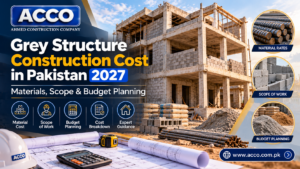
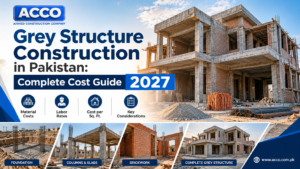
Grey Structure Construction Cost in Pakistan 2027
If you’ve been asking around about grey structure construction cost in Pakistan 2027, you’ve probably heard a dozen different numbers already. One contractor quotes PKR 3,200 per square foot. Another says PKR 4,100. A friend in DHA says he paid less last year. A relative in Bahria Town swears it’s going to be PKR 5,000 by next summer.
They’re not all wrong. They’re just quoting different scopes, different materials, and different years. The truth is that grey structure pricing in Pakistan is volatile by nature — steel and cement move with global commodity markets, fuel costs shift weekly, and society approval requirements vary from one housing scheme to the next.
What you need isn’t a single number. It’s a framework for understanding what drives that number, what a fair rate looks like in 2027, and how to protect yourself from the hidden costs that catch most first-time builders off guard. That’s exactly what this guide delivers — with insights from ACCO, a Lahore-based construction firm with 25+ years of experience building across Pakistan, from DHA Phase 6 to commercial plazas in Gulberg.
What Grey Structure Actually Means in 2027
Before you can talk about cost, you need to be precise about scope. In Pakistan’s construction industry, “grey structure” can mean wildly different things depending on who’s quoting it. Some contractors include roof waterproofing in their rate. Others exclude it entirely, then charge you separately.
Here’s the standard definition ACCO uses on every project, from a 5 Marla house in Johar Town to a warehouse in an industrial zone:
The Included Scope
- Excavation and foundation: PCC, footings, plinth beams, and any necessary soil treatment
- RCC frame: Columns, beams, slabs, and stairs — all reinforced with Grade 60 steel carrying mill certificates
- Brickwork: All external and internal walls, plus boundary wall
- Services rough-in: Electrical conduits, plumbing, drainage, and gas piping embedded in walls and slabs
- Damp-proofing and termite treatment: Applied before plaster goes on
- Roof waterproofing and insulation: Critical in Pakistan’s climate, often excluded by cheap contractors
- Internal and external plaster: The final layer before finishes begin
What Grey Structure Does Not Include
Floor tiles, marble, doors, windows, paint, sanitary fittings, electrical fixtures, kitchen, wardrobes, false ceilings, and elevation cladding. Society approval fees and utility connection charges are also separate. Two quotes that differ by 15–20% usually differ because one contractor included waterproofing and boundary walls while the other did not [citation:5].
For a deeper dive into how design decisions affect structural cost, explore ACCO’s architectural engineering services, where structural and architectural planning happens together from day one.
Grey Structure Rates for 2027: What to Budget
Current market data for Lahore and similar Punjab markets puts grey structure construction at PKR 2,800–3,500 per square foot for residential projects with material and labour included [citation:5]. That range shifts upward for commercial buildings with basements, where rates reach PKR 3,600–4,300 per square foot [citation:7].
Here’s how that translates to real projects:
| Plot Size | Typical Covered Area | Grey Structure Cost (2026-27) |
|---|
| 5 Marla | 1,800–2,250 sq ft | PKR 50 lakh – 79 lakh |
| 10 Marla | 2,400–2,800 sq ft | PKR 67 lakh – 98 lakh |
| 1 Kanal | 4,500–5,500 sq ft | PKR 1.26 crore – 1.93 crore |
| 2 Kanal | 8,000–10,000 sq ft | PKR 2.24 crore – 3.5 crore |
These figures assume a double-storey configuration, standard soil conditions, and no basement. Add a basement and expect the rate per square foot to climb noticeably — excavation, retaining walls, and additional waterproofing all contribute. Large open spans and cantilevers also push steel consumption higher, which is why a simple rectangular layout remains the most economical choice.
Why 2027 Rates Are Higher Than 2026
Cement prices tell part of the story. A 50kg bag averaged PKR 1,596 as of October 2026, up 14.38% from PKR 1,395 a year earlier [citation:10]. In Lahore specifically, cement reached PKR 1,630 per bag [citation:14].
Steel has followed a similar trajectory, driven by international coal prices that averaged $113.93 per tonne in the first quarter of FY27 — a significant jump from the $90.30 average a year prior [citation:10]. Since coal is a primary input in steel and cement production, these global movements translate directly into your local material costs.
The federal budget for FY 2026-27 offered some relief: sales tax on wholesale and retail building materials was reduced from 2.5% to 1.25%, effective July 2026 [citation:8]. This partially offsets the commodity-driven increases, but don’t expect prices to drop significantly. The structural trend for 2027 remains upward.
ACCO: Your Construction Partner Since 1998
ACCO (Ahmed Construction Company) has been building in Pakistan since 1998 — long enough to have seen multiple construction cycles, currency devaluations, and material price shocks. The company operates from its head office at Office 2, 3rd Floor, Bigcity Plaza, Gulberg-III, Lahore, with a second presence in Karachi.
What separates ACCO from the typical contractor isn’t just longevity. It’s the breadth of capability. The firm handles architectural design, structural engineering, MEP and firefighting systems, interior design, and construction — all under one roof. That integrated model matters enormously for grey structure projects, because design decisions made by an architect who doesn’t coordinate with the structural engineer often result in expensive changes during construction.
ACCO’s client list includes Meezan Bank, Bata, PTC, BUITMS, Savour Foods, Alpine, Lake View, and Gerry DNATA — organisations that don’t hand out construction contracts without rigorous due diligence. The firm has delivered projects across residential, commercial, industrial, hospital, and textile mill sectors, giving it a perspective on grey structure that a purely residential contractor simply cannot match.
Explore ACCO’s completed work on the Our Projects page to see the range of what the firm delivers.
What Drives Grey Structure Cost Up or Down
Material Prices: The Volatile Factor
Steel and cement together account for the largest share of grey structure cost. A 10% swing in steel prices can add or subtract PKR 200–300 per square foot from your project. This is why fixed-price contracts have become increasingly popular in Pakistan’s current environment — they transfer the inflation risk to the contractor, who can hedge by buying in bulk before price increases hit the market.
Design Complexity
A square, rectangular layout with a standard grid of columns and beams is the most economical structure to build. Every cantilever, every floating balcony, every large open lounge without intermediate support adds steel and formwork labour. If budget is a primary concern, work with your architect to minimize structural complexity in the early home floor plan design stages. Changes are far cheaper on paper than on site.
Soil and Site Conditions
Not every plot is ready to build on. Filled plots require deeper foundations or soil replacement. A high water table demands additional waterproofing measures. Sites with limited access for concrete mixers and material delivery add labour hours. These are site-specific factors that a contractor can only assess after a site visit — which is why any quote given without one is essentially a guess.
Society and Regulatory Requirements
DHA and Bahria Town, for example, require engineer-signed structural drawings and stage inspections before certain milestones can proceed [citation:5]. The Pakistan Engineering Council sets qualification requirements for contractors based on project value, which means certain projects must be executed by licensed firms with specific credentials [citation:6]. Compliance adds to the soft costs, but working with a contractor who is already familiar with these requirements saves you time and avoids stop-work orders.
Comparison: ACCO vs Typical Contractor
| Feature | ACCO | Typical Contractor |
|---|
| Experience | 25+ years, nationwide and international | Varies; often 5–10 years local only |
| Structural Design | In-house engineers, PEC-compliant drawings | Often outsourced or absent |
| Material Testing | Concrete cube tests at every slab pour | Rarely documented |
| Payment Structure | Stage-linked to inspected milestones | Often advance-heavy |
| Scope Documentation | Itemised BOQ, signed scope | Verbal or vague |
| 3D Design & Visualisation | Architectural 3D modeling and walkthroughs | Not offered |
| BIM Capability | Modular BIM modeling for clash detection | No digital coordination |
| Project Timeline | 4–6 months for 5–10 Marla grey structure | Highly variable |
| Coverage | Nationwide Pakistan + UAE, UK, Saudi Arabia | City-specific |
| Client Support | Dedicated project manager, regular reporting | Owner-dependent |
For projects involving complex MEP coordination — hospitals, commercial plazas, industrial facilities — ACCO’s BIM modeling capability allows clash detection between structural, mechanical, and electrical systems before construction begins. That’s a level of pre-construction planning that prevents costly on-site rework.
How ACCO Delivers Your Grey Structure: Step by Step
Every ACCO project follows a structured process that keeps the client informed and the budget controlled. Here’s how it works from first contact to completion.
- Consultation and Site Visit. An ACCO engineer visits your plot, assesses soil conditions, access, and society requirements. You discuss your vision, budget range, and timeline. This is where realistic expectations are set.
- Design and Structural Drawings. ACCO’s architects prepare the architectural 3D modeling and floor plans, while structural engineers design the RCC framework. Society-required drawings are prepared for DHA, Bahria, or other authority approval.
- Detailed BOQ and Cost Estimate. You receive an itemised bill of quantities — not a vague per-square-foot number. Each material, each labour component, each inclusion is listed. This is your budget baseline.
- Contract Signing and Payment Schedule. ACCO uses stage-linked payments: you pay when a milestone is completed and inspected, not upfront. Excavation, foundation, frame, brickwork, and roof each have their own payment stage.
- Construction Execution. A dedicated site team executes the work. Concrete cube testing happens at every slab pour. Steel is sourced with mill certificates. Progress is documented and shared with the client.
- Stage Inspections and Client Walkthroughs. Before each payment milestone, you inspect the completed work. This keeps quality visible and prevents disputes at handover.
- Handover and Documentation. On completion, you receive as-built drawings, material test reports, and warranty documentation. The structure is ready for finishes.
Why Clients Across Pakistan Trust ACCO
Pakistan’s construction landscape is diverse — from the planned societies of DHA and Bahria Town to the industrial zones around Lahore and Karachi, to the commercial corridors of Gulberg and Model Town. Each environment has its own requirements, inspection regimes, and material logistics. ACCO operates across all of them.
The firm’s portfolio spans residential homes in Wapda Town and Lake City, commercial plazas in Gulberg, institutional buildings for BUITMS, bank branches for Meezan Bank, and industrial facilities for clients like Gerry DNATA. That diversity means the ACCO team has encountered and solved the range of problems that Pakistani construction sites produce — from unexpected soil conditions to society approval bottlenecks.
If you’re planning a project in DHA, Bahria Town, Askari Housing, or any major society, working with a contractor who already understands the approval workflow saves weeks of delays. Learn more about ACCO’s construction capabilities and how they apply to your specific project by reaching out directly.
The Numbers Behind ACCO
- 25+ years of construction experience in Pakistan
- 500+ projects completed across residential, commercial, and industrial sectors
- 2 offices in Pakistan — Lahore (Gulberg-III) and Karachi
- 5+ countries served: Pakistan, UAE, UK, Saudi Arabia, Canada
- 20+ industries served, from banking to textiles to food processing
- 4–6 months typical timeline for a 5–10 Marla grey structure
These aren’t just marketing numbers. They represent two and a half decades of navigating Pakistan’s construction market through every economic cycle, material price shock, and regulatory change. That institutional memory is what keeps projects on track when conditions shift unexpectedly.
Frequently Asked Questions
What is architectural engineering?
Architectural engineering combines architectural design with structural and building systems engineering. Unlike a pure architect who focuses on aesthetics and spatial planning, an architectural engineer ensures that the building’s structural framework, mechanical systems, and electrical infrastructure are designed as an integrated whole. In practice, this means fewer coordination errors between drawings and less rework on site. ACCO’s architectural engineering team brings this integrated approach to every project.
How do I get a floor plan designed for my house?
Start by defining your requirements: number of bedrooms, living spaces, kitchen style, and any special needs like a home office or prayer area. Share your plot dimensions and society bylaws. A professional firm then prepares concept plans, refines them with your feedback, and produces technical drawings for approval and construction. ACCO’s home floor plan design service includes society-compliant drawings ready for DHA, Bahria, or other authority submission.
What is the difference between architectural design and structural engineering?
Architectural design shapes how a building looks and functions — room layouts, elevations, natural light, and circulation. Structural engineering determines how the building stands — the size and placement of columns, beams, foundations, and reinforcement. Both must coordinate closely. A beautiful floor plan that requires an impractical structural grid will cost more to build. ACCO provides both services in-house, which eliminates the communication gaps that occur when architect and engineer work separately.
Do you provide 3D walkthroughs?
Yes. ACCO’s architectural 3D modeling service produces photorealistic visualisations and walkthrough animations. You can see exactly how your home or commercial building will look before construction begins — exterior facades, interior spaces, material finishes, and lighting conditions. This is invaluable for making design decisions early, when changes are cheap, rather than during construction when they are expensive.
Can ACCO design commercial plazas and hospitals?
Absolutely. ACCO has delivered commercial plazas, bank branches, institutional buildings, and industrial facilities. Hospital projects require specialised coordination between architectural, MEP, and medical equipment planning — a capability ACCO has developed through its multi-disciplinary team. The firm’s BIM modeling services are particularly valuable for healthcare projects where mechanical, electrical, and plumbing systems must be precisely coordinated to avoid conflicts during construction.
How long does grey structure construction take?
For a typical 5–10 Marla residential project, grey structure takes approximately 4–6 months. A 1 Kanal house may take 6–9 months. Factors that affect the timeline include weather, society inspection schedules, material delivery lead times, and any design changes made during construction. ACCO provides a construction schedule at the start and updates it as the project progresses. Fixed-price contracts include committed timelines with accountability provisions.
What payment structure should I expect?
Reputable contractors use stage-linked payments, not large upfront advances. You should pay when work is completed and inspected — after excavation, after foundation, after each floor’s frame, after brickwork, after roof slab, and so on. This protects your investment and keeps quality visible throughout. ACCO’s payment structure ties every instalment to a completed, verified milestone. Avoid any contractor who demands 30–40% mobilisation advance without corresponding security.
Plan Your 2027 Construction with Confidence
Building in Pakistan requires more than a budget. It requires a partner who understands how material prices move, how society approvals work, and how to keep a project on schedule when the unexpected happens. The difference between a smooth build and a stressful one often comes down to the contractor you choose.
ACCO has been that partner for hundreds of clients since 1998. Whether you’re building a family home in DHA, a rental property in Bahria Town, or a commercial space in Gulberg, the firm brings the same approach: transparent scope, engineer-supervised execution, and documented quality at every stage.
Ready to start planning? Contact ACCO for a free consultation and a detailed grey structure estimate for your project.
- Phone: +92 322 800 0190 | +92 311 1749 849
- Email: info@acco.com.pk
- Office: Office 2, 3rd Floor, Bigcity Plaza, Gulberg-III, Lahore
- Hours: Monday–Saturday, 9:00 AM – 6:30 PM
Visit ACCO’s Contact Us page to schedule your consultation. Your 2027 construction project deserves a partner who has seen every market condition Pakistan can produce — and delivered through all of them.