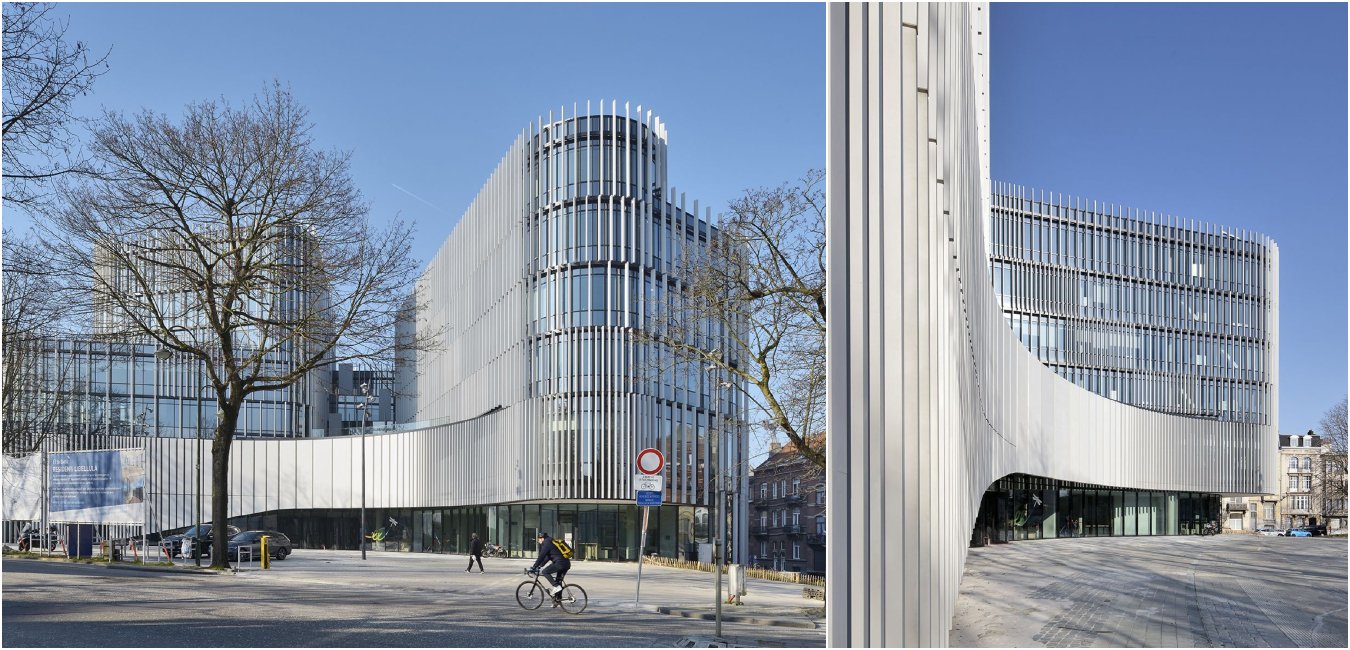
Etterbeek City Hall by BAEB + Bureau Jaspers & Eyers Architects, Brussels: Design Review
By Tanveer Ahmed, CEO, Ahmed Construction Company (ACCO) · Updated · Reviewed by ACCO architects and engineers
Quick Answer
Etterbeek City Hall by BAEB + Jaspers-Eyers: a design review of the Brussels civic hub with a suspended cantilever, solar sunshades and passive housing. Ahmed Construction Company (ACCO), based in Gulberg-III Lahore since 1998, provides ACCO design & construction services with design drawings free on award of construction.
Etterbeek City Hall by BAEB and Bureau Jaspers & Eyers Architects brings a Brussels municipality’s main public services under one roof. Completed in 2020, the roughly 35,000 m² project combines the town administration, the Public Social Action Centre (CPAS) and a local police station in a single administrative building, alongside a block of 41 subsidised apartments built to passive energy standards. Its curving form, cantilevered reception hall and sculpted concrete sunshades make it one of the more distinctive civic buildings of recent years. This design review explains the main design decisions and what they suggest for public and institutional buildings in Pakistan.
Etterbeek City Hall at a Glance
| Architects | BAEB and Bureau Jaspers & Eyers Architects; lead architects Emmanuel Bouffioux, Juan Ochogavia, Stefaan Van Acker and Peter Ory |
|---|---|
| Location | Etterbeek, Brussels, Belgium |
| Area | About 35,000 m² |
| Completed | 2020 |
| Programme | City administration, Public Social Action Centre, local police station, and 41 subsidised apartments |
| Structure | Prefabricated and in-situ concrete with steel girders and trusses in complex areas |
| Engineering | Structural: Bureau d’études Greisch; energy and environment: Neo & Ides; acoustics: D2S International |
| Contractor | CIT Blaton and CFE Brabant |
Project Background and Objectives
Before this project, Etterbeek’s municipal services were spread across different locations. Residents needing help from the town administration, social services or the police had to visit separate buildings. The main objective was to redefine the identity of the administration by consolidating these functions into one building that is easy to find, easy to use and open to the neighbourhood.
The brief also called for housing. The city of Etterbeek owns the adjoining residential block, which provides subsidised apartments. Combining civic and residential uses on one site helps keep the area lived-in outside office hours and makes efficient use of publicly owned land.
A further aim was urban: the design was intended to improve communication and connections between existing neighbourhoods, rather than sit as an isolated object.
Design Concept: Organic Forms and Public Space
The building’s most obvious feature is its organic, curving plan. Instead of a rectangular block, the façades meander around the site, shaping a series of public plazas, pathways and courtyards between the buildings. These outdoor spaces knit the complex into its surroundings and give pedestrians new routes through the block.
The main plaza is anchored by a large cantilever that marks the entrance and draws visitors towards the heart of the project, a double-height lobby. The architects use the building’s shape to make the civic entrance obvious from the street, which is exactly what a city hall needs.
A single, legible lobby
The double-level lobby acts as the central hub of the administrative building. From the front desk, visitors are directed quickly to the service they need. Each function, administration, social services and police, also has its own independent access, so they can operate on different hours and with different security levels without interfering with each other.
Built for change
The architects describe the building as modular, designed so that its spaces can be reorganised as the municipality’s needs evolve. Public administrations restructure frequently, and a flexible floor plan avoids costly rebuilding later.
Structural and Façade Engineering
The architects identify two main technical challenges, both of which shaped the building’s appearance.
Suspended reception wing
To keep the ground floor largely free of columns, the cantilevered reception hall in the north wing is suspended from an intricate steel truss system.
Load-bearing curtain wall
The heavy concrete sunshades are carried by a specially engineered load-bearing steel curtain wall, rather than by a conventional lightweight glazing system.
Hybrid frame
Prefabricated and in-situ concrete form the main structure, with steel girders and trusses used where spans and loads are more complex.
Sunshades shaped by a solar study
The distinctive concrete sun-shading system was developed from a detailed solar study. The fibre-reinforced concrete fins control glare and solar gain on the glazed façade and give the building its identity. Here, environmental performance and architectural expression are the same element.
Interior construction
Inside the administrative building, partitions combine glass, lightweight gypsum board, gypsum blocks and concrete blocks, chosen according to the acoustic, fire and transparency needs of each space. Acoustic consultants were part of the team, reflecting the importance of speech privacy in offices and counters that deal with sensitive social and police matters.
The Subsidised Housing Block
The residential building is a city-owned subsidised housing scheme of 41 apartments, mostly two- and three-bedroom flats. Each apartment has views to the front and rear, which allows cross-ventilation and daylight from two sides, and each has private outdoor space.
Its structure also combines prefabricated and in-situ concrete. The ground floor is finished in architectural concrete for durability in exposed areas, while the upper floors have a white render finish. Internal walls are mainly concrete and gypsum blocks. The block was designed in line with recent passive energy standards, which means a highly insulated, airtight envelope and a strong focus on low energy use.
Civic Building Approaches Compared
| Aspect | Scattered municipal offices | Etterbeek City Hall approach |
|---|---|---|
| Access for citizens | Several buildings, unclear routes | One double-height lobby with direct guidance to every service |
| Operational independence | Separate sites, duplicated facilities | One building, independent entrances for each function |
| Public space | Car parks and fenced compounds | Plazas, pathways and courtyards shaped by the building |
| Solar control | Tinted glass, internal blinds | External concrete sunshades designed from a solar study |
| Land use | Single-use civic land | Civic offices combined with subsidised housing |
| Future change | Rigid cellular offices | Modular layout intended to adapt over time |
Strengths and Points to Consider
- Strength: consolidating services reduces travel and confusion for residents and lets departments share facilities.
- Strength: external shading integrated with the architecture is more effective than internal blinds at keeping heat out.
- Strength: mixing civic and residential uses keeps the site active beyond office hours.
- Consideration: curved forms, suspended structures and heavy sunshades increase engineering complexity and cost, and need experienced designers and contractors.
- Consideration: housing a police station with public services requires careful security zoning so that open, welcoming spaces stay safe.
Lessons for Pakistan
Pakistan’s district offices, tehsil complexes, municipal buildings and police stations are often scattered, hard to navigate and poorly suited to the climate. Etterbeek City Hall offers several ideas that translate well to local conditions.
Consolidate public services around one clear entrance
A “one-window” civic building with a single, well-signed lobby and separate secure zones behind it would serve citizens far better than dispersed offices. Independent entrances allow police, revenue and social services to keep different hours and security levels.
Shade the façade from outside
Pakistan’s sun is far stronger than Brussels’. External fins, deep reveals and jaalis designed from a proper solar study can cut cooling loads substantially, especially on east and west façades. Energy design guidance from ASHRAE and green building frameworks such as LEED can support these decisions.
Engineer cantilevers and heavy façades for earthquakes
Large cantilevers and heavy precast sunshades behave differently in an earthquake. In Pakistan they must be designed to the seismic provisions of the Building Code of Pakistan, with robust fixings for every façade element.
Design public space, not just buildings
Shaded plazas and courtyards around civic buildings give waiting citizens somewhere comfortable to be, and improve the building’s relationship with the street. Trees, covered walkways and seating are low-cost additions with high public value.
Choose experienced delivery partners
Civic and institutional buildings need contractors who understand phasing, security, MEP coordination and public-sector processes. ACCO’s institutional projects and office building construction services cover this type of work, while our apartment building construction team handles multi-unit housing. Each project is priced through an itemised BOQ. For another recent civic and cultural design review, see Henning Larsen’s Kontrapunkt Arts Center in Bergen.
Frequently Asked Questions
Who designed Etterbeek City Hall?
Etterbeek City Hall was designed by BAEB and Bureau Jaspers & Eyers Architects, with lead architects Emmanuel Bouffioux, Juan Ochogavia, Stefaan Van Acker and Peter Ory. Jaspers-Eyers also handled the interiors.
What does the building contain?
The administrative building houses the Etterbeek city administration, the Public Social Action Centre and a local police station. The complex also includes a block of 41 subsidised apartments.
How big is the project and when was it completed?
The project covers about 35,000 m² and was completed in 2020.
How is the cantilevered reception hall supported?
The cantilevered reception hall in the north wing is suspended from a steel truss system, which keeps the ground floor and interior largely free of columns.
What are the concrete sunshades for?
The fibre concrete sunshades, designed from a solar study, control glare and solar heat gain on the glazed façade and give the building its visual identity. A specially engineered load-bearing steel curtain wall supports their weight.
Could a similar civic building be built in Pakistan?
Yes. A consolidated civic building with a single public lobby, external shading and shaded plazas suits Pakistani cities well, provided it is designed for local seismic requirements, fire safety rules, security needs and the hotter climate.
Conclusion
Etterbeek City Hall by BAEB and Bureau Jaspers & Eyers Architects shows how a municipal building can be both efficient and welcoming. Consolidating the administration, social services and police in one building with a clear central lobby simplifies life for residents, while the curving form creates public plazas and the solar-designed sunshades combine performance with identity. Adding subsidised housing to the site makes good use of public land. For Pakistan, the key lessons are to consolidate civic services, shade buildings from the outside, engineer bold structures carefully for earthquakes, and design the spaces around public buildings as thoughtfully as the buildings themselves. ACCO’s design and construction services support institutional clients through each of these stages.
Related articles
ACCO services
Contact ACCO
- +92 322 8000190
- info@acco.com.pk
- Office 2, 3rd Floor, Bigcity Plaza, Gulberg-III, Lahore
Planning a Project with ACCO?
Architecture, engineering and construction from one Lahore team since 1998. Design drawings are free when ACCO is awarded the construction.
Discuss Your ProjectWhatsApp +92 322 8000190
Grey Structure Construction Cost in Pakistan 2027: What You’ll Actually Pay