CTZ2 House by Pepe Giner Arquitectos: Architecture Review
By Tanveer Ahmed, CEO, Ahmed Construction Company (ACCO) · Updated · Reviewed by ACCO architects and engineers
Quick Answer
CTZ2 House by Pepe Giner Arquitectos in Jávea, Spain reviewed: curved platforms on a steep slope, dry stone walls, sea views and lessons for Pakistan. Ahmed Construction Company (ACCO), based in Gulberg-III Lahore since 1998, provides house construction in Lahore with design drawings free on award of construction.
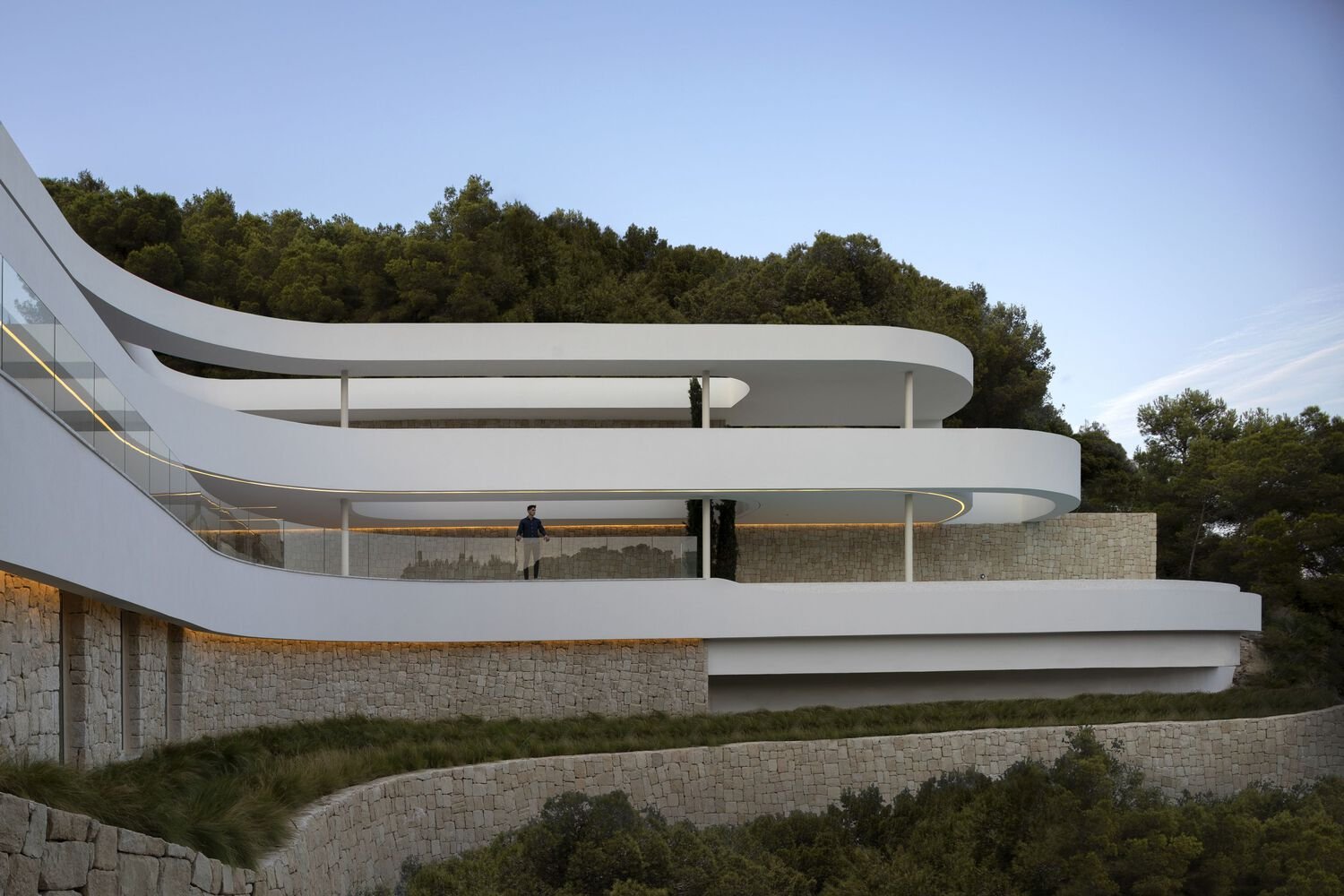
CTZ2 House by Pepe Giner Arquitectos is a 740 m² Mediterranean villa in Jávea, on Spain’s eastern coast, completed in 2022. It sits on a plot that falls steeply towards the south-east and looks over the bay of Portitxol, with Portitxol island to the north and the Punta del Cap Negre viewpoint to the south. Rather than flattening the site, the architects turned the slope into the main idea of the design: a stack of gently curved horizontal platforms that step down the hill and appear to float above the landscape. This review looks at the concept, plan, structure and materials of CTZ2 House, and then draws out lessons for building on sloping sites in Pakistan. It is an independent architectural review based on the architects’ published description, not an ACCO project.
CTZ2 House at a Glance
| Architect | Pepe Giner Arquitectos (lead architect Pepe Giner Ivars) |
|---|---|
| Location | Jávea, Alicante coast, Spain |
| Area and year | 740 m², completed 2022 |
| Site | Steep slope facing south-east over Portitxol bay |
| Concept | Curved, staggered platforms that follow the terrain and frame sea views |
| Structure | Dry stone walls and slender metal pillars supporting horizontal slabs |
| Team | Collaborating architects Borja Martí and Marta Fornés; interior design Sabrina Soria; technical architect Marisa Mas |
| Photography | Diego Opazo |
The Site: A Difficult Slope with an Exceptional View
The plot at CTZ2 has two defining qualities. It is steep and rugged, which makes construction harder and more expensive. And it faces south, towards the Mediterranean, with long views across the bay. The architects describe how the orientation, geometry and slope of the plot shaped every major decision.
What might have been treated as a problem became the organising principle. The rugged topography is not hidden behind retaining walls and a flat podium; instead, the house is shaped to follow it. This approach often produces better buildings on hillsides, because it reduces excavation and makes the most of the natural view lines.
Design Concept: Floating Horizontal Platforms
The core idea of CTZ2 House is a series of curved platforms, staggered one above another so that they track the natural fall of the land. Seen from below, the south-east façade reads as a set of long, flowing horizontal lines. Against the landscape, the slabs seem almost weightless, as if they were levitating over the slope.
To make the most of the views, the architects lifted the day area of the house, including the main terrace and pool, so that it looks out over the bay rather than into the hillside. The platforms widen in the centre to form generous terraces and taper towards the edges, where they meet the boundaries and neighbouring conditions.
Inside and Outside as One Space
On every level, terraces wrap around a glass enclosure. The line between indoor rooms and outdoor space becomes blurred: living areas open directly onto shaded platforms, and the platforms in turn open to the sea. A curved pool at the edge of the main terrace continues the line of the slab towards the horizon, so the terrace appears to extend beyond its actual edge.
Landscape Woven Through the Building
A Mediterranean garden is planted on the terraces. Cypress trees are positioned so that they grow up through openings cut into the platforms. This small but clever detail ties the building to the landscape and emphasises the horizontal lines of the slabs with strong vertical accents.
Plan and Circulation
Visitors enter through a double-height space that acts as the hub for vertical movement through the house. At its centre is a sculptural staircase finished in black Marquina marble, which links the different levels and becomes a focal point visible from many parts of the interior.
The upper level contains the entrance hall and three bedrooms. Each bedroom has its own terrace with a sea view, so the private rooms share in the same relationship with the landscape as the living spaces.
Structure and Materials
The horizontal platforms are supported by a combination of two very different elements, which together give the house its character.
Dry stone walls
Heavy, rooted walls that anchor the building to the terrain and also define the boundaries of the terraces.
Slender metal pillars
Light vertical supports that carry the slabs where walls are not needed, keeping views open.
Glass enclosures
Fully glazed rooms set back beneath the platforms, shaded by the slab above.
The contrast is deliberate. The heavy stone belongs to the ground; the thin columns and long slabs belong to the air. The interior palette adds black Marquina marble for the staircase, with furniture and lighting from Spanish manufacturers such as Andreu World and Vibia, and Cortizo window systems.
Light, Shade and the Mediterranean Climate
Jávea has hot, dry summers and mild winters, with strong sunshine for much of the year. The design of CTZ2 House manages this through its section rather than through screens or tinted glass. Each slab projects beyond the glass line of the floor below, so high summer sun is blocked while lower winter sun can reach further into the rooms. The terraces themselves become shaded outdoor rooms, which is where much of Mediterranean life takes place.
The planting reinforces this. A Mediterranean garden on the terraces softens the hard edges of the slabs, adds evaporative cooling and gives privacy between levels. The cypress trees growing through the platforms also cast moving shadows across the terraces during the day.
Privacy on a Visible Site
Hillside houses are often highly visible from below. At CTZ2, the horizontal slabs and planting filter views into the house, while the bedrooms on the upper level have their own terraces facing the sea rather than neighbours. This balance between openness and privacy is an important lesson for any house on a slope.
Hillside Design Approaches Compared
| Approach | How it works | Advantages | Drawbacks |
|---|---|---|---|
| Cut and flatten | Excavate a level platform and build a conventional house | Simple design and construction | Heavy excavation, tall retaining walls, drainage and slope-stability risks |
| Stilts and podium | Raise the house on columns above the slope | Less excavation, good views | Exposed underside, higher seismic demand on tall columns |
| Stepped platforms (CTZ2 approach) | Terraces and floors step down with the terrain | Follows contours, many terraces, views from every level | More complex structure, waterproofing and coordination |
What Makes the Project Work
CTZ2 House succeeds because one clear idea is carried through consistently. The platforms define the form, the terraces, the views, the shading and the relationship with the garden. The structure supports that idea instead of competing with it. The result is a large house that feels light and calm rather than heavy.
The design also responds to climate. The deep overhanging slabs shade the glass beneath them from high summer sun, which is essential on a south-facing Mediterranean site. Terraces provide outdoor living space for most of the year.
Lessons for Pakistan
Pakistan has many sloping residential sites: in Islamabad near the Margalla Hills, in Murree, Abbottabad, Swat, the Galiyat and parts of Rawalpindi. Too often, houses on these plots are designed as if the ground were flat, with deep cuts, tall retaining walls and blank walls facing the view. CTZ2 House points to a better way.
Work with the contours
Step floors and terraces down the slope to reduce excavation and retaining walls.
Design for earthquakes
Northern Pakistan is highly seismic, so stepped structures need careful engineering under the Building Code of Pakistan, especially where columns of different heights meet.
Manage water
Hillside sites need drainage behind retaining walls and on every terrace to prevent seepage and slope failure during the monsoon.
Use local stone
Stone walls, as used in traditional hill architecture in the north, anchor buildings visually and can be combined with modern RCC frames.
Deep overhangs and shaded glass are just as useful in Pakistan’s hot summers as on the Mediterranean coast. On hill sites, a geotechnical investigation and a structural engineer experienced in slopes are essential before design is fixed, and the architect should be registered with the Pakistan Council of Architects and Town Planners. ACCO’s luxury and custom home service handles bespoke designs of this kind.
Limitations to Keep in Mind
Large, highly glazed houses need careful thermal design in Pakistan, where summer temperatures in the plains are far higher than in Jávea and winters in the hills are colder. Glass should be shaded, double-glazed where appropriate and placed away from the harshest west sun. Long cantilevered slabs and slender columns demand precise engineering and good-quality construction, and in seismic zones the structural system may need to be heavier than in Spain. Dry stone construction also requires skilled masons, who are not available everywhere. For a related approach on a tropical hillside, see our review of House with a View by Studio Saxe.
Frequently Asked Questions
Who designed CTZ2 House?
CTZ2 House was designed by Pepe Giner Arquitectos, with Pepe Giner Ivars as lead architect and Borja Martí and Marta Fornés as collaborating architects.
Where is CTZ2 House?
It is in Jávea, on the Mediterranean coast of Spain, overlooking the bay of Portitxol.
How big is CTZ2 House?
According to the architects, the house has an area of 740 m² and was completed in 2022.
What is special about its structure?
Curved horizontal platforms are supported by a mix of dry stone walls, which anchor the building to the slope, and slender metal pillars.
Can this approach work on hill plots in Pakistan?
Yes, with careful seismic design, drainage and geotechnical investigation. Stepped houses that follow the contours often reduce excavation and improve views.
Is CTZ2 House an ACCO project?
No. This is an independent review of a project by Pepe Giner Arquitectos, written to share design lessons with readers in Pakistan.
Conclusion
CTZ2 House by Pepe Giner Arquitectos shows how a steep, awkward plot can become the source of a building’s identity. Its staggered platforms, dry stone walls and wrap-around terraces create a house that follows the land and opens fully to the sea. The same thinking can help homeowners in Pakistan’s hill areas build safer, more beautiful houses. To discuss a sloping or unusual plot, see ACCO’s house design and construction services.
Related articles
- Renovation of the Primary School Affiliated to Longjiang Foreign Language School | Atelier cnS
- Modern Hospital Architecture in Islamabad: Design & Planning Guide
- Jägerbau Headquarters by Innauer-Matt Architekten, Bludenz: Design Review
- Children’s Forest Nursery School by Takashige Yamashita Office: Design Review
Contact ACCO
- +92 322 8000190
- info@acco.com.pk
- Office 2, 3rd Floor, Bigcity Plaza, Gulberg-III, Lahore
Planning a Project with ACCO?
Architecture, engineering and construction from one Lahore team since 1998. Design drawings are free when ACCO is awarded the construction.
Discuss Your ProjectWhatsApp +92 322 8000190

Grey Structure Construction Cost in Pakistan 2027: What You’ll Actually Pay