City Within the City Commercial Building, Guangzhou by gmp: Architecture Review
By Tanveer Ahmed, CEO, Ahmed Construction Company (ACCO) · Updated · Reviewed by ACCO architects and engineers
Quick Answer
City Within the City commercial building in Guangzhou by gmp Architects: review of its six volumes, terracotta facade, atrium and lessons for Pakistan. Ahmed Construction Company (ACCO), based in Gulberg-III Lahore since 1998, provides ACCO design & construction services with design drawings free on award of construction.
Large shopping buildings in historic city centres usually turn their backs on the street: a sealed box, a blank facade and a car-park entrance. The City Within the City commercial building in Guangzhou, designed by gmp Architects (von Gerkan, Marg and Partners), takes a different approach. Instead of one large mass, it breaks a major retail building into six volumes that echo the scale of the surrounding old town, wraps them in a terracotta facade, and opens terraces and colonnades to the public. This review looks at how the City Within the City commercial building works and what Pakistani architects and plaza developers can learn from it.
City Within the City Commercial Building at a Glance
| Architects | gmp Architects; design by Meinhard von Gerkan and Stephan Schütz |
|---|---|
| Location | Zhongshan Road, old city centre of Guangzhou, China, opposite a historic monument and museum site |
| Completed | 2023 (as published by the architects) |
| Area | About 35,500 m² |
| Height | About 35 m, arranged as six volumes |
| Key features | Prefabricated terracotta facade with integrated LED lighting, central atrium, roof terrace, colonnades at street level |
| Facade consultant | SuP Ingenieure |
Site and Context
The building stands in the historic core of Guangzhou, on Zhongshan Road, facing a protected monument and museum site. Around it is a fine-grained district of narrow streets and modest buildings. Dropping a conventional mall into this setting would have overwhelmed the neighbourhood both in height and in the length of blank wall facing the street.
The design brief therefore had two goals that pull in different directions: provide a large amount of retail space, and keep the scale and character of the old city. The architects’ answer was to treat the building not as one object but as a small cluster of buildings, which explains the project’s name.
Massing: Six Volumes Instead of One Box
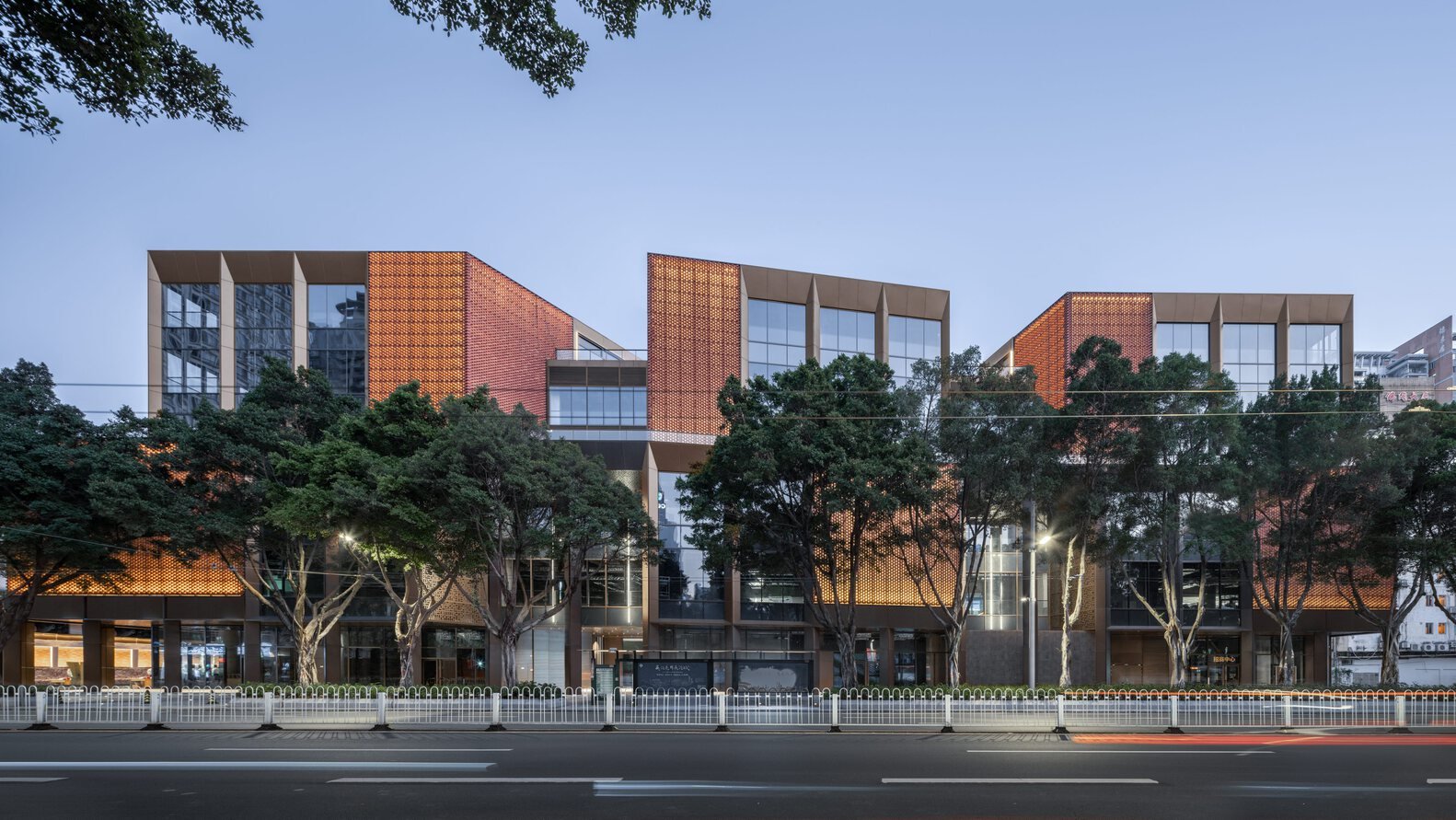
The building is divided into six volumes whose proportions follow those of the surrounding buildings. Gaps and recesses between the volumes break the long frontage into shorter sections, so from the street it reads more like a row of buildings than a single mall.
Why this matters
- It reduces the visual bulk of a very large floor area
- It creates openings that bring daylight and views into the interior
- It allows terraces and outdoor spaces at different levels
- It respects the height and rhythm of the historic district
Recessed upper levels form a wrap-around terrace, and the topmost level provides a roof plaza with shops and restaurants open to the outside, offering views over the old city and the modern skyline.
The Terracotta Facade
The facade is the project’s signature. Reddish terracotta elements, chosen to relate to the colour of nearby historic buildings, are threaded onto stainless-steel tubes in an offset pattern with gaps between them. These prefabricated facade units are fixed to a supporting structure that also carries integrated LED strips.
Material
Terracotta links the new building to traditional local materials and weathers well.
Prefabrication
Elements assembled off site give consistent quality and faster installation.
Depth
The offset pattern and varying tones create a three-dimensional surface that changes with viewing angle.
Night effect
LED lighting between the elements makes the facade glow and shimmer after dark.
Glazed vertical sections reflect the street and the monument opposite, while entrances are marked by perforated bronze-coloured metal screens.
Interior: Atrium, Galleries and Daylight
Inside, a central atrium brings light down from above, while the gaps between the volumes admit light from the sides. Galleries on eight levels, including two below ground, surround the atrium and give access to shops facing both the interior and the street.
Circulation
Long escalators cross the atrium, making vertical movement part of the visitor experience and encouraging people to explore upper floors. This addresses a common problem in multi-storey retail, where upper levels struggle to attract footfall.
Public Space and the Qilou Tradition
Along the main frontage, colonnades recall the qilou arcade buildings typical of southern Chinese cities, where shops sit behind a covered walkway that shelters pedestrians from sun and rain. By extending this tradition, the building gives part of its ground floor back to the street and makes shopping feel continuous with the city around it.
Climate Response and Building Performance
Guangzhou has a hot, humid subtropical climate with heavy summer rain, conditions not far from those of Karachi or Lahore during the monsoon. Several features of the design respond to this, whether by intention or as a by-product of its urban approach.
Shading and filtered light
The open-jointed terracotta screen acts partly as a sun filter. Light passes through the gaps, but direct sun on the inner wall is reduced compared with a fully glazed facade. This helps limit heat gain while still allowing views out and a glimpse of activity inside.
Covered outdoor space
Colonnades and recessed terraces provide shade and shelter from rain, making outdoor space usable for much of the year. In hot cities, covered transitional spaces between street and interior often see more use than open plazas exposed to the sun.
Durable materials
Terracotta and stainless steel are long-lasting, low-maintenance materials. Compared with painted or composite cladding, they are less likely to fade or need replacement, which matters for a building intended to stand in a historic setting for decades.
Delivery and Prefabrication
A facade made of many small elements could be slow and inconsistent if built piece by piece on site. Prefabricating the terracotta units, with elements threaded onto steel tubes and assembled into panels, moves much of the work into controlled conditions. On-site installation then becomes a matter of fixing finished panels to the supporting structure. The approach is relevant to Pakistani projects too, where facade quality often suffers from site-made work and inconsistent workmanship.
Conventional Mall vs City Within the City Approach
| Aspect | Conventional mall | City Within the City |
|---|---|---|
| Massing | Single large box | Six volumes at neighbourhood scale |
| Street frontage | Blank walls, few entrances | Colonnades, gaps and multiple entrances |
| Daylight | Mostly artificial | Atrium skylight and side openings |
| Facade | Cladding panels and signage | Prefabricated terracotta with integrated lighting |
| Public space | Enclosed and private | Terraces and roof plaza open to the city |
Lessons for Pakistan
Pakistani cities face similar pressures. Commercial plazas in Lahore, Karachi and Rawalpindi increasingly rise beside older, smaller buildings, and in places like the Walled City of Lahore new development must respect heritage. The Guangzhou project offers several transferable ideas.
Break up the mass
Large plazas can be divided visually into smaller blocks with recesses and setbacks, reducing their impact on neighbours.
Use local materials
Brick and terracotta have deep roots in Punjab and perform well in heat, offering an alternative to all-glass facades.
Shade the street
Arcades and colonnades suit Pakistan’s climate, much like traditional bazaars, and draw shoppers in.
Activate upper floors
Atriums, escalators and roof terraces help upper levels let as well as ground floors.
Any such design must still comply with local rules. In Lahore, height, setbacks and parking are set by the Lahore Development Authority or the relevant scheme, and heritage areas fall under the Walled City of Lahore Authority. Large atriums also need careful fire engineering, including smoke control and protected escape routes in line with NFPA principles; our fire-safe commercial plaza design guide explains the main requirements.
For facade options suited to local conditions, see our review of commercial plaza elevation design trends. ACCO’s commercial plaza design and construction service applies these principles to projects in Lahore.
Frequently Asked Questions
Who designed the City Within the City commercial building?
It was designed by gmp Architects (von Gerkan, Marg and Partners), with Meinhard von Gerkan and Stephan Schütz credited as design architects.
Where is the building located?
It is on Zhongshan Road in the historic centre of Guangzhou, China, opposite a protected monument and museum site.
What is the facade made of?
Prefabricated units of reddish terracotta elements threaded onto stainless-steel tubes, combined with integrated LED lighting and glazed sections.
Why is it divided into six volumes?
To match the scale of surrounding buildings, reduce visual bulk, and create openings for daylight, terraces and views.
Can terracotta facades be used in Pakistan?
Yes. Brick and terracotta are traditional in Punjab and suit the climate. Modern systems need proper engineering for fixings, wind and seismic loads.
What can Pakistani plaza developers learn from it?
That large commercial buildings can respect their neighbourhood through broken massing, shaded frontages, local materials and active upper floors, while still providing large lettable areas.
Conclusion
The City Within the City commercial building shows that a large retail development does not have to dominate a historic district. By breaking its mass into six volumes, using a crafted terracotta facade, opening terraces and colonnades to the public and filling its interior with daylight, gmp created a building that feels part of the city rather than separate from it. Those ideas translate well to Pakistani cities, where commercial growth increasingly meets older urban fabric. For developers, the lesson is that respecting context is not only a planning obligation; a building that people enjoy walking past and into is also a building that attracts tenants and footfall over the long term.
Related articles
ACCO services
Contact ACCO
- +92 322 8000190
- info@acco.com.pk
- Office 2, 3rd Floor, Bigcity Plaza, Gulberg-III, Lahore
Planning a Project with ACCO?
Architecture, engineering and construction from one Lahore team since 1998. Design drawings are free when ACCO is awarded the construction.
Discuss Your ProjectWhatsApp +92 322 8000190