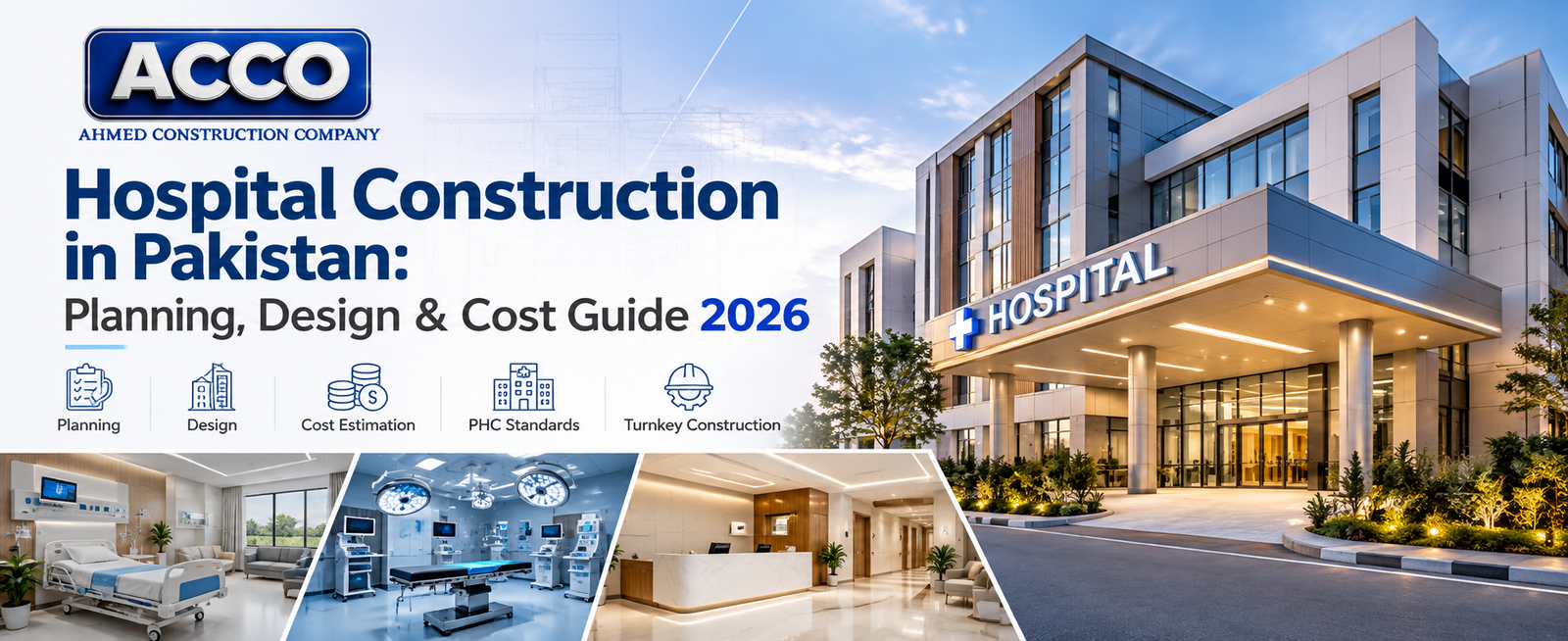

Turnkey Hospital Design and Construction Services in Afghanistan
By Tanveer Ahmed, CEO, Ahmed Construction Company (ACCO) · Updated · Reviewed by ACCO architects and engineers
Quick Answer
Turnkey hospital construction in Afghanistan: one contract for design, procurement, construction, utilities and handover. How it works and what to check. Ahmed Construction Company (ACCO), based in Gulberg-III Lahore since 1998, provides hospital design & construction services with design drawings free on award of construction.
Building a hospital in Afghanistan is a demanding task. Sites can be remote, supply chains cross borders, power and water are often unreliable, winters are harsh in much of the country, and many sponsors manage the project from abroad. When design, construction, MEP, equipment and commissioning sit with separate parties, every gap between them becomes the owner’s problem. Turnkey hospital construction in Afghanistan solves much of this by placing the whole project, from feasibility to a working building, under one accountable partner. This guide explains what a turnkey service includes, why it suits Afghan conditions, how the process runs, and what owners should check before signing a turnkey contract.
Turnkey Hospital Construction in Afghanistan at a Glance
| What turnkey covers | Feasibility, medical planning, architecture, structural and MEP design, procurement, construction, utilities, equipment coordination, testing, commissioning and handover |
|---|---|
| Typical clients | Private investors, diaspora sponsors, NGOs, charitable trusts and development agencies |
| Key references | WHO health facility and infection-prevention guidance, NFPA life safety, ASHRAE 170 healthcare ventilation, seismic design codes |
| Site realities | Seismic risk, cold winters in many provinces, hot summers in the south, limited grid power, groundwater-dependent water supply |
| Pricing | Itemised BOQ against an agreed brief; see the Afghanistan hospital construction cost guide |
What Turnkey Hospital Construction Means
In a turnkey contract the owner appoints one company to deliver a complete, functioning facility. The same partner is responsible for design and construction, coordinates every specialist trade and supplier, and hands over a hospital that has been tested and is ready for staff to move in. The owner sets the brief, approves key decisions and pays against agreed milestones, but does not have to manage dozens of separate contracts.
This differs from the traditional design-bid-build route, where the owner hires a designer, tenders the design to contractors, and then manages the interfaces between the builder, MEP subcontractors and equipment suppliers. That approach can work in stable markets with strong local project management, but it places a heavy burden on the owner in Afghanistan.
What a Turnkey Service Includes
Feasibility and brief
Population served, services, bed numbers, staffing assumptions, site capacity and funding plan, documented for sponsors and donors.
Design
Medical planning, architecture, seismic structural design and full MEP, coordinated in one model.
Procurement
Materials, fabricated items and equipment sourced and shipped under one logistics plan.
Construction
Site management, quality control, health and safety, and progress reporting for remote owners.
Utilities
Hybrid solar, battery and generator power, boreholes and water treatment, heating, oxygen supply and waste handling.
Commissioning
Testing of every system, equipment installation support, staff orientation and handover documents.
Why Turnkey Suits Afghan Conditions
One supply chain instead of several
Many materials, fabricated steel, MEP components and equipment are brought in from neighbouring countries, including through the Torkham and Chaman crossings from Pakistan. A turnkey partner can plan these shipments as one programme, so items arrive in the right order and customs or transport delays are managed centrally.
One point of responsibility
When design and construction sit with the same company, there is no dispute about whether a problem is a design error or a construction error. The partner fixes it. For owners who are not on site, this clarity is extremely valuable.
Suited to remote owners
Diaspora sponsors, NGOs and international agencies often manage projects from abroad. A turnkey partner provides a single channel for reporting, photographs, inspections and payment milestones.
Faster overall programme
Design, procurement and early site works can overlap under one contract, which shortens the time from decision to opening compared with sequential tendering.
Turnkey vs Traditional Delivery
| Factor | Traditional design-bid-build | Turnkey |
|---|---|---|
| Number of contracts | Many: designer, contractor, MEP, suppliers | One main contract |
| Coordination risk | Carried by the owner | Carried by the turnkey partner |
| Price certainty | Known only after tender, exposed to variations | Agreed earlier against a defined brief and BOQ |
| Programme | Sequential stages | Overlapping design, procurement and construction |
| Owner involvement | Heavy day-to-day management | Brief, approvals and milestone reviews |
| Design control | Direct through the designer | Through the brief, reviews and approvals |
Designing for Afghan Sites
Seismic safety
Much of Afghanistan is seismically active. Hospitals should be designed as essential facilities, with ductile structural detailing, braced ceilings and services, and anchored equipment so that the building remains usable after an earthquake.
Climate
Kabul and the northern and central provinces have cold winters, so insulation, efficient heating and protection of water pipes are essential. Southern provinces such as Kandahar and Helmand face very hot summers, where shading and cooling dominate. Dust is a concern almost everywhere, so filtration and sealed envelopes matter.
Power and water
Grid power is limited or unreliable in many areas. Turnkey designs typically combine solar panels, battery storage and diesel generators, with critical loads such as theatres, ICU and oxygen equipment on protected circuits. Water usually comes from boreholes, with storage tanks, treatment and hot water systems sized for clinical use.
Medical oxygen
On-site oxygen generation, supported by cylinder backup and a pipeline network, reduces dependence on long supply chains. Our medical gas pipeline guide explains system design.
How a Turnkey Hospital Project Runs
Feasibility and concept
Brief, site survey, concept layout and first BOQ estimate for sponsor approval.
Detailed design
Architecture, structure and MEP are completed and coordinated, and the BOQ is refined.
Procurement and construction
Materials and equipment are ordered while site works proceed, with regular reporting.
Testing and handover
All systems are commissioned, equipment is installed, and the hospital is handed over ready for use.
Facility Types Suited to Turnkey Delivery
The turnkey model works for almost any healthcare building, but the emphasis changes with the facility.
- Basic and comprehensive health centres need simple, robust layouts, reliable off-grid power and water, and finishes that small teams can clean and maintain easily.
- District and provincial hospitals need emergency, theatres, maternity, inpatient wards, laboratory, imaging and support services, with careful planning of flows and utilities.
- Maternity and children’s hospitals need a labour suite, obstetric theatre and newborn care unit close together, with protected power and oxygen.
- Private specialist hospitals in Kabul and other cities focus on efficient layouts, patient comfort and a strong equipment plan.
- Modular clinics and wards can be manufactured off site and assembled quickly where speed is critical.
Working With Donors and Funding Agencies
Many Afghan health facilities are funded wholly or partly by charities, trusts and development agencies. These funders usually require clear documentation: a needs assessment, a design that follows recognised standards, an itemised budget, a procurement record and regular progress reports. A turnkey partner can prepare these documents as part of the service and provide one set of reports for all funders, which saves sponsors considerable effort and helps future funding applications.
What to Check Before Signing a Turnkey Contract
- A clear brief. Services, bed numbers and equipment responsibilities should be written into the contract.
- An itemised BOQ. Even in a lump-sum contract, an itemised BOQ shows what is included and helps price any changes.
- Specifications. Key materials, finishes and systems should be specified, not left open.
- Milestones and reporting. Payments should be tied to verifiable progress, with photographs and inspection reports.
- Testing and warranties. The contract should list the tests required before handover and the warranty and defects period.
- Independent review. Owners can appoint an independent engineer to review design and inspect construction on their behalf.
Common Risks and How Turnkey Reduces Them
- Late changes to the brief, reduced by agreeing services and equipment before detailed design
- Border and transport delays, reduced by early ordering and a single logistics plan
- Power failures after opening, reduced by designing hybrid power and redundancy from the start
- Systems that are installed but not working, reduced by formal commissioning and handover testing
Planning for Operation After Handover
A hospital is only successful if it keeps working after the contractor leaves. A good turnkey proposal includes operation and maintenance manuals, as-built drawings, a spare parts list, training for the hospital’s engineering staff and a defects period during which the partner returns to fix problems. For remote sites, remote monitoring of generators, solar systems and oxygen plant can help an off-site engineer support local staff. Asking for these items at contract stage costs little and protects the investment for many years.
Frequently Asked Questions
What is a turnkey hospital project?
It is a single contract in which one company designs, builds, equips (or coordinates equipment), tests and hands over a complete, working hospital.
Why is turnkey useful in Afghanistan?
It reduces the number of contracts the owner manages, centralises cross-border logistics and gives one point of responsibility, which helps remote sponsors in particular.
Does turnkey cost more than traditional contracting?
Not necessarily. The partner carries more risk, but owners avoid many coordination costs and variations. Each project is priced through an itemised BOQ.
Can medical equipment be included?
Yes. Equipment can be supplied within the contract or procured by the owner, with the turnkey partner coordinating rooms, services and installation.
How are hospitals powered in areas with weak grid supply?
Usually with a hybrid system of solar panels, batteries and generators, with critical loads on protected circuits and UPS.
How can an owner abroad monitor progress?
Through milestone-based payments, regular photographic and written reports, scheduled site visits and, if wanted, an independent engineer.
Conclusion
Turnkey hospital construction in Afghanistan places design, procurement, construction and commissioning with one accountable partner. For owners facing remote sites, cross-border supply chains and limited utilities, that single responsibility can be the difference between a building and a working hospital. For wider guidance read our hospital design and construction guide for Afghanistan, or explore ACCO’s hospital construction services.
Related articles
Contact ACCO
- +92 322 8000190
- info@acco.com.pk
- Office 2, 3rd Floor, Bigcity Plaza, Gulberg-III, Lahore
Planning a Project with ACCO?
Architecture, engineering and construction from one Lahore team since 1998. Design drawings are free when ACCO is awarded the construction.
Discuss Your ProjectWhatsApp +92 322 8000190