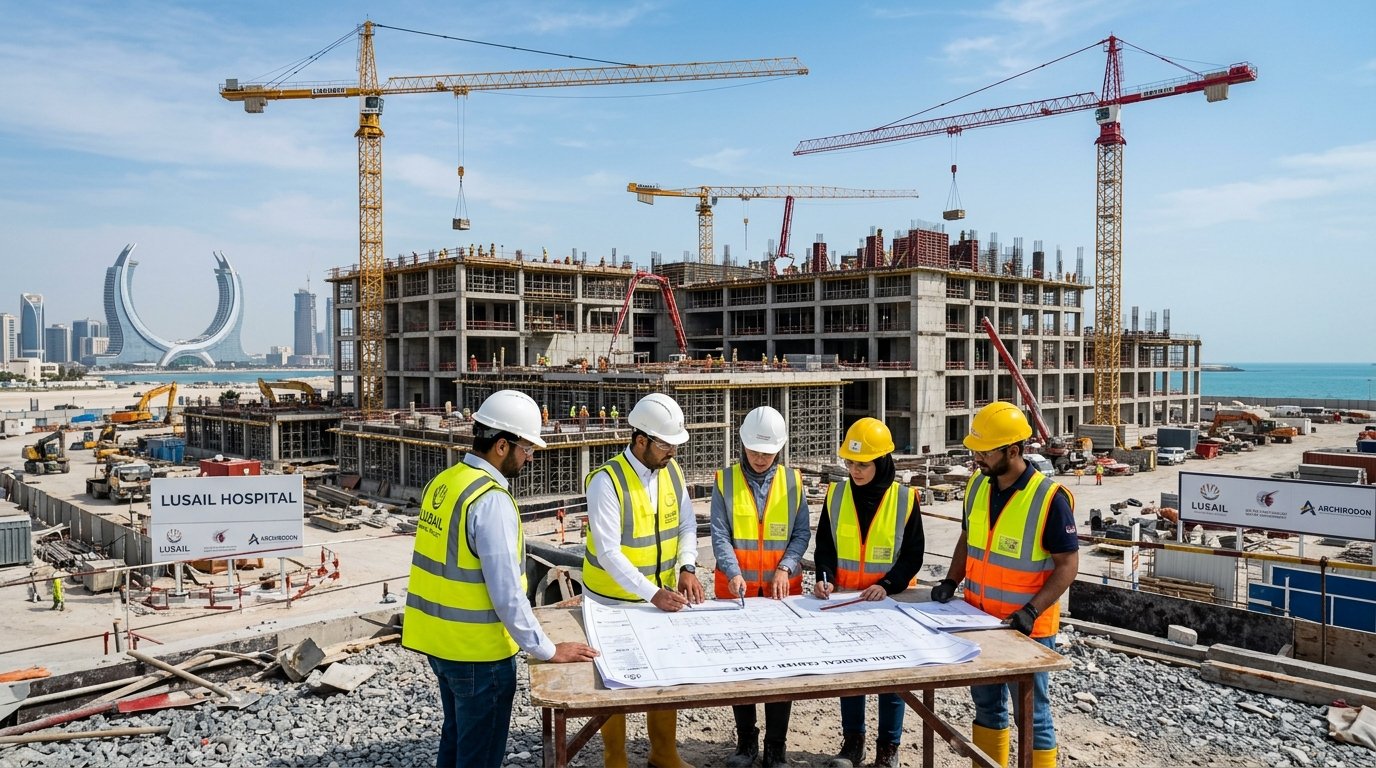
Hospital Construction Cost in Qatar (2026-27): Budgeting & Cost Drivers Guide
By Tanveer Ahmed, CEO, Ahmed Construction Company (ACCO) · Updated · Reviewed by ACCO architects and engineers
Quick Answer
Hospital construction cost in Qatar for 2026-27: what drives the budget, cost components, MEP share, equipment, approvals, contingency and BOQ-based pricing. Ahmed Construction Company (ACCO), based in Gulberg-III Lahore since 1998, provides hospital design & construction services with design drawings free on award of construction.
Planning a hospital budget in Qatar starts with a simple question that has no simple answer: how much will it cost? Hospital construction cost in Qatar depends on the type of facility, the share of high-technology clinical space, the engineering specification, imported materials and equipment, site conditions and the delivery model. Flat rates per square metre found online are rarely reliable because they hide these differences. This 2026-27 guide explains what makes up a hospital budget in Qatar, which factors push costs up or down, and how investors can build a dependable estimate through an itemised bill of quantities (BOQ).
Hospital Construction Cost in Qatar at a Glance
| Health regulator | Ministry of Public Health (MoPH) licensing |
|---|---|
| Fire and life safety | Qatar Civil Defence approval, with NFPA standards widely referenced |
| Construction standards | Qatar Construction Specifications (QCS); ASHRAE 170 for healthcare ventilation |
| Sustainability | GSAS green building assessment, commonly required for major projects |
| Biggest cost drivers | Clinical complexity, MEP specification, imported materials and equipment, site and utilities |
| Pricing method | Itemised BOQ based on design and specification, not a flat rate |
Why There Is No Single Rate per Square Metre
A hospital is not one type of space. A ward floor, an operating theatre suite, an MRI room and a car park have very different costs, and every hospital has a different mix of them. Two hospitals with the same floor area can have budgets that differ widely because:
- One has six theatres and a cath lab, the other has two theatres and no interventional services
- One uses mostly single patient rooms, the other multi-bed wards
- One targets international accreditation and a high amenity standard
- One sits on an easy site with utilities nearby, the other needs a substation, deep foundations or extensive site works
For this reason, a reliable estimate is built from quantities and specifications, department by department. Published benchmarks can be used only as a rough reasonableness check, and their source and scope should always be understood.
The Main Components of a Hospital Budget
Substructure and structure
Foundations, basements and the structural frame. Ground conditions near the coast, high water tables and the need for basements for parking and plant can add significantly to this element.
Envelope and architecture
Facades, roofing, glazing, shading, internal walls, doors and finishes. Qatar’s heat and humidity favour well-insulated, shaded facades, which cost more initially but reduce cooling costs over the life of the building.
Mechanical, electrical and plumbing (MEP)
In hospitals, MEP is often the largest single part of the construction cost. It includes HVAC with dehumidification and pressure control, chilled water plant or district cooling connections, medical gases, standby generators and UPS, low-voltage systems, plumbing and drainage, and fire protection.
Specialist clinical fit-out
Modular operating theatres, radiation shielding for imaging, cleanrooms for pharmacy, CSSD equipment, pneumatic tube systems and specialist ceilings and pendants.
Medical equipment and IT
Imaging, theatre, critical care, laboratory and other equipment, plus clinical and business IT. This is often budgeted separately from construction but must be included in the total project cost.
External works and utilities
Roads, parking, landscaping, drainage, connections to the power, water and sewer networks, and any on-site substation or plant buildings.
Fees, approvals and contingency
Design and supervision fees, authority fees, testing and commissioning, insurance and a contingency for risk.
Key Cost Drivers in Qatar
Clinical complexity
The proportion of theatres, ICU, imaging and interventional suites has the biggest effect on cost per square metre.
Imported supply chain
Much of the MEP equipment, specialist fit-out and medical equipment is imported, so exchange rates, shipping and lead times affect cost and programme.
Climate and energy
Cooling and dehumidification loads, and GSAS requirements, influence plant size and envelope specification.
Other drivers include the level of redundancy in critical systems, the finish and amenity standard, the construction programme (accelerated programmes cost more), the procurement route and the contractor market at the time of tender.
How Facility Type Affects Cost
| Facility type | Typical clinical content | Relative cost intensity |
|---|---|---|
| Primary care or polyclinic | Consulting rooms, minor procedures, basic imaging, pharmacy | Lower |
| Day-surgery centre | Small theatre suite, recovery, CSSD, outpatient clinics | Moderate |
| General hospital | Emergency, theatres, ICU, imaging, maternity, wards | Higher |
| Tertiary or specialist hospital | Multiple theatres, cath labs, advanced imaging, isolation and critical care | Highest |
The relative ranking is consistent across Gulf markets; the actual amounts must be established through a BOQ for each project. For comparison of cost drivers in neighbouring markets, see ACCO’s guides to hospital construction cost in the UAE and hospital construction cost in Saudi Arabia.
Building a Reliable Hospital Budget
Brief and space programme
Services, bed numbers and a room-by-room area schedule agreed with the operator.
Elemental estimate
Cost estimated element by element from the concept design, with clear assumptions.
Itemised BOQ
Detailed quantities and specifications from developed design, used for tendering and cost control.
Cost control during delivery
Change control, valuations and forecasting through construction and commissioning.
ACCO prepares hospital BOQs and cost plans as part of its BOQ, cost estimation and feasibility service.
Ways to Control Hospital Construction Cost
- Fix the brief early. Design changes during construction are the most common cause of overruns.
- Right-size the facility. Base bed numbers and theatre counts on a demand study.
- Coordinate in BIM. Resolve clashes before construction to avoid rework.
- Standardise rooms. Repeating room layouts reduces design time and construction errors.
- Consider whole-life cost. Better insulation and efficient plant may cost more initially but reduce running costs.
- Plan equipment early. Late equipment decisions cause redesign of rooms and services.
- Keep a realistic contingency. Hospitals carry more technical risk than ordinary buildings.
Hidden and Often-Forgotten Costs
Investors are sometimes surprised by costs that do not appear in early estimates:
- Utility infrastructure such as substations and large water storage
- Authority fees and the cost of design changes required during approvals
- Testing, commissioning and validation of clinical spaces
- Furniture, fixtures and non-medical equipment
- Pre-opening costs such as recruitment, training and trial operations
- Escalation if the programme is extended
How the Procurement Route Affects Cost
The way a hospital is procured changes not only the price but also who carries the risk of cost increases.
Design-bid-build
The design is completed before tender, so contractors price a defined scope. This gives good price competition, but any gaps or errors in the design become variations during construction. The quality of the tender documents and BOQ therefore has a direct effect on the final cost.
Design-build and turnkey
The contractor takes responsibility for completing the design and delivering the building, often for a lump sum. This can give more cost certainty and a shorter programme, but contractors price the risk they take on, and the owner must define the brief, specification and quality standards precisely. An independent technical reviewer helps protect the owner’s interests.
Phased or packaged contracts
Some owners split works into packages, such as enabling works, structure, MEP and fit-out, to start on site earlier. This can save time but needs strong coordination to avoid interface gaps and claims.
Whichever route is chosen, a clear itemised BOQ remains the best tool for comparing tenders, valuing progress and controlling changes. It lets investors see exactly what is included, what is excluded and where money is being spent at every stage of the project.
For first-time healthcare investors in Qatar, appointing an experienced cost consultant at concept stage, before any procurement decision is made, is usually the single most effective way to keep the budget under control.
How ACCO Supports Qatar Hospital Budgets
Ahmed Construction Company (ACCO), based in Lahore since 1998, provides healthcare planning, design consultancy and itemised BOQ preparation for international hospital projects. For the wider project journey, see the guide to hospital design and construction in Qatar and modern hospital design standards in Qatar.
Frequently Asked Questions
What is the average hospital construction cost in Qatar?
There is no dependable single average because hospitals differ greatly in clinical content and specification. A reliable figure comes from an elemental estimate and then an itemised BOQ for the specific project.
What is the most expensive part of a hospital?
MEP systems are often the largest share of construction cost, followed by specialist clinical areas such as theatres, ICU and imaging. Medical equipment is a major additional cost.
Is medical equipment included in construction cost?
Usually not. Medical equipment is normally budgeted separately, but it must be part of the total project budget and planned early because it affects room design.
How much contingency should a hospital project carry?
It depends on the design stage and risk profile. Contingency is typically higher at concept stage and reduces as design develops; a cost consultant should set it for each project.
Does GSAS certification increase cost?
Some measures add initial cost, such as better insulation or metering, but many reduce energy and water bills over the hospital’s life.
How does ACCO price hospital projects?
Through an itemised BOQ based on the agreed design and specification, giving investors a transparent breakdown of each cost element.
Conclusion
Hospital construction cost in Qatar is driven by what the hospital contains and how it is engineered, not simply by its floor area. Investors who start with a clear brief, build an elemental estimate, move to an itemised BOQ and control changes during construction get budgets they can rely on and hospitals that are economical to operate.
Related articles
Contact ACCO
- +92 322 8000190
- info@acco.com.pk
- Office 2, 3rd Floor, Bigcity Plaza, Gulberg-III, Lahore
Planning a Project with ACCO?
Architecture, engineering and construction from one Lahore team since 1998. Design drawings are free when ACCO is awarded the construction.
Discuss Your ProjectWhatsApp +92 322 8000190
2026-27 House Construction Cost in Pakistan: Your Complete Planning Guide