Xi’an Gaoxin No.1 High School Expansion and Shared Car Park by Qu Peiqing Studio, Xi’an: Design Review
By Tanveer Ahmed, CEO, Ahmed Construction Company (ACCO) · Updated · Reviewed by ACCO architects and engineers
Quick Answer
Xi'an Gaoxin No.1 High School Expansion by Qu Peiqing Studio: a design review of a stacked city campus with an elevated playground and shared car park. Ahmed Construction Company (ACCO), based in Gulberg-III Lahore since 1998, provides ACCO design & construction services with design drawings free on award of construction.
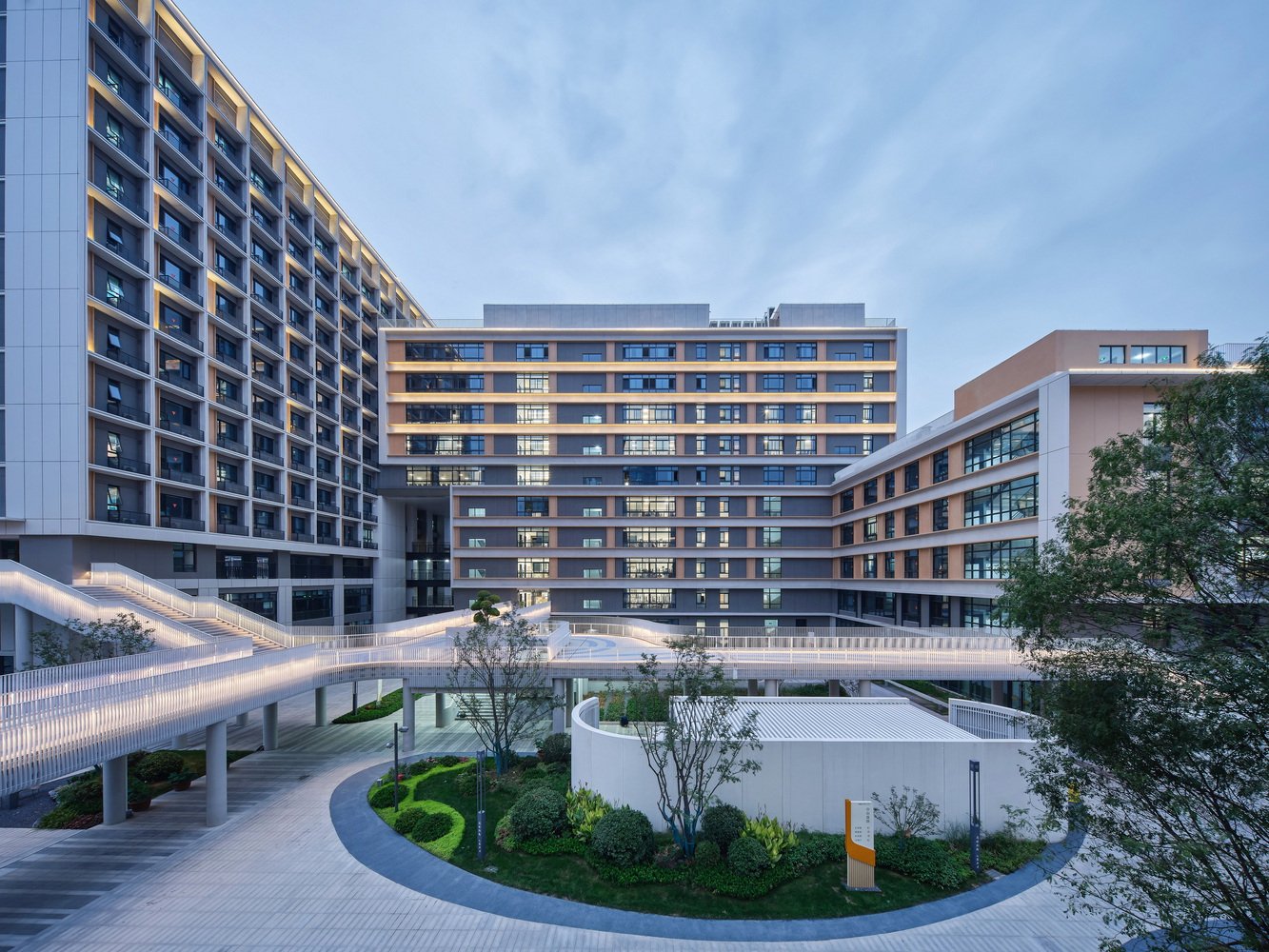
The Xi’an Gaoxin No.1 High School Expansion and Shared Car Park by Qu Peiqing Studio is a useful case study in how to grow a busy city-centre school without moving it. Located in the central area of Xi’an’s Gaoxin (high-tech) District in China, the project rebuilt and extended an operating campus, stacked sports and teaching functions on top of each other, and placed a car park below ground that serves both the school and the surrounding neighbourhood. This design review looks at the main ideas behind the scheme, how the brief was resolved, and what Pakistani school owners, trusts and designers can learn from it.
Xi’an Gaoxin No.1 High School Expansion at a Glance
| Architect | Qu Peiqing Studio of China Southwest Architectural Design Research Institute (lead architects Peiqing Qu, Qi Wang, Xue Bai) |
|---|---|
| Location | Gaoxin District, Xi’an, Shaanxi Province, China; site bounded by Tangyan Road to the east and Keji No.3 Road to the south |
| Project type | Expansion and reconstruction of an operating high school, with a shared public car park |
| Total construction area | About 78,549 m², of which about 49,887 m² is above ground and about 28,663 m² below ground |
| Programme | Teaching building with dormitories, elevated playground over a gymnasium and lecture hall, sunken courtyard, underground parking, extended outdoor corridor |
| Timeline | Design and construction from August 2021 to late August 2023, as described by the project team |
| Landscape | Tongji University Architectural Design Research Institute |
Project Background and Brief
Like many successful schools in fast-growing cities, Gaoxin No.1 High School had outgrown its campus. Before the project, the site held three teaching buildings and one dormitory block. The surrounding urban core had developed rapidly, and the school faced the familiar pressures of limited space, rising enrolment and traffic congestion at drop-off and pick-up times. Changes to China’s national college entrance examination system also affected how teaching space is organised, with more subject choice and smaller, more varied class groupings.
The school could not simply relocate. Its value lay partly in its central location, and the city did not have a spare plot of equal size nearby. The brief therefore asked for more teaching, boarding and sports space on the same footprint, while easing traffic on the adjoining roads and improving the school’s relationship with the neighbourhood.
Collaborative planning
The project team describes a strategy developed jointly by the design team, the school management committee, government departments and the construction units. This matters. A campus expansion that must stay open during works, interfaces with city traffic and includes a public car park cannot be designed by architects alone. Early agreement between all parties on phasing, access and responsibilities is a large part of why such projects succeed.
Design Concept: “Book Mountain and Green Island”
The architects framed the scheme around the idea of “ascending the book mountain and green island”. In practice this means a campus that rises in layers, with teaching spaces, terraces and landscape stepping upwards rather than spreading across the ground. Two construction principles support the concept:
- A shared campus space. Facilities are planned so that parts of the school, especially parking and some open space, can serve the wider community as well as students.
- A three-dimensional approach. Instead of placing buildings, sports fields and parking side by side, functions are stacked vertically to free up ground area.
The result is a compact, layered complex that reads as one coherent piece of city rather than a collection of separate blocks.
Stacking the Programme: How the Campus Was Reorganised
The most instructive part of the project is how the programme was redistributed. The design keeps one existing teaching building and renovates or reconstructs the remaining structures. Around it, the team created a new complex made up of several connected parts.
Comprehensive teaching building with dormitories
Teaching and boarding accommodation are combined in one comprehensive building. For a boarding school on a tight site, this shortens daily movement between classrooms and residences and makes supervision simpler.
Elevated playground over sports and assembly space
The playground is lifted above ground level, with a gymnasium and a lecture hall beneath it. This is the key move: the land that would normally be taken by a running track or sports field now does two jobs. Outdoor sport happens on top, while indoor sport and large gatherings happen below, sheltered from weather.
Sunken courtyard and underground parking
A sunken courtyard brings daylight and air down to lower levels, so below-ground spaces do not feel like a basement. Underneath, the car park serves the school and is shared with the public, which helps relieve kerbside congestion in the district.
Extended outdoor corridor
An extended outdoor corridor links the different parts of the campus. Covered links of this kind give students sheltered routes between buildings and act as informal social space between lessons.
Keep and renovate
One existing teaching building is retained, reducing demolition and keeping part of the school’s identity.
Stack the sports
An elevated playground sits over a gymnasium and lecture hall, doubling the use of the same land.
Go below ground
Roughly a third of the construction area is underground, housing parking and supporting functions.
Share with the city
The car park is planned as a shared facility, easing traffic on surrounding roads.
Urban Integration and Traffic
School traffic is one of the most visible problems a campus causes for its neighbours. Parents’ cars queue along roads at the same times every day, blocking traffic and creating safety risks for children. By adding a shared underground car park, the project moves part of that demand off the street.
The shared model is also a planning argument. A car park used by parents during school runs can serve local residents, shoppers or visitors at other times. This makes a large below-ground investment easier to justify and gives the neighbourhood a direct benefit from the school’s expansion.
The architects also talk about creating “a new cityscape and visual identity”. The layered, terraced form gives the school a recognisable presence on its two street frontages, while landscaped levels soften the mass of what is a large building.
Traditional Campus Expansion vs the Gaoxin Approach
| Issue | Conventional expansion | Gaoxin No.1 approach |
|---|---|---|
| Land use | New blocks added on remaining open ground, often over the playground | Functions stacked; playground raised over gymnasium and hall |
| Parking | Surface parking or none; queues on the road | Underground car park shared with the public |
| Existing buildings | Often fully demolished or left unaltered | One building retained, others renovated or rebuilt |
| Daylight below ground | Basements used only for services | Sunken courtyard brings light and air to lower levels |
| Movement | Open walks between separate blocks | Extended outdoor corridor connects the complex |
| Planning process | Architect and client only | School, government, designers and builders plan together |
Construction and Engineering Considerations
The project team notes that it weighed the city, campus, form, function and cost together to make the scheme coherent. Several technical issues follow from the design choices, and they are worth highlighting for anyone considering a similar approach.
- Long-span structure. A playground over a gymnasium and lecture hall requires long spans carrying heavy loads, including soil, surfacing, drainage and live loads from students. Structure, waterproofing and drainage must be designed together.
- Deep excavation. With close to 28,700 m² below ground, excavation, shoring and dewatering next to operating buildings and public roads need careful sequencing.
- Phasing around an operating school. Keeping classes running while demolishing and building requires safe segregation of construction zones, temporary routes and noise control during exam periods.
- Ventilation and fire safety below ground. Underground car parks and occupied lower floors need mechanical ventilation, smoke control and protected escape routes.
The project credits separate teams for structure, water supply and drainage, electrical and intelligent (low-voltage) systems, which reflects how much engineering coordination a stacked school demands.
Lessons for Pakistan
Many established schools in Lahore, Karachi, Rawalpindi and other Pakistani cities face the same problem as Gaoxin No.1: a good location, rising demand, no spare land and daily traffic jams at the gate. The project offers several ideas that can be adapted to local conditions.
Build up and down before building out
Raising a sports deck over a multipurpose hall, or placing parking and stores in a basement, can unlock space on a constrained urban plot. Any such scheme must work within the local development authority’s bylaws on height, setbacks, basement extent and parking, so early checks with bodies such as the Lahore Development Authority are essential.
Treat school traffic as a design problem
On-site drop-off lanes, basement parking and staggered gates can take queues off busy roads. Even where a full public car park is not possible, internal circulation space for school vans and parents’ cars makes a real difference to neighbours and to child safety.
Design for heat, not only for space
Xi’an has cold winters, while most of Pakistan has long, hot summers. A raised playground in Pakistan needs shade, heat-reflective or planted surfaces and good roof insulation over the hall below. Sunken courtyards can work well here, but they must be drained properly for monsoon rain.
Engineer for earthquakes and fire
Schools in Pakistan should be designed to the Building Code of Pakistan seismic provisions, with particular care for long-span roofs and heavy decks. Basements and assembly halls need fire separation, smoke ventilation and clear escape routes, following recognised life-safety principles such as those published by NFPA.
Phase the works around the school year
Expanding an operating campus is best planned around vacations and exam periods, with safe segregation of construction zones. A contractor with education experience will plan this from the outset. ACCO’s school and college construction services cover planning, design and phased construction, and examples of educational and public work are shown on our institutional projects page.
How a Stacked School Project Comes Together
Audit the campus
Survey existing buildings, decide what to retain, and record enrolment, traffic and space needs.
Agree the brief
School management, authorities and designers agree goals, phasing and any shared public facilities.
Coordinate design
Architecture, long-span structure, basement works and MEP are resolved together, with an itemised BOQ.
Build in phases
Construction is sequenced around the academic calendar to keep classes running safely.
For budgeting, ACCO prices every project through an itemised BOQ rather than a flat rate, because basements, long spans and phasing all change the cost significantly. Our full range of design and construction services explains how projects are delivered. You may also find our review of the Learning Center Campus Los Niches by Carreño Sartori Arquitectos useful as a contrasting, low-rise approach to educational design.
Frequently Asked Questions
Who designed the Xi’an Gaoxin No.1 High School Expansion?
The project was designed by Qu Peiqing Studio of China Southwest Architectural Design Research Institute, with lead architects Peiqing Qu, Qi Wang and Xue Bai. Landscape design was by Tongji University Architectural Design Research Institute.
How large is the project?
The total construction area is about 78,549 m², with about 49,887 m² above ground and about 28,663 m² below ground.
What is the shared car park?
It is an underground car park built as part of the expansion and planned to serve both the school and the public, helping to reduce traffic congestion around the campus.
Why is the playground elevated?
Raising the playground allows a gymnasium and a lecture hall to sit beneath it, so the same area of land provides both outdoor sport and indoor sports and assembly space.
Can a similar approach work for schools in Pakistan?
Yes, in principle. Stacked sports decks, basement parking and on-site drop-off can work on constrained urban plots, provided the design meets local bylaws, seismic code requirements and fire safety rules, and is adapted for hot summers and monsoon rain.
Does ACCO build schools and colleges?
Yes. ACCO provides design and construction for schools, colleges and other institutional buildings, with each project priced through an itemised BOQ.
Conclusion
The Xi’an Gaoxin No.1 High School Expansion and Shared Car Park shows that a constrained urban campus can grow without relocating, if functions are stacked, land is used twice and the school is planned as part of the city. Retaining an existing building, lifting the playground over a gymnasium and hall, and sharing an underground car park with the public are simple ideas executed at scale. For Pakistani schools facing similar pressures, the lessons are clear: plan collaboratively, build vertically, treat traffic as a design issue, and engineer carefully for local climate, earthquakes and fire safety.
Related articles
ACCO services
Contact ACCO
- +92 322 8000190
- info@acco.com.pk
- Office 2, 3rd Floor, Bigcity Plaza, Gulberg-III, Lahore
Planning a Project with ACCO?
Architecture, engineering and construction from one Lahore team since 1998. Design drawings are free when ACCO is awarded the construction.
Discuss Your ProjectWhatsApp +92 322 8000190
Grey Structure Construction Cost in Pakistan 2027: What You’ll Actually Pay