
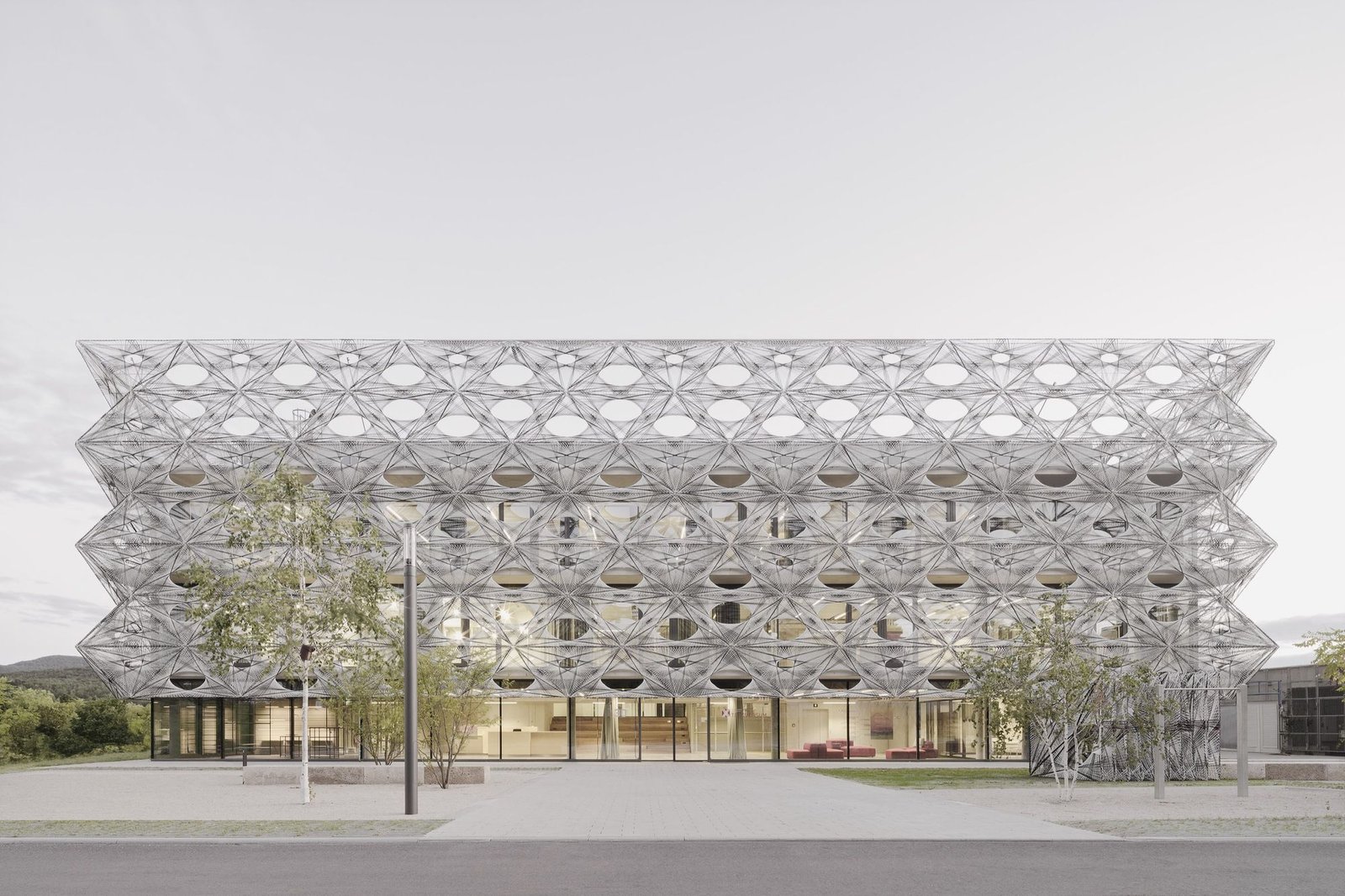
Texoversum Innovation Center by allmannwappner: Design Review
By Tanveer Ahmed, CEO, Ahmed Construction Company (ACCO) · Updated · Reviewed by ACCO architects and engineers
Quick Answer
Texoversum Innovation Center by allmannwappner at Reutlingen University: robotically wound fibre facade, split-level interior and lessons for Pakistan. Ahmed Construction Company (ACCO), based in Gulberg-III Lahore since 1998, provides ACCO design & construction services with design drawings free on award of construction.
The Texoversum Innovation Center by allmannwappner is a teaching, research and innovation building for textile technology at Reutlingen University of Applied Sciences in Germany. It is best known for its facade: a skin of woven carbon-fibre and glass-fibre tiles made by a robotic winding process, described as the first building facade of its kind. Behind this textile skin is an open, split-level interior designed to bring students, researchers and industry together. This review explains how the building works, why its facade matters, and what it suggests for textile-led cities and innovation buildings in Pakistan, particularly Faisalabad and Lahore.
Texoversum Innovation Center at a Glance
| Architect | allmannwappner |
|---|---|
| Client and location | Reutlingen University of Applied Sciences, Reutlingen, Germany |
| Use | Teaching, research and innovation centre for cross-disciplinary textile technologies |
| Facade | Self-supporting tiles of carbon and glass fibre made by robotic winding, based on five templates |
| Interior | Open split-level floors around an atrium, leading to a rooftop terrace |
| Character | Industrial: exposed concrete and technical ceilings, with a colour gradient inside |
| Photography | Brigida González |
A Building About Textiles, Made from Textiles
The Texoversum was planned as a key part of Reutlingen University’s campus expansion. Its subject is textile technology in the widest sense: not only clothing, but technical textiles used in cars, aircraft, medicine, construction and filtration. The architects took this literally. The building “weaves” together different disciplines and activities inside, and its outer skin is itself a woven fibre structure.
This gives the building a clear purpose beyond appearance. The facade is a working demonstration of what fibre-based materials and textile techniques can achieve in architecture, visible to every student, visitor and industrial partner who arrives.
The Robotically Wound Fibre Facade
The facade tiles are made from carbon fibre and glass fibre, wound by a robot around a frame to form a lightweight, open lattice. Each tile is custom made, yet the whole system is based on just five templates. Tiles are positioned according to the path of the sun, so the facade varies in density and creates a multi-layered appearance.
What the tiles do
- Self-support. The tiles are self-supporting and do not need a separate load-bearing frame behind them.
- Sun protection. Their staggered arrangement shades the glazing according to orientation.
- Fall protection. In places the tiles act as a safety barrier.
- Views. Gaps between tiles keep views out of the building and offer passers-by “postcard” glimpses of the activity inside.
- Symbolism. The facade communicates the building’s purpose at a glance.
Why robotic winding matters
Coreless or minimal-core filament winding allows fibres to be placed only where they are needed structurally. This produces very light components with high strength, and robots can repeat or vary the pattern precisely. Research groups in Germany have been developing this approach for architecture for several years, and the Texoversum brings it from pavilion experiments to a permanent university building.
The Split-Level Interior
Inside, the building follows the same principles of transparency and connection. Floors are staggered at half-level intervals around a central atrium, so each level can see the ones above and below. This creates a spatial continuum that climbs through the building and ends at a large rooftop terrace.
Atrium
The heart of the building, linking split levels visually and encouraging chance meetings.
Open workspaces
Open-plan areas let different user groups share knowledge and equipment.
Rooftop terrace
A shared outdoor space at the top of the route through the building.
The interior has an industrial character, with unfinished concrete and exposed technical ceilings. A continuous colour gradient runs through the levels, referring to colour-printed textiles and to historic Gobelin tapestries. Colour also helps people find their way and makes the neutral, flexible structure feel lively.
Innovation Buildings: Why Openness Matters
Innovation centres aim to bring together people who would not usually meet: students and professors, researchers from different fields, and companies looking for new ideas. Closed corridors and cellular offices work against this. Atriums, split levels, shared labs and visible workshops make activity public, which encourages conversation and collaboration. The Texoversum applies this thinking clearly, and the transparent facade extends it to the street.
Conventional Facade vs Texoversum Fibre Facade
| Aspect | Conventional facade with sunshades | Texoversum fibre facade |
|---|---|---|
| Material | Aluminium, steel, glass or concrete | Carbon and glass fibre composite tiles |
| Support | Separate frame and brackets | Self-supporting tiles |
| Weight | Moderate to heavy | Very light |
| Variation | Usually repetitive | Five templates arranged to follow the sun |
| Manufacturing | Standard extrusion or casting | Robotic filament winding |
| Message | Neutral | Shows the building’s textile research purpose |
Role in the Campus Expansion
The Texoversum is more than a standalone landmark. As part of Reutlingen University’s campus expansion plan, it gives the textile faculty a visible front door and a shared place where teaching, applied research and partnerships with companies can happen under one roof. University buildings of this kind often host start-ups, industry workshops and exhibitions as well as classes, so flexibility is essential.
The open floor plates support that flexibility. Exposed technical ceilings make it easier to add or move services such as power, data, compressed air or extraction as research needs change, without opening up finished ceilings. Unfinished concrete surfaces are hard-wearing and suited to workshops where machines and prototypes are moved around. The neutral structure, brightened by the colour gradient, can adapt to new programmes over the life of the building.
Planning points for innovation buildings
- Provide a mix of open workspace, enclosed labs and quiet rooms
- Make workshops and prototypes visible from public areas to spark interest
- Allow services to be extended easily through exposed or accessible routes
- Design floor loads and ceiling heights for heavier equipment than a standard office
- Include outdoor spaces, such as terraces, for informal meetings and events
These points apply equally to research parks, incubators and technical training institutes, and they are worth considering at the feasibility stage, before the structural grid and floor heights are fixed.
Questions the Facade Raises
Innovative materials come with questions that owners and engineers must answer. Composite tiles must be tested for fire behaviour, UV resistance, weathering and long-term strength. Replacement tiles must be available if one is damaged, and cleaning methods must suit an open lattice. Recycling carbon-fibre composites at the end of their life is still more difficult than recycling steel or aluminium. These points do not reduce the value of the project, but they show why such facades are still rare and why research buildings are a sensible place to test them.
Lessons for Pakistan
Pakistan’s textile industry is one of the country’s largest exporters, centred on Faisalabad, Lahore, Karachi and Sialkot. Universities such as the National Textile University in Faisalabad already train engineers for this sector. The Texoversum offers ideas for how textile education and innovation buildings here could be designed.
Show the industry
Facades, screens and interiors can use local textiles, jute, cotton composites or woven metal mesh to express the building’s purpose.
Shade with screens
Pakistan’s sun calls for deep shading. Screens and jaali-like facades placed by orientation reduce cooling loads.
Open the interior
Atriums and split levels encourage collaboration between students, researchers and industry.
Test new materials
Any new facade material should be tested for fire, heat, UV and dust before use.
Atriums in Pakistan need careful smoke-control and fire design, guided by the Building Code of Pakistan and international references such as NFPA. Ventilation for labs and workshops should follow recognised guidance, such as that published by ASHRAE.
ACCO supports institutional and commercial clients with architectural design, curtain wall and facade interiors and school and institutional interiors. For a wider view, see all ACCO services.
There is also an opportunity to link universities and industry more directly. A textile innovation building in Faisalabad, for example, could combine teaching labs, a materials library, testing facilities and space for mills to run trials of new fabrics. Designing such a building around shared, visible spaces, rather than separate departments behind closed doors, would follow the same logic that makes the Texoversum effective, while using materials and shading suited to Punjab’s hot climate.
Frequently Asked Questions
What is the Texoversum Innovation Center?
It is a teaching, research and innovation building for textile technologies at Reutlingen University of Applied Sciences in Germany, designed by allmannwappner.
What is the Texoversum facade made of?
It is made of self-supporting tiles of carbon fibre and glass fibre, produced by robotic winding and based on five templates.
Is the fibre facade structural?
The tiles are self-supporting and do not need a separate load-bearing frame, but the building itself has its own main structure.
Why are the floors split-level?
Staggering the floors at half levels around an atrium connects spaces visually, encourages collaboration and creates a continuous route up to the rooftop terrace.
What does the colour gradient inside refer to?
It refers to colour-printed textiles and historic Gobelin tapestries, and helps highlight the connections between levels.
Could a similar facade be used in Pakistan?
Composite or textile facades are possible but must be tested for heat, UV, dust and fire. Local screens in brick, metal mesh or terracotta can achieve similar shading at lower risk.
Conclusion
The Texoversum Innovation Center turns its subject into its architecture. Its robotically wound fibre facade demonstrates new material possibilities, while its open, split-level interior supports the collaboration that innovation depends on. For Pakistan, with its large textile economy, the project is a reminder that education and research buildings can express local industry, shade intelligently and bring people together.
Related articles
ACCO services
Contact ACCO
- +92 322 8000190
- info@acco.com.pk
- Office 2, 3rd Floor, Bigcity Plaza, Gulberg-III, Lahore
Planning a Project with ACCO?
Architecture, engineering and construction from one Lahore team since 1998. Design drawings are free when ACCO is awarded the construction.
Discuss Your ProjectWhatsApp +92 322 8000190