Kunshuis House and Gallery by Strukt Architects: Architecture Review
By Tanveer Ahmed, CEO, Ahmed Construction Company (ACCO) · Updated · Reviewed by ACCO architects and engineers
Quick Answer
Kunshuis House and Gallery by Strukt Architects: a South African home that doubles as an art gallery, its planning, materials and lessons for Pakistan. Ahmed Construction Company (ACCO), based in Gulberg-III Lahore since 1998, provides house construction in Lahore with design drawings free on award of construction.
Most houses are designed around family life first and then decorated with art. Kunshuis House and Gallery, by Strukt Architects, reverses that order. Built for a couple of passionate collectors of South African art in the small town of Riebeek Kasteel, it is both a private home and a gallery that can occasionally open to the public. This review of Kunshuis House and Gallery looks at how the architects balanced those two roles on a tightly regulated plot, how the design draws on local building traditions, and what Pakistani homeowners and architects can take from it.
Kunshuis House and Gallery at a Glance
| Architects | Strukt Architects; lead architects Niel Basson and Ashleigh Basson |
|---|---|
| Location | Riebeek Kasteel, Western Cape, South Africa |
| Completed | 2022 (as published by the architects) |
| Built area | About 446 m² |
| Site | About 852 m², with 50% maximum coverage and a 6 m height limit |
| Use | Private residence combined with an art gallery open to the public at times |
| Key features | Two intersecting sets of planes, carved-out courtyards, sunken bedroom, sliding security screens, north-facing stoep |
The Brief: A Home That Is Also a Gallery
The clients wanted to live with their collection and to share it. Riebeek Kasteel has an active art community, and the plot’s position on the main road made occasional public access possible. That created a set of competing demands:
- Wall space for hanging art, which argues for solid walls
- Views and daylight for a pleasant home, which argues for openings
- Protection of artworks from direct sunlight and ultraviolet damage
- Security for both the residents and a valuable collection
- Privacy for family life when visitors are present
Much of the design can be read as a series of negotiations between these needs, rather than a single gesture.
Working Within Strict Planning Limits
The site rules were tight. With coverage limited to half the plot and height capped at 6 metres, the building footprint could not exceed roughly 426 m² on a site of about 852 m². The architects approached this by imagining a solid mass filling the permitted envelope and then carving spaces out of it.
Carving rather than adding
Carving out courtyards and openings from a solid volume allowed the team to reach the required coverage while controlling exactly where light and views enter. Instead of a detached house surrounded by leftover garden, the result is a compact, inward-looking plan with outdoor rooms built into it.
Going below ground
The height limit meant that the accommodation could not simply go up. To fit a second bedroom, part of the house was set into the ground. Sinking rooms also helps keep them cool in summer, a benefit that applies strongly in hot climates.
Planning Geometry: Two Sets of Planes
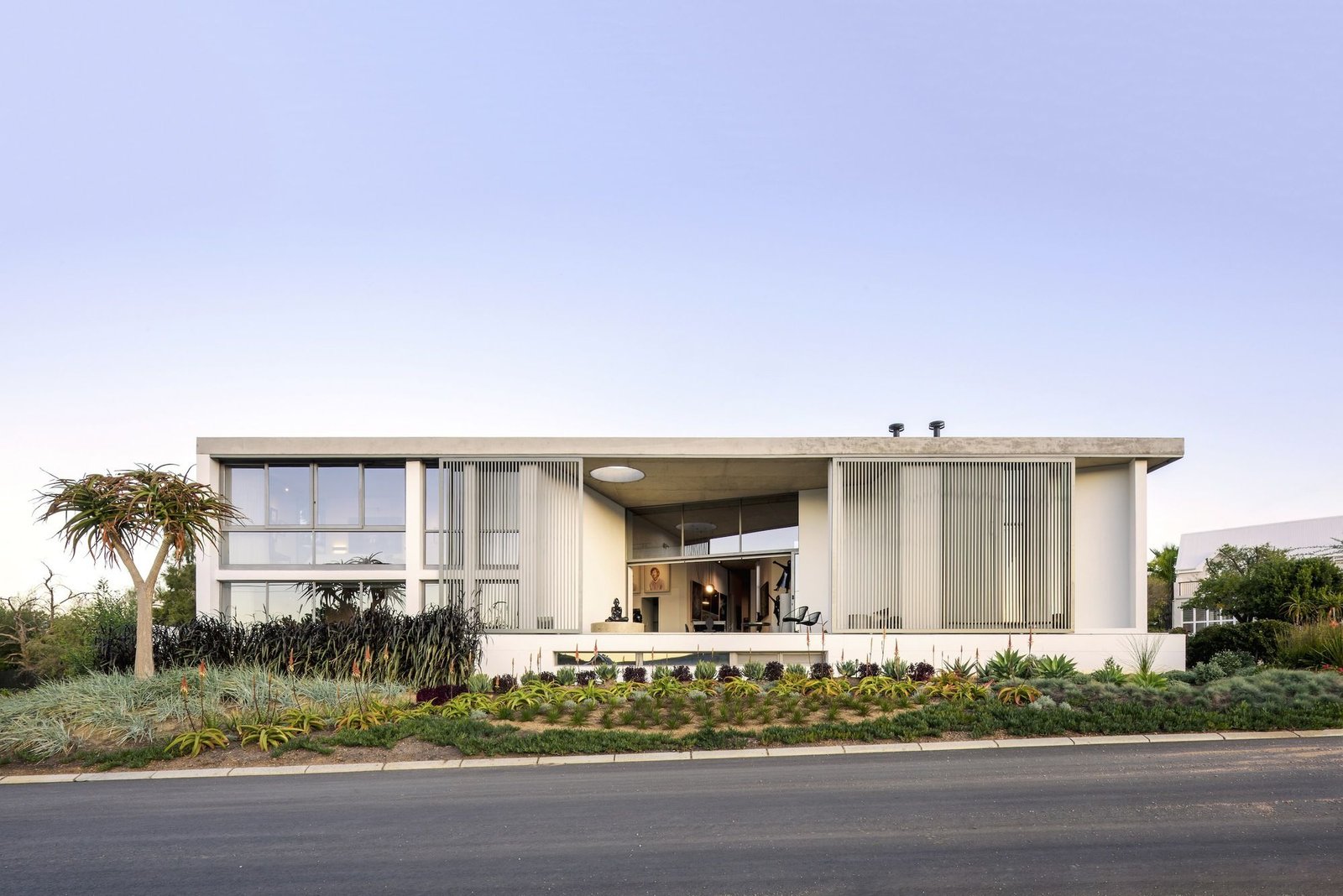
The plan is organised by two sets of walls. One set is aligned to true north, which allows the architects to control sunlight precisely and to frame views of the Kasteelberg mountain. The other follows the site boundaries and forms a clear edge to the street. Where the two systems meet, they create angled spaces and varied wall surfaces, which suit the display of art and give each room a distinct character.
North-aligned walls
Orient rooms to the sun and to mountain views, and help manage daylight on artworks.
Boundary-aligned walls
Define the street edge and make full use of the regulated footprint.
Carved courtyards
Bring light and air into the centre of the plan while keeping privacy.
Security Without Fortress Walls
High boundary walls are common in South Africa for security, but they can make a home feel closed and grim. At Kunshuis, the architects combined high perimeter walls with sliding screens. When closed, the screens secure the house and shade living spaces from direct sun; when open, they connect the interior to courtyards and views. Security becomes part of the architecture rather than an afterthought added to the boundary.
Materials and Local Vernacular
The building takes cues from local architecture in its scale and finishes. Its elevations are divided into three parts:
- Base: smooth plaster
- Middle: a textured Tyrolean render, a finish familiar in the region
- Top: an exposed concrete roof
A north-facing stoep, the traditional South African porch, faces the street and holds a sculpture by local artist Anton Momberg on a low plinth. Landscaping with mounds and indigenous plants softens the scale of the building and ties it to the surrounding landscape.
Daylight, Heat and Living Comfort
The Western Cape has hot, dry summers and cool, wet winters. A house that is also a gallery must stay comfortable for people and stable for artworks through both seasons, and the design addresses this mainly through form rather than machinery.
Controlling the sun
In the southern hemisphere the sun tracks across the northern sky, so north-facing openings receive the most light. By aligning one set of walls to true north, the architects could predict where sunlight would fall at different times of year. Openings can then bring winter sun into living spaces while keeping direct light off the walls where art hangs.
Thermal mass and shade
Solid plastered walls and a concrete roof store heat and release it slowly, smoothing out daily temperature swings. The sliding screens add a layer of shade in summer, and the courtyards allow cross-ventilation. The partly sunken bedroom benefits from the stable temperature of the surrounding ground.
Living around the collection
Because the house is occasionally open to visitors, the plan separates public gallery areas from private rooms. Visitors can experience the art without passing through bedrooms or service areas, while the owners can still enjoy the collection as part of daily life when the house is closed.
Gallery House vs Conventional House
| Aspect | Conventional house | Kunshuis House and Gallery |
|---|---|---|
| Priority | Rooms and family functions | Display of art balanced with home life |
| Walls | Many windows, little hanging space | Long solid walls with controlled openings |
| Daylight | As much as possible | Directed and filtered to protect artworks |
| Security | Boundary wall and grilles | Integrated sliding screens |
| Public access | None | Occasional, from the main road |
Designing Spaces for Art at Home
For readers thinking of displaying a collection at home, Kunshuis illustrates several principles that apply anywhere:
- Plan long, uninterrupted walls in living areas and corridors
- Use indirect daylight from high windows or courtyards rather than direct sun on artworks
- Install adjustable track or picture lighting so displays can change
- Keep wall finishes neutral and robust so works can be rehung without damage
- Consider temperature and humidity, which affect paintings, paper and textiles
Lessons for Pakistan
Pakistani house plots are often small and heavily regulated, with setbacks, coverage and height limits set by authorities such as the Lahore Development Authority and DHA Lahore. Kunshuis shows how tight rules can produce a better design rather than a compromised one.
Courtyards
Carved courtyards echo the traditional haveli and bring light into deep plans on narrow plots.
Orientation
Aligning rooms to the sun reduces heat gain, especially important in Punjab’s summers.
Integrated security
Screens and jaali can provide security and shade without heavy grilles.
Local finishes
Plaster, brick and textured renders suit the climate and age well.
Basements, like the sunken bedroom at Kunshuis, can add space within height limits, but in Pakistan they need proper structural design to the Building Code of Pakistan and careful waterproofing. For owners planning a new home, ACCO’s house construction service in Lahore covers design and building, and our luxury home construction and interior design studio pages explain how custom homes and interiors are delivered.
Frequently Asked Questions
Who designed Kunshuis House and Gallery?
Strukt Architects, with Niel Basson and Ashleigh Basson as lead architects.
Where is Kunshuis located?
In Riebeek Kasteel, a small town in the Western Cape of South Africa known for its art community.
Why does the house have a sunken bedroom?
A 6 m height limit prevented adding another storey, so part of the house was set into the ground to fit a second bedroom.
How does the design protect the art?
By providing long solid walls, directing daylight through controlled openings and courtyards, and shading living spaces with sliding screens.
What is a stoep?
A stoep is a raised porch or veranda common in South African vernacular houses. At Kunshuis it faces north towards the street and displays a sculpture.
Can a similar design work in Pakistan?
Its principles can: courtyards, orientation to the sun, integrated security and local materials all suit Pakistani plots and climate, subject to local bylaws and structural design.
Conclusion
Kunshuis House and Gallery is a thoughtful answer to an unusual brief. By carving spaces from a regulated volume, organising the plan around the sun and the street, and drawing on local materials and traditions, Strukt Architects created a home that serves both daily life and a serious art collection. For Pakistani homeowners working within tight plot rules, it is a useful reminder that limits can sharpen a design rather than restrict it.
Related articles
Contact ACCO
- +92 322 8000190
- info@acco.com.pk
- Office 2, 3rd Floor, Bigcity Plaza, Gulberg-III, Lahore
Planning a Project with ACCO?
Architecture, engineering and construction from one Lahore team since 1998. Design drawings are free when ACCO is awarded the construction.
Discuss Your ProjectWhatsApp +92 322 8000190

Grey Structure Construction Cost in Pakistan 2027: What You’ll Actually Pay