
How to Choose the Best Hospital Construction Company in Pakistan
By Tanveer Ahmed, CEO, Ahmed Construction Company (ACCO) · Updated · Reviewed by ACCO architects and engineers
Quick Answer
How to choose a hospital construction company in Pakistan: experience to check, questions to ask, BOQ and contract tips, red flags and a comparison table. Ahmed Construction Company (ACCO), based in Gulberg-III Lahore since 1998, provides hospital design & construction services with design drawings free on award of construction.
Choosing a hospital construction company in Pakistan is one of the biggest decisions a hospital owner, doctor or investor will make. The contractor you appoint will shape the safety, cost, opening date and running cost of the facility for decades. Unlike a house or office, a hospital depends on specialist systems such as clean-air theatres, medical gases, essential power and infection-control finishes, and a contractor without healthcare experience can get these badly wrong. This guide explains what to look for, what to ask, how to compare offers fairly and which warning signs to avoid.
Choosing a Hospital Construction Company at a Glance
| Most important factor | Proven healthcare experience, including theatres, ICUs and medical gas systems |
|---|---|
| Registration to check | Contractor licence with the Pakistan Engineering Council in a category suited to the project size; PEC-registered engineers on the team |
| Standards to expect | Building Code of Pakistan, provincial healthcare commission requirements, ASHRAE 170, NFPA 99 and 101, HTM 02-01 |
| Pricing to insist on | An itemised BOQ with specifications, not a lump-sum rate per square foot alone |
| Delivery options | Design-bid-build, design-build or turnkey hospital construction |
Why the Choice of Contractor Matters More for Hospitals
In most buildings, a contractor’s mistake leads to a repair bill. In a hospital, it can lead to an infection outbreak, a failed licensing inspection or a power failure in an ICU. Common problems on hospitals built by inexperienced contractors include theatres that cannot hold the right air pressure, medical gas pipes that are not tested or labelled, ceilings too low for ducts, corridors too narrow for beds and finishes that cannot be cleaned properly. Many of these issues are expensive or impossible to fix once the hospital is open.
1. Check Real Healthcare Experience
Ask for a list of completed healthcare projects with the scope the company delivered on each. Then verify it.
- Visit at least one completed hospital and, if possible, speak to its owner or facility manager
- Ask specifically about theatres, ICUs, labour suites, isolation rooms and imaging rooms
- Check whether the company did the MEP work itself or only the civil works
- Ask who will lead your project and what hospitals that person has worked on
A company that has built many houses and plazas may be a good builder, but hospitals require a different skill set.
2. Confirm Registration and Team
Check the company’s contractor licence with the Pakistan Engineering Council and that its category matches the value of your project. The structural, electrical and mechanical engineers who sign drawings should be PEC-registered. Ask for the organisation chart for your project: project manager, site engineers, MEP engineers, quality control and safety staff.
3. Look for In-House Design and MEP Capability
Hospitals succeed when architecture, structure and building services are designed together. A company that can coordinate all three, or that works with experienced healthcare consultants, reduces clashes between ducts, beams and pipes. Ask whether the company uses BIM or similar coordination, and ask to see coordinated drawings from a previous project.
HVAC
Can they design and install dedicated air handling for theatres with HEPA filtration and pressure control?
Medical gases
Do they install and test oxygen, vacuum and medical air pipelines to a recognised standard?
Electrical
Can they deliver essential circuits, generator changeover, UPS and isolated power for critical areas?
4. Understand How They Price the Work
The safest basis for a hospital contract is an itemised Bill of Quantities (BOQ) linked to drawings and specifications. It shows exactly what is included, the quantity of each item, the specified material and the rate. This lets you compare offers on a like-for-like basis and control variations later.
Be careful with quotes given only as a rate per square foot. They often exclude MEP, medical gases, specialist finishes or external works, and the gap appears later as extra claims. ACCO prices every hospital through an itemised BOQ; see the hospital BOQ and cost estimation guide and the hospital construction cost guide.
5. Compare Delivery Models
| Model | How it works | Best for | Owner’s risk |
|---|---|---|---|
| Design-bid-build | Consultant designs; contractors bid on full drawings | Owners with time and an experienced consultant | Coordination gaps between designer and builder |
| Design-build | One company designs and builds to the owner’s brief | Faster projects with a clear brief | Owner must review design quality carefully |
| Turnkey | One company delivers design, approvals support, construction, MEP and commissioning, ready to operate | Doctors and investors who want a single point of responsibility | Lower, if scope and BOQ are clearly defined |
| Labour-only | Owner buys materials; contractor supplies labour | Rarely suitable for hospitals | High: quality and coordination fall on the owner |
6. Ask These Questions Before You Sign
- Which hospital projects have you completed, and can we visit one?
- Who will be the project manager and site engineer for our hospital?
- Will you deliver MEP and medical gases yourselves or through subcontractors?
- Which standards will the theatres, ICU and gas systems be designed and tested to?
- Is your BOQ itemised, and what exactly is excluded?
- How will variations be priced and approved?
- What is the schedule, and how will progress be reported?
- What testing and commissioning will be done before handover?
- What defects liability period and warranties do you offer?
7. Check the Contract Terms
A clear contract protects both sides. It should include the scope, drawings and specifications, the BOQ, the programme, payment terms linked to verified progress, a retention amount held until defects are cleared, a defects liability period and a process for variations. For larger projects, standard forms such as those published by PEC can be used as a base.
8. Assess Their Quality Control and Testing
Ask each shortlisted company to explain, in writing, how it controls quality on site. A credible answer will include a quality plan, inspection and test plans for each trade, and named staff responsible for checking work before it is covered up.
Structural quality
Concrete cube testing, checks of reinforcement before every pour, and records of curing should be routine. These matter more in hospitals because the building is an essential facility.
Systems testing
Before handover, a hospital should go through full testing and commissioning: pressure and purity tests on medical gas lines, air change and pressure measurements in theatres and isolation rooms, generator and UPS load tests, fire alarm tests and water quality checks. Ask to see test certificates from a previous hospital project.
9. Consider Support After Handover
A hospital is never finished in the usual sense. Staff need training on the building systems, maintenance teams need as-built drawings and operating manuals, and defects that appear in the first year must be fixed quickly without disrupting patients. Ask what the company provides after handover: as-built drawings, operation and maintenance manuals, training sessions for engineering staff, a defects response time and, if needed, an annual maintenance contract for HVAC, generators and medical gas systems.
Red Flags to Watch For
- A very low price with no detailed BOQ
- No completed hospital you can visit
- Large advance payments not linked to work done
- Reluctance to name the project team
- Vague answers about ventilation, medical gases or testing
- No written schedule or quality plan
How the Selection Process Should Run
Prepare the brief
Fix services, beds and equipment, ideally with a feasibility study.
Shortlist
Select three to five firms with verified healthcare experience.
Compare offers
Request itemised BOQs on the same scope and compare line by line.
Contract and mobilise
Agree terms, schedule, reporting and testing requirements.
Frequently Asked Questions
What should I look for in a hospital construction company?
Look for completed hospital projects you can visit, PEC registration, in-house or experienced MEP capability, an itemised BOQ, a named project team and a clear testing and commissioning plan.
Is the lowest quote the best option?
Not usually. Low quotes often exclude MEP, medical gases or specialist finishes. Compare itemised BOQs on the same scope to see the real difference.
Should I choose turnkey or separate design and construction?
Turnkey gives one point of responsibility and suits owners who cannot manage several firms. Separate design and construction can work well with an experienced healthcare consultant overseeing the contractor.
How do I check a contractor’s PEC registration?
The Pakistan Engineering Council maintains records of registered constructors and engineers, which can be checked through its website or offices.
What warranties should a hospital contractor give?
Expect a defects liability period written into the contract, retention money held until defects are cleared, and manufacturer warranties for major equipment such as chillers, generators and medical gas plant.
Why choose ACCO for hospital construction?
ACCO, based in Gulberg-III, Lahore and working since 1998, provides hospital design, MEP, construction and commissioning as a turnkey service, priced through an itemised BOQ. See hospital construction services.
Conclusion
The best hospital construction company in Pakistan for your project is one that can prove its healthcare experience, explain how it will deliver clean air, medical gases and reliable power, price the work transparently through an itemised BOQ and stand behind its work after handover. Take time to verify these points, and the hospital you open will be safer, licensed faster and cheaper to run. To see how ACCO approaches hospital projects, visit the ACCO services page.
Related articles
Contact ACCO
- +92 322 8000190
- info@acco.com.pk
- Office 2, 3rd Floor, Bigcity Plaza, Gulberg-III, Lahore
Planning a Project with ACCO?
Architecture, engineering and construction from one Lahore team since 1998. Design drawings are free when ACCO is awarded the construction.
Discuss Your ProjectWhatsApp +92 322 8000190
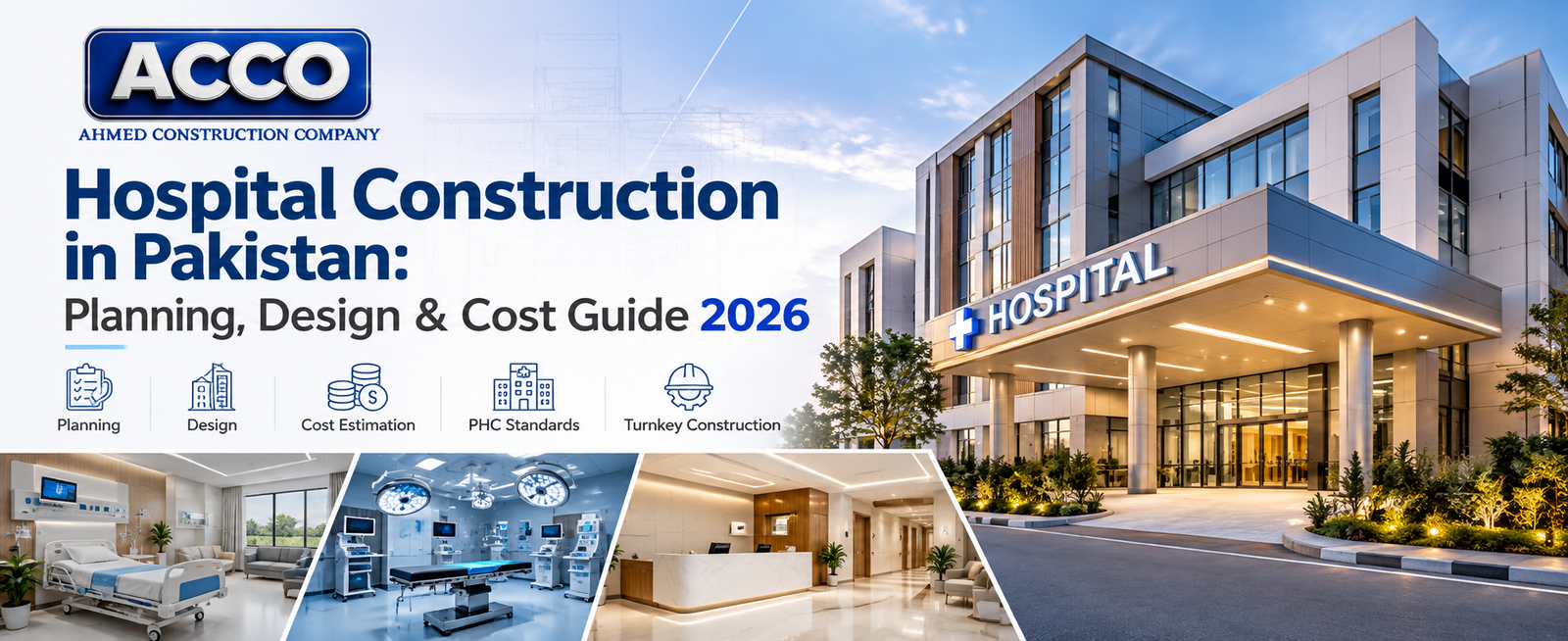
Hospital Construction in Pakistan: 2026-27 Planning & Cost Guide