Floresta House by DB Estudio de Arquitectura: Architecture Review
By Tanveer Ahmed, CEO, Ahmed Construction Company (ACCO) · Updated · Reviewed by ACCO architects and engineers
Quick Answer
Floresta House by DB Estudio de Arquitectura: a review of its tree-led plan, double-height entry, pergolas and materials, with lessons for Pakistan. Ahmed Construction Company (ACCO), based in Gulberg-III Lahore since 1998, provides house construction in Lahore with design drawings free on award of construction.
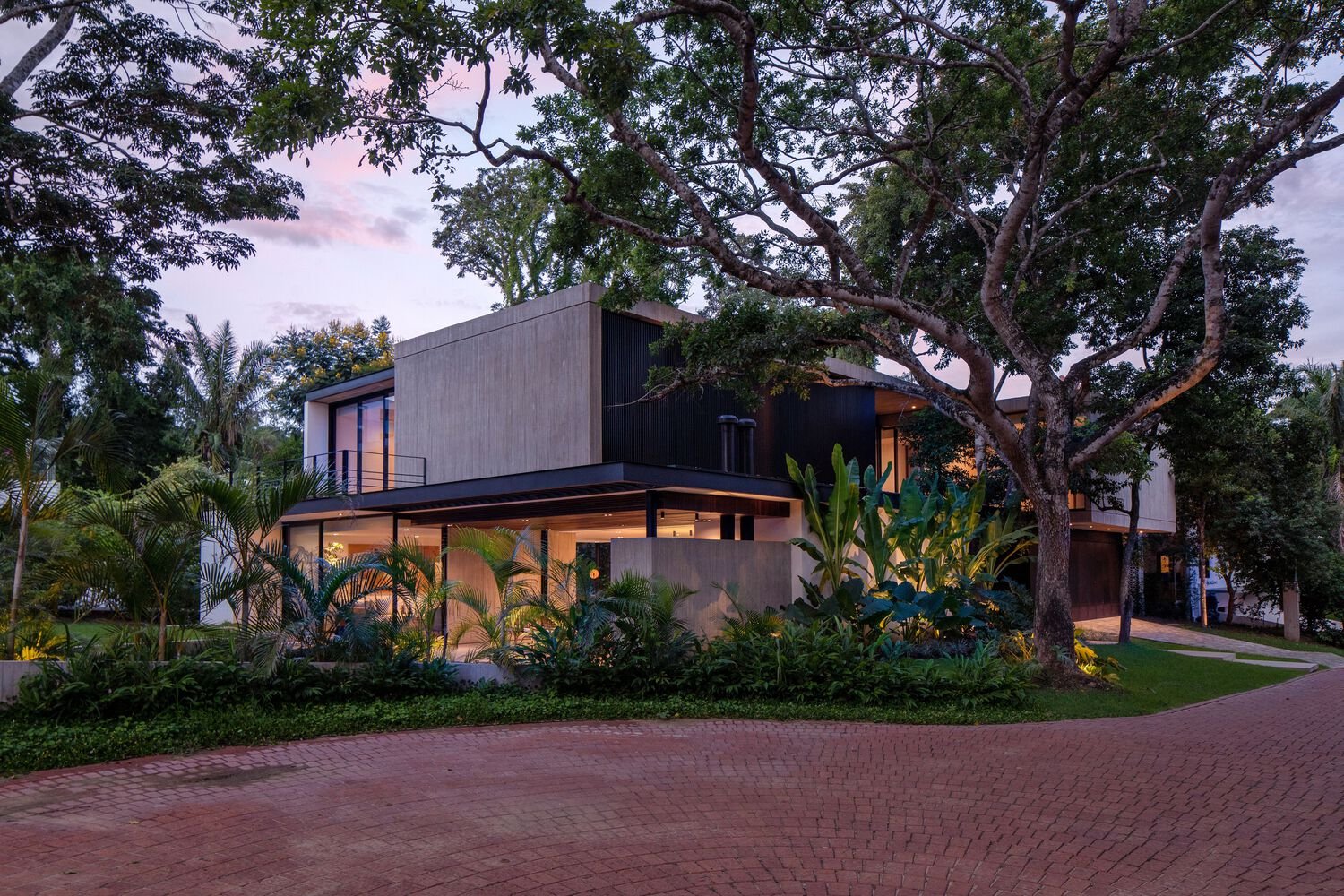
Many houses are designed first and landscaped afterwards. The Floresta House by DB Estudio de Arquitectura does the opposite. Built in 2022 in Santa Cruz de la Sierra, Bolivia, this two-storey family home was planned around the large trees already on its plot, with rooms placed according to their size and position. The result is a house that seems to float among the vegetation. This review explains its planning, materials and climate response, and what Pakistani homeowners and architects can take from it for houses in Lahore, Islamabad and other cities.
Floresta House at a Glance
| Architects | DB Estudio de Arquitectura (lead architects include Daniela Bejarano, Dayane Vega, Carlos Rojas, Rodrigo Farel Salazar and Emirzon Paraba Majon) |
|---|---|
| Location | Santa Cruz de la Sierra, Bolivia |
| Year | 2022 |
| Area | About 610 m² |
| Type | Two-storey single-family house with pool |
| Materials | Concrete, steel frames, timber, fabric and textured glass outside; timber ceilings inside |
| Structural engineer | Zelmar Ybáñez |
| Photography | Paul Renaud |
The Brief: Architecture and Landscape Together
The aim of the project was to integrate architecture and landscape in a residential setting with abundant vegetation. Rather than clearing the site, the architects treated the existing trees as fixed elements of the design. Their size and location determined where rooms could go, how big they could be and which way they would face.
This approach changes the order of design decisions. Instead of starting with a room list and fitting it onto a cleared plot, the designers started with the trees, then found spaces between and around them. The house therefore feels specific to its site rather than a standard plan placed on any piece of land.
Massing: Concrete Volumes Above the Planting
The main concrete volumes are designed to appear to float above the planting, emphasising a connection to nature rather than a heavy presence on the ground. Metal pergolas extend from the building and blend with the tree canopy, creating shaded outdoor rooms and softening the transition between built and natural elements.
Front and rear
The house has two clearly different faces. The street front is designed for privacy, with limited openings. The rear opens fully onto the garden, pool and trees to make the most of the views. This public-private split is familiar to Pakistani homeowners, who often want a closed street elevation and an open, private family side.
The Double-Height Entrance
On entering, visitors arrive in a double-height space that works as a glass box, blurring the boundary between inside and outside. This entrance is the organising centre of the house:
- Horizontally, it separates the social areas from the service areas.
- Vertically, it separates the social floor from the private floor above, with the staircase located here.
- Visually, its glazing gives an immediate sense of being immersed in the surrounding vegetation.
Using one space to sort circulation in this way keeps corridors short and makes the house easy to navigate.
Plan: Two Floors, Clear Zones
Ground floor
Kitchen, dining and barbecue area, all connected and overlooking the pool, plus a service area attached to a large garage.
First floor
Four suites and a TV room, with views out into the treetops.
Outdoors
Pool, pergolas and garden, framed by the existing trees.
The upper floor gives the bedrooms a particular quality: from the suites, residents look into the canopy, which the architects describe as a treetop walk. Privacy is achieved by height and planting rather than by solid walls and small windows.
Materials and Atmosphere
Outside, the palette combines concrete, fabric, timber, steel frames and textured glass. Each material has a role: concrete for the main structure and mass, steel for the lighter pergolas and frames, fabric for shade, and textured glass for privacy without losing light. Inside, timber ceilings create a calm, warm atmosphere that contrasts with the concrete shell.
This mix of heavy and light materials is a useful lesson. The heavy parts give stability and thermal mass; the light parts provide shade and flexibility and can be replaced or adjusted over time.
Climate Response
Santa Cruz de la Sierra has a warm climate for much of the year, so shade and ventilation are important. Floresta House uses several passive strategies: mature trees shading the building, pergolas and fabric over outdoor areas, a closed street face that limits exposure, and openings oriented towards the shaded garden. The pool and planting also help cool the immediate surroundings of the living spaces.
These measures work together. Trees and pergolas cut direct sun before it reaches walls and glass; the closed street face reduces exposure to the hottest and noisiest side; and the open garden side lets breezes move through the ground-floor living areas. None of these strategies is high-tech, and all of them reduce the load placed on mechanical cooling. That makes them relevant to any hot-climate city where electricity costs are a concern, including much of Pakistan.
Conventional Plot House vs Floresta House
| Aspect | Conventional approach | Floresta House approach |
|---|---|---|
| Site | Plot cleared, landscaping added later | Existing trees kept and used to shape the plan |
| Street face | Large windows facing the road | Private, mostly closed front |
| Garden side | Small openings | Fully open to garden, pool and trees |
| Circulation | Long corridors | Double-height entrance sorts social, service and private areas |
| Shade | Mainly air-conditioning | Trees, pergolas and fabric shading first |
Strengths and Limitations
The strongest aspect of Floresta House is its commitment to the site. Keeping mature trees gives instant shade, privacy and character that new planting would take decades to achieve. The double-height entrance is an efficient and memorable organising device.
The limitations are mainly practical. Designing around trees requires careful foundation design to avoid damaging roots, and future tree growth or loss can change how the house works. Large glazed areas and double-height spaces can increase cooling loads and require good shading. A 610 m² house on a large plot is also a luxury that most urban families do not have.
Lessons for Pakistan
1. Survey and protect existing trees
Many plots in Pakistan, especially in older parts of Lahore, Islamabad and cantonment areas, have mature trees. A tree survey before design allows the architect to keep valuable trees and use them for shade. Foundations near trees should be designed with the structural engineer to avoid root damage and future movement, in line with the Building Code of Pakistan.
2. Close the street face, open the garden side
Pakistani families value privacy. A mostly solid street elevation with a fully open garden or courtyard side gives both privacy and light. This works well on houses in Lahore from 10 marla upwards.
3. Use the entrance to organise the house
A well-designed entrance hall can separate the guest (drawing and dining) area from family and service areas, and place the stair at the junction. This reduces corridor space and keeps the house easy to use.
4. Combine heavy and light materials
RCC and brick suit Pakistani construction practice. Adding steel pergolas, timber or fabric shades, and textured or frosted glass gives shade and privacy without heavy walls.
5. Shade before you cool
Pergolas, trees, verandahs and fabric awnings reduce the heat reaching the house. Designers can refer to ASHRAE thermal comfort guidance to balance passive shading with air-conditioning.
6. Respect by-laws
Coverage limits, setbacks and height rules in authorities such as the LDA and DHA affect how far a tree-led layout can go. Plans should be checked against the relevant by-laws early.
Applying These Ideas Step by Step
Survey
Record trees, levels, sun path, neighbours and by-law limits.
Concept
Place the entrance, stair, living spaces and outdoor rooms around the best trees and views.
Engineering
Coordinate foundations, structure, shading and services.
BOQ and build
Price through an itemised BOQ and protect trees during construction.
ACCO provides architectural design services and construction for homes across Pakistan. For early budgeting, see the house construction cost guide for Lahore.
Common Mistakes to Avoid
- Cutting down mature trees before the design is fixed
- Placing foundations or drains through major root zones without engineering advice
- Using large unshaded glass on west-facing walls
- Storing materials and parking machinery under trees during construction, which compacts and damages roots
- Planning double-height spaces without considering cooling and cleaning access
Frequently Asked Questions
Who designed Floresta House?
Floresta House was designed by DB Estudio de Arquitectura, a practice based in Bolivia.
Where is Floresta House?
It is in Santa Cruz de la Sierra, Bolivia.
What is the main idea behind the design?
To integrate architecture and landscape by planning the house around the existing trees, so that rooms are placed according to the trees’ size and position.
Can a house in Pakistan be designed around existing trees?
Yes, where the plot and by-laws allow. A tree survey, careful foundation design and protection of roots during construction are essential.
What is a double-height entrance?
It is an entrance hall that rises through two floors. In Floresta House it also contains the stair and separates social, service and private zones.
Does ACCO design houses with large gardens and courtyards?
Yes. ACCO designs and builds houses with gardens, courtyards and outdoor living spaces, adapted to the plot, budget and local regulations.
Conclusion
Floresta House by DB Estudio de Arquitectura shows what happens when a house is designed with its landscape rather than imposed on it. Existing trees shape the plan, a double-height entrance organises the house, and a mix of concrete, steel, timber, fabric and glass provides structure, shade and warmth. For Pakistani homes, the same thinking, applied within local by-laws and climate, can create houses that are cooler, more private and more connected to nature.
Related articles
Contact ACCO
- +92 322 8000190
- info@acco.com.pk
- Office 2, 3rd Floor, Bigcity Plaza, Gulberg-III, Lahore
Planning a Project with ACCO?
Architecture, engineering and construction from one Lahore team since 1998. Design drawings are free when ACCO is awarded the construction.
Discuss Your ProjectWhatsApp +92 322 8000190