Turbosealtech New Incubator and Office Building | New Wave Architecture
By Tanveer Ahmed, CEO, Ahmed Construction Company (ACCO) · Updated · Reviewed by ACCO architects and engineers
Quick Answer
Turbosealtech new incubator and office building by New Wave Architecture: glass envelope, aluminium shading, green roof corridor and lessons for Pakistan. Ahmed Construction Company (ACCO), based in Gulberg-III Lahore since 1998, provides ACCO design & construction services with design drawings free on award of construction.
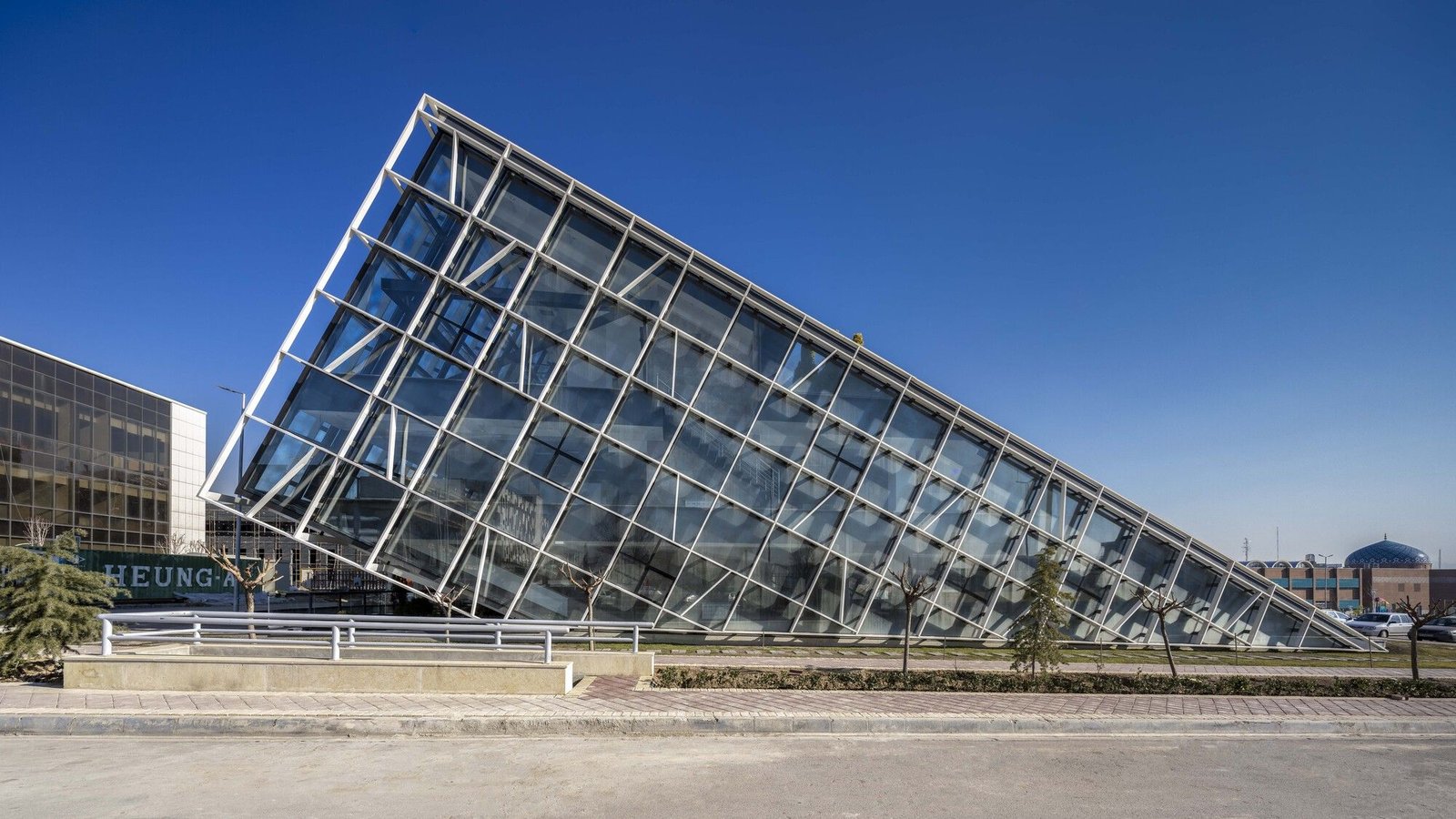
The Turbosealtech new incubator and office building by New Wave Architecture is a compact workplace in Pardis Technology Park, east of Tehran, that combines offices, a visible production workshop and shared social space in one glass-wrapped volume. At around 2,500 m², it is a medium-sized project, but it deals with questions that matter to any small technology or manufacturing company: how to show production rather than hide it, how to control heat in a glass building, and how to give staff outdoor space on a tight site. This review explains the design and draws out lessons for incubators, light-industrial offices and company headquarters in Pakistan.
Turbosealtech Incubator and Office Building at a Glance
| Location | Pardis Technology Park, Tehran Province, Iran |
|---|---|
| Architect | New Wave Architecture; principal architects Lida Almassian and Shahin Heidari |
| Client | Turbosealtech Company |
| Area | About 2,500 m² |
| Completed | 2022 |
| Form | Five-level, pyramid-like glass volume with a sloping, partly voided roof |
| Façade | Glass envelope with an outer layer of aluminium profiles to control solar heat gain (façade contractor Pars Amoud Co.) |
| Water | Rainwater tank for irrigation and non-potable use |
What a Business Incubator Building Needs
An incubator is a building for young or growing companies that need a mix of office space, workshop or lab space, meeting rooms and shared facilities. Unlike a standard office block, it has to support research, prototyping and sometimes small-scale production under the same roof.
- Flexibility. Teams grow and shrink quickly, so floors must be easy to reconfigure.
- Mixed uses. Clean office areas sit next to workshops with heavier floor loads, power needs and ventilation.
- Interaction. Incubators work best when people from different teams meet informally, so shared stairs, lobbies and terraces matter.
- Visibility. Showing what the company makes helps with investors, clients and recruitment.
Pardis Technology Park was set up as a base for research-led companies, and its buildings are largely the work of Iranian architects. The Turbosealtech building follows that tradition of using architecture to express a company’s identity.
The Role of Technology Parks
Technology parks group research-led companies on one managed site with shared infrastructure, such as reliable power, data connections, security, conference facilities and sometimes testing labs. Their purpose is to help firms grow faster by reducing setup costs and putting them near universities, investors and each other.
The quality of buildings in a park affects how well it works. Parks made of identical sheds rarely create a sense of place, while a mix of well-designed company buildings, landscape and shared amenities encourages people to stay, meet and collaborate. The Turbosealtech building contributes to this by giving its company a clear identity and by offering terraces and green space that make the park more attractive.
Planning a building inside a park
- Park design codes may set height, setbacks, materials and parking, so these must be checked before design.
- Shared utilities can simplify services design, but capacity for power-hungry equipment must be confirmed.
- Future expansion space should be reserved on the plot, as successful firms often outgrow their first building.
Design Concept: Technology, Site, Function and Landscape
The architects describe the design as the meeting point of four themes: technology, site, function and landscape. The form was shaped by three practical concerns: keeping views across the site open, controlling heat, and fitting the building’s functions.
The volume appears to rise out of the ground, sloping upwards to create a distinctive skyline while keeping the building’s bulk low at the edges. This helps it sit comfortably in its landscape rather than standing as a tall box.
An exposed, industrial structure
Inside, the structure is left exposed. Its pattern follows the building’s form and recalls the construction of industrial buildings, which suits a company whose work involves engineering and production.
Layout: Showing the Workshop
The building has five horizontal levels connected vertically by a transparent lift. The programme is stacked simply:
Lower levels
An open-plan workshop sits in a transparent enclosure, so visitors can see the company’s production as they arrive.
Upper levels
Offices occupy the higher floors, with views out across the park and daylight from the glazed envelope.
Entrance
The main entrance sits at the triangular corner of the plan, which draws people into the building.
Roof terrace
A cut-out in the roof forms a terrace that brings in light and air and gives staff and visitors a shared outdoor space.
Putting production on display is a deliberate choice. Many companies hide workshops at the back of a site; here, the workshop is part of the building’s public face.
Controlling Heat in a Glass Building
Glass buildings in hot, sunny climates can overheat quickly. Tehran has hot, dry summers, so the design uses a two-layer approach:
- An inner glass envelope that encloses the spaces and admits daylight.
- An outer layer of aluminium profiles that shades the glass, cutting direct sun and reducing heat gain.
This is a version of the double-skin or brise-soleil principle: stop the sun before it reaches the glass, rather than trying to remove the heat with air conditioning afterwards. The aluminium also gives the façade texture and depth, so the building changes character with the light.
Why external shading beats tinted glass
Tinted or reflective glass reduces heat but also darkens interiors all year. External shading blocks high summer sun while letting in more light in winter and on cloudy days. Design guidance from bodies such as ASHRAE consistently shows that external shading is one of the most effective ways to reduce cooling loads.
The Green Corridor and Rainwater Reuse
The sloping roof is opened up to create a green corridor running from the ground to the roof. This planted route gives the building a landscape spine, adds space for people to walk and meet, and helps lower building temperatures and energy use.
A water tank beside the building collects rainwater for irrigation and other non-potable uses. In dry climates, capturing rainwater for landscape is a sensible way to keep planting alive without drawing heavily on mains supply.
Incubator Building Options Compared
| Option | Typical form | Strengths | Weaknesses |
|---|---|---|---|
| Standard office block | Repeated office floors | Simple, cheaper to build | Poor for workshops and heavy equipment |
| Shed with office annex | Workshop shed plus small office block | Good for production | Weak identity, little interaction |
| Integrated building (Turbosealtech) | Workshop and offices in one designed volume | Visible production, shared spaces, strong identity | Higher design and façade cost |
| Multi-tenant incubator | Flexible units around shared facilities | Serves many start-ups | Needs strong management |
Structural and Services Considerations
Combining workshops and offices in one building raises engineering issues that designers must resolve early:
- Workshop floors need higher load capacity and may need isolation from vibration-sensitive offices above.
- Machines may require three-phase power, compressed air and local extraction.
- Fire separation is needed between production areas and offices.
- A sloping, glazed roof must be detailed carefully for waterproofing, drainage and maintenance access.
- Shading systems must be fixed securely to resist wind loads and be easy to clean.
Working Environment and Well-Being
The design puts people first in several ways. Daylight reaches most of the building through the glazed envelope, views from the offices look out across the technology park, and the roof terrace offers a place to get fresh air, take a break or hold an informal meeting. A transparent lift and open circulation make movement through the building part of the experience, so staff see each other and the workshop below as they move between floors. These small decisions make a compact building feel more generous than its area suggests.
Lessons for Pakistan
Pakistan has a growing number of software houses, engineering start-ups and light manufacturers in Lahore, Faisalabad, Sialkot and Karachi. Many work from converted houses or basic sheds. The Turbosealtech building suggests a better model.
Shade before you cool
External shading on south and west faces cuts cooling loads in Pakistan’s summers far more than tinted glass alone.
Combine office and production
A single, well-planned building can house both, provided loads, power and fire separation are designed in.
Use roofs and terraces
Shaded roof terraces give staff outdoor space on tight urban plots.
Follow local rules
Design to the Building Code of Pakistan and obtain approvals from the relevant authority, such as the LDA in Lahore.
ACCO designs and builds commercial and light-industrial buildings in Pakistan. See our industrial building and warehouse construction in Lahore, the commercial plaza construction in Gulberg guide and our full construction services. Every project is priced through an itemised BOQ.
Frequently Asked Questions
Who designed the Turbosealtech incubator and office building?
It was designed by New Wave Architecture, led by principal architects Lida Almassian and Shahin Heidari.
Where is the Turbosealtech building?
It is in Pardis Technology Park, a research and technology park in Tehran Province, Iran.
How big is the building?
It has a floor area of about 2,500 m² over five levels.
How does the façade control heat?
An outer layer of aluminium profiles shades the glass envelope, reducing direct sun and heat gain while still admitting daylight.
Why is the workshop visible from outside?
The open-plan workshop on the lower levels sits in a transparent enclosure so visitors can see the company’s production, which expresses its identity.
Can a similar building be built in Pakistan?
Yes. A combined workshop and office building with external shading suits Pakistani conditions. The cost depends on size, façade system and services, and is set out in an itemised BOQ.
Conclusion
New Wave Architecture’s Turbosealtech building shows how a modest incubator can combine production, offices and shared space in a single, memorable form. Its external aluminium shading, visible workshop, roof terrace and green corridor are practical responses to climate and to the way technology companies work, and they translate well to the needs of growing businesses in Pakistan.
Related articles
ACCO services
Contact ACCO
- +92 322 8000190
- info@acco.com.pk
- Office 2, 3rd Floor, Bigcity Plaza, Gulberg-III, Lahore
Planning a Project with ACCO?
Architecture, engineering and construction from one Lahore team since 1998. Design drawings are free when ACCO is awarded the construction.
Discuss Your ProjectWhatsApp +92 322 8000190
Grey Structure Construction Cost in Pakistan 2027: What You’ll Actually Pay