De Chill House by X11 Design Studio: Architecture Review
By Tanveer Ahmed, CEO, Ahmed Construction Company (ACCO) · Updated · Reviewed by ACCO architects and engineers
Quick Answer
De Chill House by X11 Design Studio: a review of this Vietnamese tube house, its light wells, gardens and climate buffers, with lessons for Pakistani plots. Ahmed Construction Company (ACCO), based in Gulberg-III Lahore since 1998, provides house construction in Lahore with design drawings free on award of construction.
Narrow urban houses are often dark, hot and stuffy, because neighbours on both sides block light and air. The De Chill House by X11 Design Studio in Vietnam tackles that problem directly. Completed in 2022 for a three-generation family, this tube house uses voids, skylights, gardens and buffer spaces to bring daylight, ventilation and greenery deep into a tight plot. This review explains how the design works and why its ideas are especially relevant to 3, 5 and 10 marla houses in Pakistan’s crowded cities.
De Chill House at a Glance
| Architects | X11 Design Studio (lead architect Tran Tuan Anh) |
|---|---|
| Country | Vietnam |
| Year | 2022 |
| Area | About 260 m² |
| Building type | Urban tube house for a three-generation family |
| Key features | Three “breathing” zones, central void and skylight, interwoven gardens, alternating balconies, rooftop courtyard, planted screens |
| Photography | Hoang Le |
The Problem: Tube Houses in Dense Cities
Vietnamese cities are full of tube houses: long, narrow buildings on deep plots, often sharing side walls with neighbours. They make efficient use of expensive urban land but tend to have little natural light in the middle of the plan. Rooms away from the street and rear can feel enclosed and rely on artificial lighting and air-conditioning throughout the day.
The same pattern appears across Pakistan. Houses on narrow plots in Lahore, Karachi, Rawalpindi and Faisalabad are often built wall to wall with neighbours, with windows only at the front and back. Middle rooms become dark, and heat builds up under concrete roofs. That is why the De Chill House is worth studying closely.
The Concept: Three Breathing Zones
The architects created three open “breathing” zones within the house: one at the front, one in the middle and one at the rear. Each zone is linked to a void running vertically through the building, topped by a skylight. Rooms are arranged so that each one opens onto at least one of these zones.
What the breathing zones achieve
- Daylight: the skylight and void carry natural light down to lower floors.
- Ventilation: warm air rises through the void and escapes, drawing fresher air through the house.
- Connection: family members on different floors can see and hear each other across the void.
- Greenery: plants are placed in the zones, so every level has a view of planting.
Gardens, Balconies and the Rooftop Courtyard
Green spaces are woven into the daily routes through the house rather than confined to a single garden. Balconies are arranged alternately on successive floors, which lets light reach the levels below and creates a vertical sequence of small outdoor rooms. The route through the house ends on the third floor at a spacious courtyard that acts as an extension of the interior, where private life meets the outdoors.
The architects describe the family gathering at weekends to tend the garden and meet friends there. For a three-generation household, this shared outdoor space gives children room to play, adults room to relax and grandparents a calm place to sit, all within the boundary of a narrow urban plot.
Responding to Heat and Dry Winds
The house is designed to deal with heat radiation, hot dry winds and limited rainfall. Its strategy is layered rather than relying on a single device:
Buffer spaces
Porches, balconies and gardens sit between the street or sky and the rooms, absorbing heat before it reaches living spaces.
Planted screens
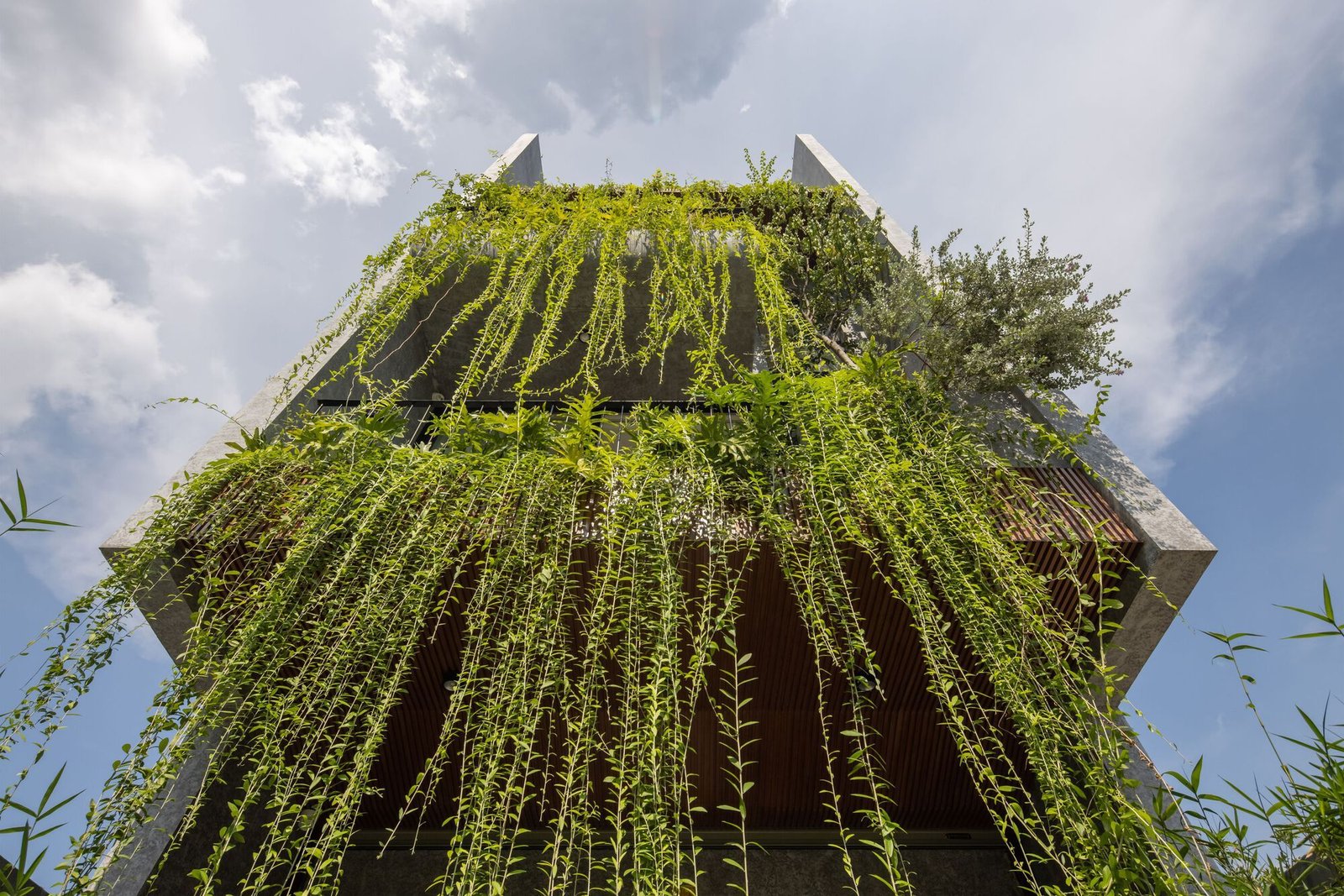
Climbing plants form green curtains that shade openings, filter dust and soften the view from the street.
Stack ventilation
The central void lets hot air rise and escape through the top of the house, encouraging natural airflow.
Inside, the rooms remain bright and filled with plants, while direct sun and hot wind are kept at a distance.
Architectural Character
The De Chill House follows a minimal, balanced style. Surfaces are simple and natural materials are used to create a calm, slightly rustic atmosphere. The architecture steps back and lets light, plants and the activities of the family become the main features. This restraint also has a practical benefit: simple finishes are easier to maintain and less likely to date.
Conventional Tube House vs De Chill House
| Aspect | Conventional narrow house | De Chill House approach |
|---|---|---|
| Daylight | Front and rear windows only; dark middle rooms | Three light zones and a central skylight |
| Ventilation | Mostly mechanical | Stack effect through a vertical void |
| Greenery | Small front lawn or none | Gardens on several levels and a rooftop courtyard |
| Heat control | Air-conditioning after heat enters | Buffer spaces and planted screens stop heat first |
| Family life | Floors feel separate | Visual links across the void connect generations |
Strengths and Trade-offs
The main strength is that the house turns the weaknesses of a narrow plot into opportunities. The voids and gardens make the building feel larger than its footprint. The trade-offs are also clear. Voids and courtyards use floor area that could otherwise be rooms; planting needs regular care and water; and open voids can carry sound and cooking smells between floors. Skylights and roof gardens also require careful waterproofing.
Lessons for Pakistan
Many Pakistani homes share the De Chill House’s problem: narrow plots, attached neighbours and intense summer heat. Several of its ideas transfer directly.
1. Add a light well or internal courtyard
Even on a 5 or 10 marla plot, a small light well with a skylight or open top can transform the middle of the house. Traditional havelis in Lahore’s old city used courtyards for exactly this reason. In a modern house built in Lahore, a light well can sit beside the staircase so it also lights the stairs.
2. Use the stairwell for ventilation
A stair core with high-level openings or a ventilated skylight lets hot air escape, creating a stack effect similar to the De Chill void. This can reduce reliance on air-conditioning in spring and autumn.
3. Create buffer spaces
Verandahs, deep balconies, jaalis and planted screens between rooms and the outside reduce heat gain. They also give families usable outdoor space in the evenings.
4. Insulate and green the roof
Roofs are the biggest source of heat in Pakistani houses. Roof insulation, reflective finishes and planted terraces cool upper floors. Rooftop courtyards like De Chill’s are a good use of space that is often left empty.
5. Check by-laws and structure
Voids, skylights and roof gardens must comply with local building regulations, such as those of the Lahore Development Authority or the relevant housing society, and must be designed structurally to the Building Code of Pakistan. Roof gardens add load and need proper waterproofing and drainage.
6. Plan for thermal comfort, not just cooling
Designers can use thermal comfort principles, such as those published by ASHRAE, to balance shading, ventilation and air-conditioning rather than relying on equipment alone.
Applying These Ideas on a Pakistani Plot
Site study
Map sun direction, neighbours, wind and by-law limits on coverage and height.
Concept
Locate the light well, stair, buffer spaces and roof terrace before arranging rooms.
Detail
Design waterproofing, drainage, structure and services for voids and gardens.
BOQ and build
Price the design through an itemised BOQ and build with close supervision.
ACCO’s house design and elevation service uses these principles on plots from 5 marla to 2 kanal. For budgeting, see the house construction cost guide for Lahore.
Common Mistakes When Adding Voids and Gardens
- Leaving skylights unshaded, which turns a light well into a heat trap in June
- Building roof gardens without root barriers, drainage outlets or a tested waterproofing membrane
- Making the void so large that it removes useful rooms on a small plot
- Forgetting safety railings and child-proof edges around open voids and balconies
- Choosing plants that need more water than the household can reliably provide
- Ignoring sound and kitchen smells that travel through an open void; a door or glazed screen at the kitchen solves this
Frequently Asked Questions
Who designed the De Chill House?
The house was designed by X11 Design Studio in Vietnam, with Tran Tuan Anh as lead architect.
What is a tube house?
A tube house is a long, narrow urban house, common in Vietnam, built on a deep plot and usually sharing side walls with neighbours.
How does the De Chill House bring in natural light?
It uses three open zones at the front, middle and rear, linked by a vertical void with a skylight, so light reaches rooms deep inside the plan.
Can a light well work in a 5 marla house in Pakistan?
Yes. A small light well or skylight beside the staircase can bring daylight and ventilation to the middle of a 5 marla house, provided it complies with by-laws and is properly waterproofed.
Do roof gardens damage houses?
Not when they are designed correctly. Roof gardens need structural allowance for the extra load, a reliable waterproofing system, root barriers and good drainage.
Does ACCO design houses with courtyards and light wells?
Yes. ACCO designs and builds houses across Lahore and Pakistan and can include courtyards, light wells and roof terraces where the plot and by-laws allow.
Conclusion
The De Chill House by X11 Design Studio proves that a narrow, attached urban house does not have to be dark or stuffy. Light zones, a ventilating void, layered buffer spaces and gardens on every level make it bright, green and comfortable. For Pakistani homeowners on tight plots, the same ideas, adapted to local by-laws and climate, can deliver cooler and more pleasant homes.
Related articles
Contact ACCO
- +92 322 8000190
- info@acco.com.pk
- Office 2, 3rd Floor, Bigcity Plaza, Gulberg-III, Lahore
Planning a Project with ACCO?
Architecture, engineering and construction from one Lahore team since 1998. Design drawings are free when ACCO is awarded the construction.
Discuss Your ProjectWhatsApp +92 322 8000190