Sanctuario de La Salle by CAZA: Campus Chapel Design Review
By Tanveer Ahmed, CEO, Ahmed Construction Company (ACCO) · Updated · Reviewed by ACCO architects and engineers
Quick Answer
Sanctuario de La Salle by CAZA: a campus chapel of circular chambers, slatted screens and a shaded ambulatory in the Philippines, with lessons for Pakistan. Ahmed Construction Company (ACCO), based in Gulberg-III Lahore since 1998, provides ACCO design & construction services with design drawings free on award of construction.
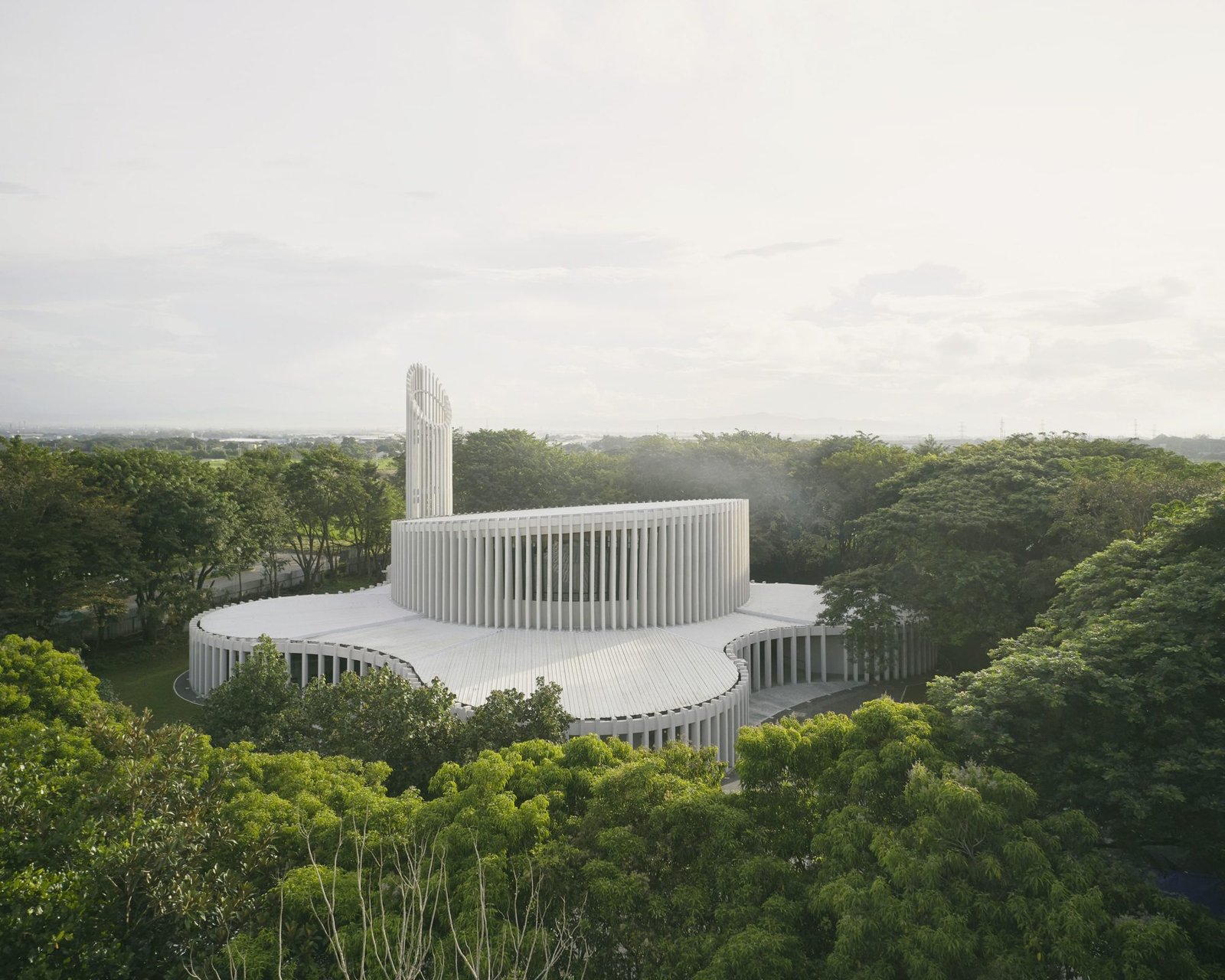
Sanctuario de La Salle by CAZA is a campus chapel that sets aside the familiar long nave and tower of a traditional church. Built in 2022 for De La Salle University in Biñan City, in the Philippine province of Laguna, it is made up of a cluster of circular chambers wrapped in a screen of vertical slats. The building is designed as an inclusive religious space within a wider campus concept, and its form tries to express the idea of individuals coming together as a community. This review looks at how the chapel is planned, how it handles light, climate and materials, and what Pakistani architects and institutions can learn from it when designing prayer halls and contemplative spaces on campuses.
Sanctuario de La Salle at a Glance
| Architect | CAZA |
|---|---|
| Client | De La Salle University |
| Location | Biñan City, Laguna, Philippines |
| Completed | 2022 |
| Building type | Campus chapel and religious space |
| Key ideas | Cluster of circular chambers, slatted outer screen, semi-outdoor ambulatory, double-height central space lit from above |
| Photography | Rory Gardiner |
Context: A Chapel on a Busy Campus
University campuses are noisy, crowded places. Students move between lectures, laboratories and canteens, often in large groups. A chapel, prayer hall or meditation room on such a campus has a specific job: it must give people a calm place within a few steps of that activity, without feeling cut off from campus life.
CAZA’s response was to create a gradual transition. Visitors pass from the open campus into a shaded, semi-outdoor zone, then through one of many doorways into the inner chambers, and finally into a tall central space. Each step reduces noise, brightness and activity, so the change of mood happens naturally rather than at a single heavy door.
The Design Concept: Many Volumes, One Community
The chapel is an assemblage of varied shapes rather than one dominant block. The architects describe the composition as a spatial experience that is more than the sum of its parts, in the same way that individuals join together to form a community of faith.
A succession of circular chambers
Inside, the building is made of a series of round rooms of different sizes. These provide nooks for liturgical functions with different levels of formality, from small spaces for quiet reflection to the main gathering room.
An amorphous exterior
From outside, the building reads as a soft, slightly mysterious mass. A veneer of vertical slats breaks down its large volume and gives it lightness and permeability. Raw, untreated materials on the exterior link the chapel to the surrounding landscape.
A change of materials inside
As visitors move inward, the palette shifts to softwoods and metals. The warmer, more refined interior materials signal arrival in the sacred core.
The Ambulatory and Fourteen Doorways
Between the slatted outer screen and the inner chambers is a permeable ambulatory: a covered walkway that is neither fully inside nor fully outside. This rhythmic zone allows worshippers to move from the busy academic setting into quieter areas at their own pace.
Fourteen separate doorways lead from the ambulatory into a double-height central core. The number and spacing of these openings make the chapel accessible from many directions, which suits a campus where people arrive from different buildings. The placement and width of the columns along the route are intended to suggest bodies moving through space and finding their own path.
Outer screen
Vertical slats filter sunlight, give privacy and allow air to move through the ambulatory.
Ambulatory
A shaded semi-outdoor route that acts as a buffer between campus noise and the sacred interior.
Central core
A double-height drum lit from above, where the whole congregation gathers.
Light and the Central Space
The main congregation space is a drum-like room with an inclined ceiling. Its arc is intended to recall the orbits of planets and the moon, linking the individual, the sacred atmosphere and nature. Pendant lights hang from the ceiling like small points of light, giving an almost star-like effect.
A tall clerestory window draws on a long tradition in religious architecture: light arriving from high above, so that people look upward. Natural top light is also practical. It brings daylight deep into a round plan without placing windows at eye level, which keeps the interior calm and private.
Climate and Comfort
The Philippines has a hot, humid tropical climate with heavy seasonal rain. The chapel’s layered design responds to this in simple ways. The slatted screen shades the walls, the ambulatory provides covered movement during rain, and the gaps between volumes allow air to flow. These passive measures reduce reliance on mechanical cooling, although a large gathering space will usually still need some mechanical ventilation or cooling at peak times. Internationally, thermal comfort and ventilation for occupied spaces are commonly assessed against ASHRAE standards.
Construction and Material Considerations
A building of curved chambers and slatted screens is harder to build well than a simple rectangular hall. Several practical points stand out for anyone planning a similar project:
- Setting out curved walls. Circular rooms need accurate survey and formwork. Small errors in radius become visible once finishes and ceilings are installed.
- Screen supports. Vertical slats must be fixed to a secondary frame that resists wind and allows for movement, with stainless or galvanised fixings to avoid staining.
- Timber protection. Softwoods used inside need treatment against insects and moisture, and exposed timber outside needs a maintenance plan.
- Roof drainage. Several roofs meeting at different levels create valleys and junctions that must be detailed carefully to avoid leaks in heavy rain.
- Acoustics. Round rooms can focus sound. Absorbent finishes and carefully shaped ceilings help speech and recitation remain clear.
These points apply equally in Pakistan, where monsoon rain, termites and dust make durable detailing and regular maintenance essential for any building with exposed timber or complex roofs.
Traditional Church Plan vs Sanctuario de La Salle
| Factor | Traditional nave plan | Sanctuario de La Salle |
|---|---|---|
| Form | Long rectangular hall with a clear axis | Cluster of circular chambers |
| Entry | Main door on one axis | Fourteen doorways from a shared ambulatory |
| Transition | Direct from street to interior | Gradual, through a shaded semi-outdoor zone |
| Light | Side windows along the nave | Top light from a tall clerestory |
| Exterior | Solid masonry walls | Permeable slatted screen |
Strengths and Questions
Strengths
- A clear idea of transition from busy campus to calm interior.
- Climate-responsive screening and covered circulation suited to tropical weather.
- Multiple entrances make the building welcoming and easy to reach.
Questions
- Exposed timber and slatted screens need regular maintenance in humid conditions.
- Many entrances can make security and acoustic separation harder to manage.
- Curved walls and inclined ceilings require skilled site work and careful detailing.
Lessons for Pakistan
Many Pakistani universities, colleges, hospitals and housing schemes include a mosque or prayer hall. These are often designed as simple halls with little thought about approach, shading or daylight. The design of Sanctuario de La Salle offers ideas that can be adapted respectfully to local religious and cultural requirements.
Create a transition zone
A shaded verandah, courtyard or arcade between the campus and the prayer hall helps people slow down and reduces noise.
Use screens for shade
Slatted or perforated screens, similar in purpose to traditional jaali work, cut glare and heat while allowing air movement.
Bring light from above
Clerestory windows and skylights give even daylight and keep the interior private.
Design for the climate
Plan cross-ventilation, roof insulation and shading for Pakistan’s hot summers and monsoon rain, and follow the Building Code of Pakistan for structural and seismic safety.
ACCO designs and builds campus buildings through its school and college construction services, and its architects in Gulberg Lahore work on institutional and religious spaces as part of larger projects. Each project is priced through an itemised BOQ; the Lahore construction cost per square foot guide explains what affects the budget. See all ACCO services for design, approvals and construction.
Frequently Asked Questions
Who designed Sanctuario de La Salle?
The chapel was designed by the architecture practice CAZA for De La Salle University, as part of a wider campus concept in Biñan City, Philippines.
What makes the chapel’s design unusual?
Instead of a long nave, it is made of a cluster of circular chambers wrapped in a slatted screen, with fourteen doorways leading into a double-height central space lit from above.
What is an ambulatory?
An ambulatory is a covered walkway around a central space. At Sanctuario de La Salle it is semi-outdoor and acts as a calm buffer between the campus and the chapel interior.
How does the building respond to a hot, humid climate?
The slatted screen shades the walls, the covered ambulatory protects people from sun and rain, and gaps between volumes help air to move through the building.
Can similar ideas be used for a mosque or prayer hall in Pakistan?
Yes. Shaded approaches, screens, top lighting and good cross-ventilation can all be adapted to mosque and prayer hall design while respecting religious requirements.
Does ACCO design campus and institutional buildings?
Yes. ACCO provides architectural design, engineering, approvals support and construction for schools, colleges and institutional buildings across Pakistan.
Conclusion
Sanctuario de La Salle by CAZA shows that a religious building on a busy campus can be both welcoming and calm. Its cluster of chambers, shaded ambulatory and top-lit core create a gradual journey from activity to reflection, while its screens and covered routes respond sensibly to a tropical climate. For Pakistan, the most useful lessons are the transition zone, the use of screens for shade and light from above, all of which can be built with local materials and skills.
Related articles
ACCO services
Contact ACCO
- +92 322 8000190
- info@acco.com.pk
- Office 2, 3rd Floor, Bigcity Plaza, Gulberg-III, Lahore
Planning a Project with ACCO?
Architecture, engineering and construction from one Lahore team since 1998. Design drawings are free when ACCO is awarded the construction.
Discuss Your ProjectWhatsApp +92 322 8000190

Grey Structure Construction Cost in Pakistan 2027: What You’ll Actually Pay