
Building Efficient and Durable Facilities for the Paper Industry
Paper Industry Project
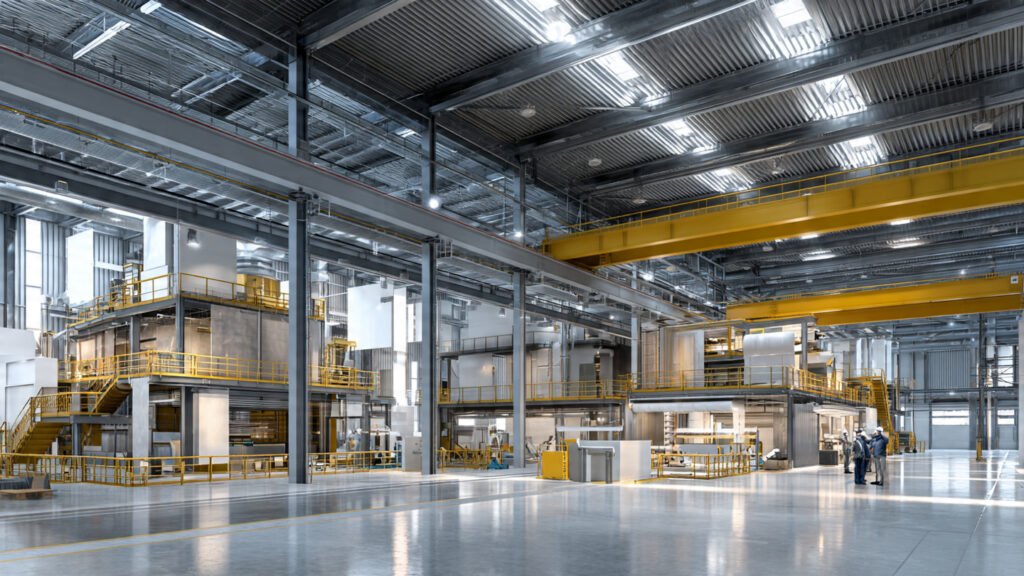
At Ahmed Construction Company, we understand the unique challenges of constructing facilities for the paper industry. From heavy machinery foundations to large-scale production halls, our team ensures every structure is safe, durable, and optimized for operational efficiency. We combine modern engineering techniques with practical construction experience to deliver projects that stand the test of time.
Paper Industry Project Services in Pakistan
Pakistan’s paper industry serves education, packaging, and hygiene sectors. From writing paper to cardboard boxes, paper products are essential to daily life. But here is the critical reality: paper mills operate in extremely demanding environments. Pulp digesters run at high temperatures and pressures. Paper machines are massive—hundreds of feet long, weighing thousands of tons, running 24/7. Chemical recovery areas handle corrosive black liquor. A structural failure in a paper mill means production stops, rolls of paper are ruined, and millions in revenue are lost. Consequently, paper mill structures demand engineering expertise that goes far beyond ordinary industrial facilities. At Ahmed Construction Company (ACCO), we provide specialized paper industry project services in Pakistan designed for heavy loads, high humidity, and corrosive chemicals. For over 25 years, we have designed and built structural frameworks for paper mills across Pakistan. From paper machine foundations to pulp storage tanks, our PEC-certified engineers deliver paper mills that produce reliably.
What Are Paper Industry Structural Services?
Paper industry structural services encompass the engineering, design, and construction of load-bearing frameworks for pulp and paper manufacturing facilities. This includes: woodyard structures (debarkers, chippers, chip storage), pulp mill buildings (digesters, blow tanks, washers, bleach plant), paper machine buildings (wet end, press section, dryer section, reel), finishing and converting areas (cutters, rewinders, packaging), chemical recovery areas (evaporators, recovery boiler, causticizing plant), effluent treatment plant structures, and finished goods warehouses. Unlike ordinary industrial facilities, paper mills face unique challenges: heavy paper machines (100-500 tons, 200+ feet long), high humidity (paper machine areas at 50-70% RH, corroding steel), high-temperature equipment (dryers at 150°C, recovery boiler at 900°C), corrosive chemicals (black liquor, white liquor, chlorine dioxide), massive dynamic loads (pumps, fans, refiners), precise alignment requirements (paper machine rolls aligned to 0.1mm), continuous operation (24/7/365, fatigue considerations), and fire safety (paper dust is highly flammable).
In Pakistan, the Pakistan Engineering Council (PEC) and industry standards require compliant structural designs. Furthermore, international standards (ACI 318 for concrete, AISC for steel, NFPA for fire safety) apply for export-oriented mills. Therefore, ACCO’s paper industry project services in Pakistan meet both local regulations and international best practices. We serve pulp, paper, board, and tissue manufacturers.
Who We Are: ACCO – 25+ Years of Paper Industry Excellence
For over two and a half decades, Ahmed Construction Company (ACCO) has been the trusted structural partner for Pakistan’s paper industry. From our head office at Office 2, 3rd Floor, Bigcity Plaza, Gulberg-III, Lahore, and our operational hub in Karachi, we have delivered structural solutions for paper mills across Punjab and Sindh.
What sets us apart is our understanding of papermaking processes and environmental demands. We know that paper machine foundations must be perfectly level (to 0.1mm over 200 feet) to maintain roll alignment. We know that high-humidity areas need corrosion-resistant steel (epoxy-coated or galvanized). We know that chemical recovery areas need acid-resistant concrete and secondary containment. Consequently, when you choose ACCO for paper industry project services in Pakistan, you get a team that designs for paper quality and mill reliability. Learn more about our Architectural Engineering capabilities.
Our Paper Industry Structural Services – Detailed Breakdown
We provide complete structural solutions for all types of pulp and paper manufacturing facilities across Pakistan.
1. Paper Machine Foundations & Support Structures
The paper machine is the heart of any mill—200-500 feet long, weighing 500-2,000 tons. We design massive continuous foundations for: fourdrinier/wet end, press section, dryer section (hundreds of drying cylinders), size press, calender stack, reel, and winder. Our designs include: ±0.1mm alignment (over entire machine length), vibration isolation (for rotating rolls), anchor bolt templates (precise to ±1mm for each roll), massive concrete mass (to control vibration), and access pits (for under-machine maintenance). Poor paper machine foundations cause sheet breaks, poor roll profiles, reduced production speed, and paper quality defects.
2. Pulp Digester & Blow Tank Foundations
Pulp digesters operate at high pressure (8-12 bar) and temperature (160-170°C). We design heavy foundations for: batch digesters, continuous digesters, blow tanks, and washing systems. Our designs include: thermal expansion allowances, anchor bolt templates (precise mounting), massive concrete mass (to absorb dynamic loads), and access provisions for manways and instrumentation.
3. High-Humidity Corrosion Protection for Paper Machines
Paper machine buildings operate at 50-70% relative humidity (to control paper properties). This environment corrodes ordinary steel. We specify: epoxy-coated rebar for concrete structures, hot-dip galvanized steel for structural steel, stainless steel fasteners, corrosion-resistant coatings for all exposed surfaces, and proper ventilation supports to minimize condensation. We have designed paper machine buildings that remain corrosion-free for 20+ years.
4. Recovery Boiler & Chemical Recovery Structures
Recovery boilers are massive (50-100 feet tall) with high-temperature combustion (900°C) and molten smelt. We design: recovery boiler foundations (with high-temperature concrete, thermal expansion allowances), smelt spout supports (access platforms), electrostatic precipitator supports (for particulate collection), evaporator building structures, and causticizing plant foundations (for lime kiln, slakers, clarifiers).
5. Chemical Storage & Pulp Storage Tanks
Paper mills store pulp (in high-density storage towers) and chemicals (white liquor, black liquor, chlorine dioxide). We design: reinforced concrete pulp storage towers (20-40 meters tall), chemical tank foundations (with secondary containment, cathodic protection for steel tanks), liquor storage tank foundations (API 650), and bund walls (secondary containment for hazardous chemicals).
6. Refiner & Pump Foundations
Paper mills have hundreds of pumps, fans, and refiners (large rotating equipment). We design individual equipment foundations with: mass calculations (to control vibration), spring isolators (for vibration-sensitive areas), anchor bolt templates, and grouting details (epoxy grout). For refiners (disks spinning at high RPM), we perform natural frequency analysis to avoid resonance.
7. Finishing & Converting Building Structures
Finishing areas include: winders (rewinding parent rolls into customer rolls), cutters (sheeting), ream wrappers, case packers, palletizers, and stretch wrappers. We design: heavy floor slabs (for forklift traffic, roll storage), mezzanine platforms (for equipment access), crane supports (for roll handling), and warehouse long-span steel structures (for finished goods storage). Finished goods warehouses require floor slabs capable of roll stacking loads (5-15 kN/sqm).
8. Woodyard & Chip Handling Structures
Wood processing includes: debarkers, chippers, chip screens, chip storage silos, and reclaim systems. We design: heavy equipment foundations (for debarkers, chippers with impact loads), conveyor support steel (for chip transport), chip silo structures (reinforced concrete or steel), and dust collection system supports.
9. Effluent Treatment Plant (ETP) Structures
Paper mill effluent contains fibers, chemicals, and organic material. We design: primary clarifier foundations, aeration tank structures, secondary clarifier foundations, sludge handling structures, and chemical dosing platform supports. Our ETP structures include corrosion-resistant concrete (sulfate-resistant cement, epoxy-coated rebar) and secondary containment for chemical storage.
10. Seismic Design for Paper Mills
Paper mills contain expensive, continuous-process equipment. Post-earthquake production interruption costs millions. Therefore, our seismic designs include: importance factor of 1.25, ductile detailing for steel and concrete, equipment anchorage (paper machines, digesters, recovery boilers), flexible piping connections (to accommodate differential movement), and separation joints between different building blocks.
11. BIM Modeling & 3D Visualization for Paper Mills
Paper mills are equipment-dense with complex piping and ventilation systems. We provide 3D architectural walkthrough and BIM Modeling to coordinate structural, mechanical, and electrical components. This is essential for: clash detection (steel vs. paper machine framing, ducts vs. equipment), equipment access verification (for roll changes, wire changes), maintenance route planning, and client presentations. See our Architectural 3D Modeling and Modular BIM Modeling pages.
Comparison: ACCO vs. Typical Paper Mill Builders
Many contractors claim to build paper mills but lack specialized expertise. Here is why ACCO is different:
| Feature | ACCO | Typical Industrial Contractor |
|---|---|---|
| Experience | 25+ Years (Paper Mills) | <10 years, limited paper sector portfolio |
| PEC Registration | In-house registered structural engineers | No registered engineer on staff (illegal) |
| Paper Machine Foundations | ±0.1mm alignment over 200+ feet, vibration analysis, massive concrete | Basic slab – sheet breaks, roll misalignment, quality defects |
| Corrosion Protection | Epoxy-coated rebar, hot-dip galvanized steel, stainless fasteners | Ordinary steel/concrete – corrosion within 3-5 years |
| Recovery Boiler Foundations一九High-temperature concrete, thermal expansion allowances, ±1mm anchor bolts | Ordinary concrete – cracking, spalling | |
| Chemical Containment一九Secondary containment bund walls, cathodic protection, acid-resistant concrete | No containment – EPA violations, soil contamination | |
| Alignment Precision一九±0.1mm over 200+ feet, roll alignment to manufacturer specs | No precision – poor sheet profile, reduced production speed | |
| High Humidity Design一九Corrosion-resistant steel, proper ventilation supports, coatings | No humidity consideration – premature corrosion | |
| Seismic Design一九Importance factor 1.25, equipment anchorage, flexible connections | No seismic consideration – post-quake production loss |
| BIM Coordination一九Clash detection with paper machine framing, dryer piping, ventilation | None – clashes discovered during installation | |
| Project Timeline | Gantt charts & documented milestones | No schedule, production delays |
| Warranty | 2-year workmanship warranty on structures | Verbal assurances only |
| International Standards | ACI, AISC, NFPA, TAPPI guidelines compliance | Local practice only – code violations |