
Engineering Excellence for Industrial Infrastructure
Cement Plants Project
At Ahmed Construction Company (Acco), we bring decades of experience in designing and executing cement plant structures that are robust, efficient, and future-ready. From initial structural analysis to final construction, our team ensures every element meets safety standards and operational efficiency. We understand the complexities of industrial projects and deliver solutions that are practical, durable, and sustainable.Optional Call-to-Action: “Discover More Projects” (link to full project portfolio)
Cement Plants Project Services in Pakistan
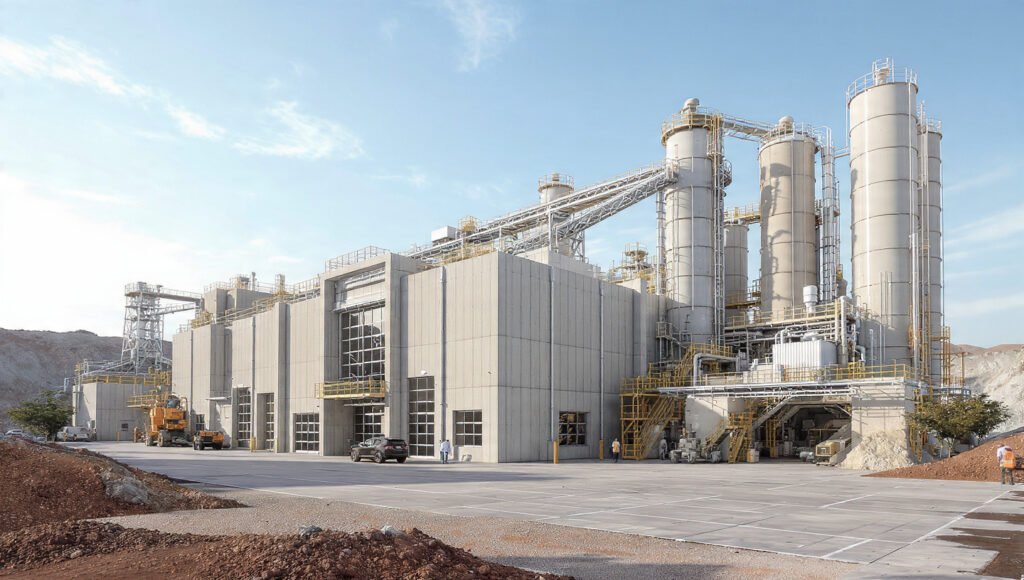
Pakistan’s cement industry is thriving. New plants are being built in the north. Existing facilities are expanding. But here is the critical reality: cement plants are among the heaviest industrial facilities on earth. Rotary kilns weighing thousands of tons. Grinding mills with massive dynamic loads. Raw material silos storing millions of tons. A structural failure in a cement plant is not just a collapse—it is a multi-million dollar production halt and a safety catastrophe. Consequently, cement plant structures demand engineering expertise that goes far beyond ordinary industrial buildings. At Ahmed Construction Company (ACCO), we provide specialized cement plants project services in Pakistan designed for decades of continuous heavy-duty operation. For over 25 years, we have designed and built structural frameworks for cement production facilities across Pakistan. From rotary kiln foundations to grinding mill supports, our PEC-certified engineers deliver cement plants that produce reliably.
What Are Cement Plant Structural Services?
Cement plant structural services encompass the engineering, design, and construction of load-bearing frameworks for cement manufacturing facilities. This includes: crusher foundations, raw material storage silos, raw grinding mill buildings, preheater towers, rotary kiln foundations, clinker coolers, cement grinding mill buildings, cement silos, packing plant structures, and heavy equipment platforms. Unlike ordinary industrial facilities, cement plants face unique challenges: extreme heavy loads (equipment weighing 50-2,000 tons), dynamic loads (rotating mills, vibrating screens), high-temperature environments (kilns at 1,450°C, preheaters at 900°C), dusty environments (abrasive clinker, raw materials), massive foundations (to control settlement), and harsh operating conditions (24/7/365 operation).
In Pakistan, the Pakistan Engineering Council (PEC) and cement industry standards require compliant structural designs. Furthermore, international standards (ACI 318 for concrete, AISC for steel, DIN for German equipment) apply. Therefore, ACCO’s cement plants project services in Pakistan meet both local regulations and international best practices. We serve all major cement producers and EPC contractors working in Pakistan’s cement sector.
Who We Are: ACCO – 25+ Years of Cement Industry Excellence
For over two and a half decades, Ahmed Construction Company (ACCO) has been the trusted structural partner for Pakistan’s cement industry. From our head office at Office 2, 3rd Floor, Bigcity Plaza, Gulberg-III, Lahore, and our operational hub in Karachi, we have delivered structural solutions for cement plants across Punjab, Khyber Pakhtunkhwa, and Sindh.
What sets us apart is our understanding of cement manufacturing processes and equipment. We know that kiln foundations must accommodate thermal expansion (kilns grow inches when hot). We know that mill foundations need massive mass to control vibration. We know that preheater towers require high-temperature concrete specifications. Consequently, when you choose ACCO for cement plants project services in Pakistan, you get a team that designs for operational reliability in extreme conditions. Learn more about our Architectural Engineering capabilities.
Our Cement Plant Structural Services – Detailed Breakdown
We provide complete structural solutions for all types of cement production facilities across Pakistan.
1. Rotary Kiln Foundation Design
The rotary kiln is the heart of any cement plant—weighing 500-2,000 tons, rotating slowly, and operating at 1,450°C. We design massive concrete foundations for kiln support rollers, thrust rollers, and drive mechanisms. Our designs include: precise alignment requirements (kiln axis must be straight within 2mm), thermal expansion allowances (kiln grows inches in length when hot), massive concrete mass (to control vibration), anchor bolt templates (for roller stations), and sliding bearing details (to accommodate thermal movement). We have designed kiln foundations for plants up to 10,000 tons per day capacity.
2. Raw Mill & Cement Mill Foundations
Grinding mills (ball mills, vertical roller mills) have massive dynamic loads and vibration. We design: block foundations (for ball mills), spring-mounted foundations (for vibration isolation of VRMs), mill reducer foundations, motor foundations, and separator support structures. Our designs include: foundation mass calculations (to keep natural frequency away from mill operating frequency), anchor bolt templates (for mill mounting), grouting details (epoxy grout for precision leveling), and access provisions (for maintenance of bearings and gearboxes).
3. Preheater Tower Structures
Preheater towers are tall steel structures (80-120 meters) supporting cyclones and ductwork at high temperatures (up to 900°C). We design: steel-framed towers with thermal expansion joints, platform structures for access to cyclones, duct support steelwork, expansion joints (to accommodate thermal movement), corrosion protection (epoxy coatings for acidic environments), and cladding support (for weather protection).
4. Clinker Cooler Foundations
Clinker coolers receive red-hot clinker from the kiln (1,450°C) and cool it rapidly. We design: heavy concrete foundations with refractory-lined surfaces, grate support structures, fan foundations (for cooling air), clinker breaker foundations, and dust collection support structures. Our designs include high-temperature concrete specifications (refractory concrete where needed).
5. Raw Material & Cement Silos
Silos store thousands of tons of raw meal, clinker, cement, and additives. We design: reinforced concrete silos (circular or rectangular), silo foundation systems (raft or ring beam), hopper supports (for reclaim systems), conveyor galleries (steel structures for material transport), dust collector support structures, and truck loading platforms. Our silo designs include: wall thickness calculations (for hoop stress), flow pattern optimization (funnel flow vs. mass flow), and discharge hopper details.
6. Crusher & Conveyor Structures
Raw material crushing and conveying require specialized structures: crusher foundations (heavy block foundations for impact loads), vibration isolation (for crusher foundations), conveyor support structures (steel frames for long conveyors), transfer tower structures (where conveyors change direction), belt feeders supports, and dust enclosure structures.
7. Packing Plant & Dispatch Structures
Cement packing and dispatch require: packing machine foundations (with anchor bolt templates), rotary packer supports, palletizer foundations, truck loading platforms (with weighbridge foundations), and bag filter support structures (for dust control).
8. Heavy Equipment Platforms & Access Steel
Cement plants require extensive steel platforms for equipment access: equipment maintenance platforms (for mills, kilns, preheaters), motor and gearbox platforms, piping and duct support steel, and stair towers and access ladders (OSHA-compliant).
9. High-Temperature Concrete Specifications
Cement plant concrete must withstand high temperatures (up to 400°C for some areas). We specify: refractory concrete (for hot areas), heat-resistant aggregates, low-cement castables, thermal expansion joints (to prevent spalling), and cooling pipe integration (for massive foundations near heat sources).
10. BIM Modeling & 3D Visualization for Cement Plants
Cement plants are equipment-dense with complex piping, ductwork, and conveyors. We provide 3D architectural walkthrough and BIM Modeling to coordinate structural, mechanical, and electrical components. This is essential for: clash detection (steel vs. process ducts), equipment access verification, maintenance route planning, and construction sequencing. See our Architectural 3D Modeling and Modular BIM Modeling pages.
Comparison: ACCO vs. Typical Cement Plant Builders
Many contractors claim to handle cement plant structures but lack specialized expertise. Here is why ACCO is different:
| Feature | ACCO | Typical Industrial Contractor |
|---|---|---|
| Experience | 25+ Years (Multiple Cement Plants) | <10 years, limited cement portfolio |
| PEC Registration | In-house registered structural engineers | No registered engineer on staff (illegal) |
| Kiln Foundation Design | Massive concrete, thermal expansion details, ±2mm alignment | Basic foundation – misalignment, shell cracking |
| Mill Foundation Design | Block/spring-mounted, vibration analysis, natural frequency isolation | Basic slab – vibration damage, bearing failure |
| Preheater Towers | Steel structures with thermal expansion joints, 80-120m height | Rigid steel – thermal stress, cracking |
| Silo Design一九Reinforced concrete, hoop stress analysis, flow optimization | Basic concrete – inadequate strength, flow problems | |
| High-Temperature Concrete | Refractory concrete, heat-resistant aggregates, cooling pipes | Standard concrete – spalling, failure |
| ±2mm kiln axis, ±1mm mill alignment | No precision alignment – premature equipment failure | |
| BIM Coordination | Clash detection with ducts, piping, conveyors | None – clashes discovered during installation |
| Project Timeline | Gantt charts & documented milestones | No schedule, project delays |
| Warranty | 2-year workmanship warranty on structures | Verbal assurances only |
| International Standards | ACI, AISC, DIN, EN compliance | Local practice only – code violations |
| 可能有 |
Our Step-by-Step Cement Plant Structural Process
We follow a rigorous, quality-controlled process tailored to cement production requirements.
- Step 1: Initial Consultation & Process Specifications – You call +92 322 800 0190 or email info@acco.com.pk. We discuss: plant capacity (tons per day), equipment manufacturers (kiln, mill, preheater), process flow, and site constraints.
- Step 2: Site Investigation & Geotechnical Study – Our team visits your site. We conduct or arrange a geotechnical investigation (critical for heavy equipment foundations, silos). We analyze soil bearing capacity, settlement potential, and seismic site class.
- Step 3: Equipment Manufacturer Coordination – We obtain anchor bolt templates, equipment weights, dynamic loads, thermal expansion data, and alignment requirements from kiln, mill, preheater, and cooler manufacturers.
- Step 4: Structural Design & Analysis – Our engineers model your cement plant in ETABS/STAAD.Pro. We calculate: dead loads, live loads, equipment loads, dynamic loads (mills, crushers), thermal loads (kilns, preheaters), wind loads, and seismic loads.
- Step 5: Foundation & Steel Structure Design – We design kiln foundations (with thermal expansion details), mill foundations (with vibration isolation), preheater towers (steel with expansion joints), silos (reinforced concrete), crusher foundations, and equipment platforms.
- Step 6: Drawing Production & PEC Stamping – We produce detailed structural drawings: foundation layouts, steel framing plans, anchor bolt details, thermal expansion details, and high-temperature concrete specifications. PEC-registered engineers stamp every drawing.
- Step 7: BIM Coordination & Construction Supervision – We integrate structural, mechanical, and process models. We provide 3D architectural walkthrough for operator training and safety reviews. During construction, our engineers inspect kiln foundation alignment (checking roller positions), mill foundation vibration isolation, and preheater steel erection. A 2-year structural warranty is provided upon completion.
📢 Mid-Content CTA: Planning a Cement Plant?
Kiln foundations require precision within 2mm over 100 meters. ACCO’s cement plants project services in Pakistan include a free preliminary consultation and site visit. Call +92 322 800 0190 or email info@acco.com.pk today. Mention “CEMENT” for a priority consultation.
Why Cement Industry Clients Nationwide Choose ACCO
Pakistan’s cement industry is capital-intensive. First, kiln foundation misalignment causes shell cracking and production losses. Second, mill foundation vibration leads to bearing failure and unscheduled shutdowns. Third, inadequate preheater steel design results in thermal stress cracking. Consequently, proper structural engineering is essential for cement plant profitability.
ACCO has provided cement plants project services in Pakistan for plants across Punjab, Khyber Pakhtunkhwa, and Sindh. Our structural designs have been approved by PEC, equipment manufacturers (FLSmidth, ThyssenKrupp, Loesche), and international lenders.
Furthermore, we serve cement clients across all major production zones: Lahore, Chakwal, Dera Ghazi Khan, Karachi, and Hub. We also support international cement companies building in Pakistan with headquarters in the UAE, UK, Saudi Arabia, Canada, and the USA.
Our integrated approach means we also provide architectural drafting and building design for control rooms and administration buildings. Explore our Architectural Engineering page for more.
By The Numbers: ACCO’s Cement Plant Structural Track Record
- 10+ Cement plant projects structurally designed and supervised.
- 25+ Rotary kiln foundations designed (up to 10,000 tons per day).
- 50+ Mill foundations designed (ball mills, VRMs).
- Zero Alignment-related production losses across our portfolio.
- 100% PEC compliance rate for all cement plant submissions.
- 25+ Years of continuous cement industry practice in Pakistan.
- 10,000 tpd Maximum plant capacity supported.
- 2,000 tons Maximum single kiln weight.
- 2mm Kiln alignment precision achieved.
- 2 Offices (Lahore & Karachi) covering all cement zones.
- 10+ PEC-registered structural engineers on our heavy industrial team.
Frequently Asked Questions (FAQs) – Cement Plant Structures
1. What is the difference between cement plant and general industrial structural design?
Cement plant structural design focuses on: extreme heavy loads (kilns weighing 2,000 tons), high-temperature environments (kilns at 1,450°C, preheaters at 900°C), dynamic loads from rotating mills, massive foundations (to settle uniformly), precise alignment requirements (±2mm over 100 meters), thermal expansion accommodation, and high-temperature concrete specifications. General industrial design does not require these extreme conditions. ACCO specializes in cement production.
2. How do I get a layout designed for a cement plant?
For cement plant projects, we start with your process flow diagram and equipment specifications from manufacturers (FLSmidth, ThyssenKrupp, etc.). Our Architectural Engineering team develops a functional building design and architectural drafting that optimizes material flow, equipment access, and maintenance routes. Our structural engineers then provide the heavy-duty frameworks. Call +92 322 800 0190 to discuss.
3. What is architectural engineering, and why is it important for cement plants?
Architectural engineering integrates structural, mechanical, and process systems. For cement plants, this is critical: kiln foundations must align with preheater towers, mill foundations must coordinate with separator steel, and duct supports must allow thermal expansion. Learn more on our Architectural Engineering page.
4. Do you provide 3D walkthroughs for cement plant projects?
Yes. We provide 3D architectural walkthrough of your cement plant structure. This helps operators understand equipment access, maintenance routes, and safety egress. It is also valuable for owner training and safety inspections. See our Architectural 3D Modeling page for examples.
5. Can ACCO design foundations for vertical roller mills (VRMs)?
Absolutely. VRMs have unique vibration characteristics. We design spring-mounted foundations for VRMs with: natural frequency analysis (to avoid resonance), spring isolator specifications, anchor bolt templates (precision mounting), and grouting details. We have designed VRM foundations for plants across Pakistan.
6. Do you offer a warranty on cement plant structural work?
Yes. We provide a 2-year workmanship warranty on all cement plant structural construction services. This covers structural defects, foundation settlement, and thermal expansion detailing. For kiln and mill foundations, we provide additional alignment warranties (±2mm for kilns, ±1mm for mills).
7. How long does cement plant structural design take?
A typical cement plant line (5,000-7,000 tpd) takes 3-4 months for structural design and PEC-stamped drawings. A full plant with multiple lines may take 6-8 months. Construction supervision continues throughout the project (typically 18-30 months).
8. What is kiln alignment and why is it critical?
Kiln alignment refers to the straightness of the rotary kiln axis along its entire length (typically 50-100 meters). Misalignment of even 2-3mm causes: shell cracking, refractory damage, tire and roller wear, and reduced production. ACCO designs kiln foundations to maintain ±2mm alignment over the kiln’s operating temperature range (cold to 1,450°C).
Build Reliable Cement Plants for Production Excellence – Choose ACCO
Your cement plant is a multi-billion rupee investment. A structural failure means production stops, markets lose supply, and profits evaporate. Therefore, investing in proper cement plant structural engineering is not a cost—it is an investment in production reliability.
ACCO has been providing cement plants project services in Pakistan for over 25 years. We are trusted by cement producers across Punjab, Khyber Pakhtunkhwa, and Sindh. Our PEC-registered engineers use advanced software (ETABS, STAAD.Pro, Tekla), follow international codes (ACI, AISC, DIN, EN), and deliver designs that withstand extreme loads, high temperatures, and continuous operation.
We cover all major cement production zones nationwide: Lahore, Chakwal, Dera Ghazi Khan, Karachi, and Hub. We also support international cement companies building in Pakistan with headquarters in the UAE, UK, Saudi Arabia, Canada, and the USA.
Ready to build a cement plant that produces reliably? Contact ACCO today. Structural integrity means production continuity.
Alternate: +923 111 749 849
✉️ Email your cement plant specifications: info@acco.com.pk
🏢 Visit Us: Office 2, 3rd Floor, Bigcity Plaza, Gulberg-III, Lahore (near Kalma Chowk)
🕒 Working Hours: Monday–Saturday, 9:00 AM – 6:30 PM
→ REQUEST A CEMENT PLANT CONSULTATION ←
ACCO – Engineering Heavy Industry Infrastructure. Since 1998.
Explore related services: Learn about our Architectural Engineering integration or view our Our Projects gallery to see our cement plant structural work in action.