Hospital Design and Construction in Qatar: Complete Guide for Healthcare Investors (2026)
Driven by Qatar National Vision 2030 and the ongoing modernization of its National Health Strategy, the State of Qatar has established one of the world’s most advanced and rigorously regulated healthcare ecosystems. For healthcare operators, private equity funds, and international medical syndicates, navigating hospital design and construction in Qatar demands an exacting balance: meeting stringent Ministry of Public Health (MoPH) technical guidelines, fulfilling mandatory health insurance integration requirements, and managing high-capital expenditure through resilient, energy-efficient engineering.
n
As international healthcare master planners and turnkey engineering consultants, ACCO (Ahmed Construction Company) delivers comprehensive design-build expertise that bridges architectural excellence, clinical functionality, and commercial return on investment (ROI). In this definitive 2026 investor guide, we break down the operational phases, licensing frameworks, engineering imperatives, and financial strategies essential for launching tertiary, secondary, and specialized private hospital developments in Doha, Lusail, and Al Rayyan.
n
Strategic Healthcare Investment Drivers in Qatar
n
Qatar’s healthcare landscape is undergoing an ambitious transition from public-dominated care delivery toward a robust public-private partnership (PPP) model. Key macro drivers fueling private hospital demand include:
n
- n
- Mandatory Private Health Insurance: The nationwide rollout of compulsory health insurance for expatriates, business visitors, and tourists has created a massive recurring patient pool seeking premium private inpatient and outpatient care.
- Sub-Specialty Care Localization: While Hamad Medical Corporation (HMC) handles broad public healthcare, substantial market voids exist in high-demand sub-specialties—including outpatient oncology infusions, advanced orthopedic sports medicine, assisted reproductive technology (IVF), and dedicated pediatric rehabilitation.
- Medical Tourism & Regional Patient Hubs: With Hamad International Airport acting as a global aviation crossroads, Qatar is capturing lucrative elective medical travel from across the GCC and South Asia.
n
n
n
n
Regulatory Compliance & MoPH Licensing Roadmap
n
A fatal pitfall for foreign healthcare syndicates is treating Qatari architectural submissions as conventional commercial buildings. In Qatar, hospital design is subject to layered statutory oversight from preliminary concept through final facility commissioning:
n
- n
- Healthcare Facilities Licensing and Accreditation Department (HFLAD): The MoPH regulatory arm that oversees room-by-room architectural Schedule of Accommodation (SoA), clinical clean-dirty circulation segregation, minimum clear ceiling heights, and clinical equipment spatial clearances.
- Qatar Civil Defense Department (QCDD): Enforces ultra-stringent life safety standards based on NFPA 101 (Life Safety Code) and NFPA 99 (Health Care Facilities Code), requiring dedicated smoke barrier compartments every 22,500 sq ft, redundant emergency stairwells, and certified firestop assemblies.
- Ministry of Municipality (Baladiya): Oversees urban zoning bylaws, Floor Area Ratio (FAR), mandatory basement parking capacities, and environmental impact assessments.
- Kahramaa (Qatar General Electricity & Water Corporation): Regulates utility infrastructure loads, high-voltage transformer substation design, and specialized water quality storage standards for clinical autoclaves and dialysis systems.
n
n
n
n
n
Engaging experienced architectural design specialists early in the pre-concept phase eliminates costly structural redesigns and accelerates statutory MoPH architectural approvals by 4 to 6 months.
n
Clinical Spatial Programming & Departmental Zoning
n
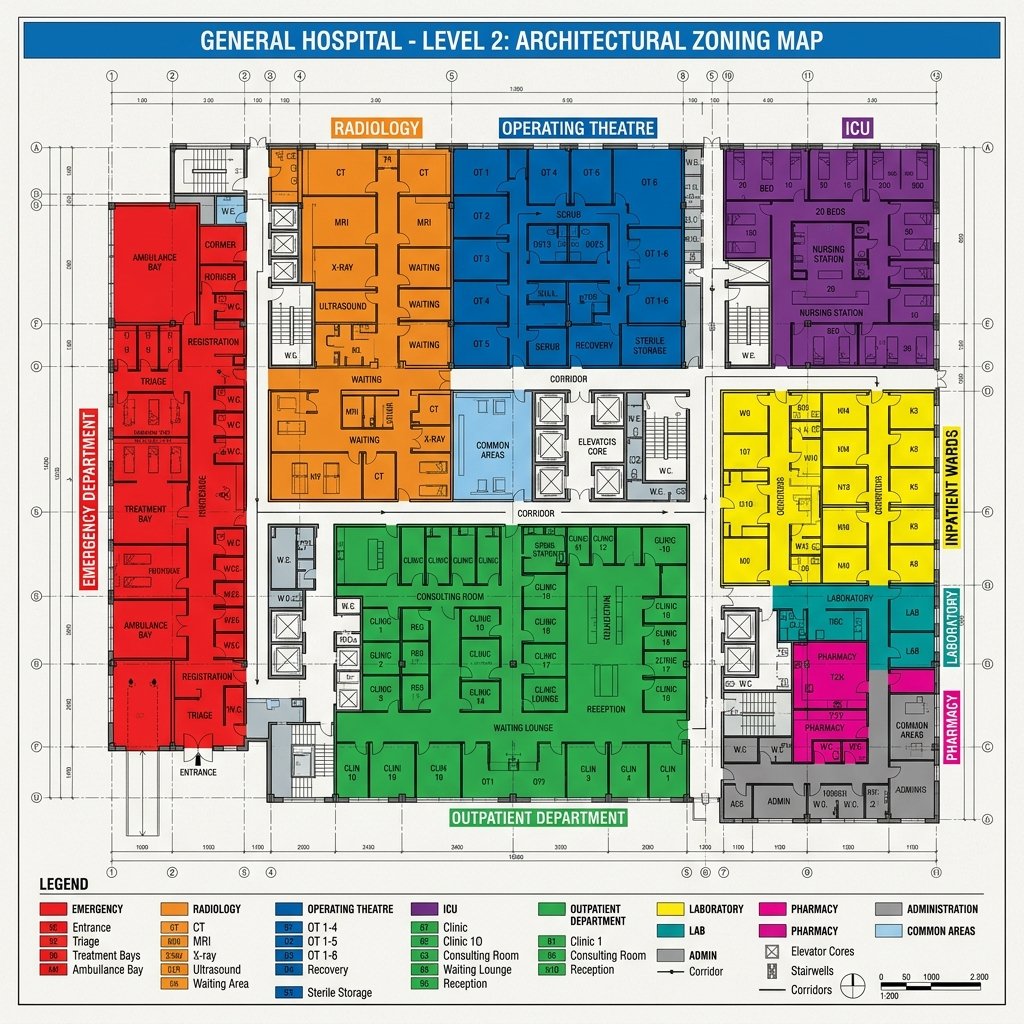
Modern hospital planning in the GCC demands strict departmental segregation to prevent nosocomial infections while maintaining frictionless clinical pathways:
n
- n
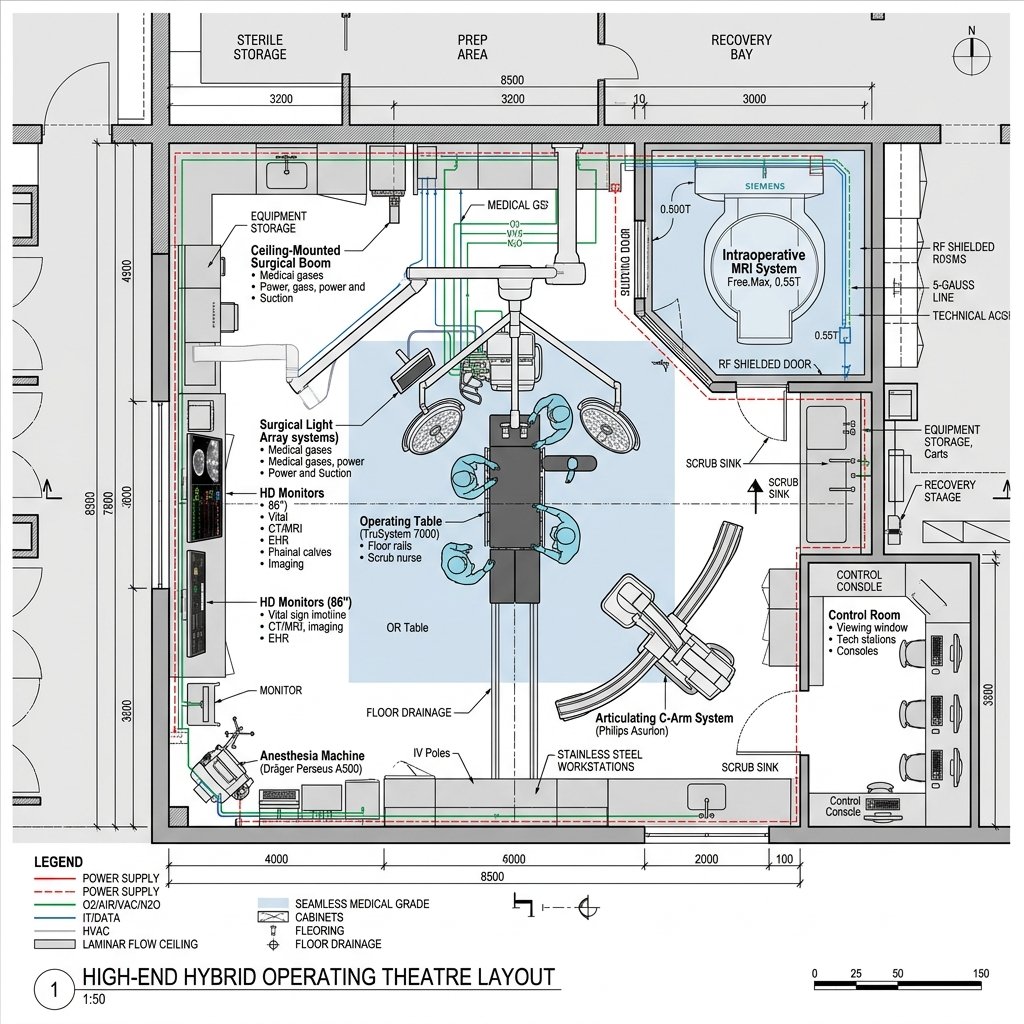
- The Diagnostic & Interventional Core: Grouping Operation Theater (OT) suites, Intensive Care Units (ICU), and Central Sterile Services Departments (CSSD) along dedicated vertical elevators to prevent clean-sterile path intersections.
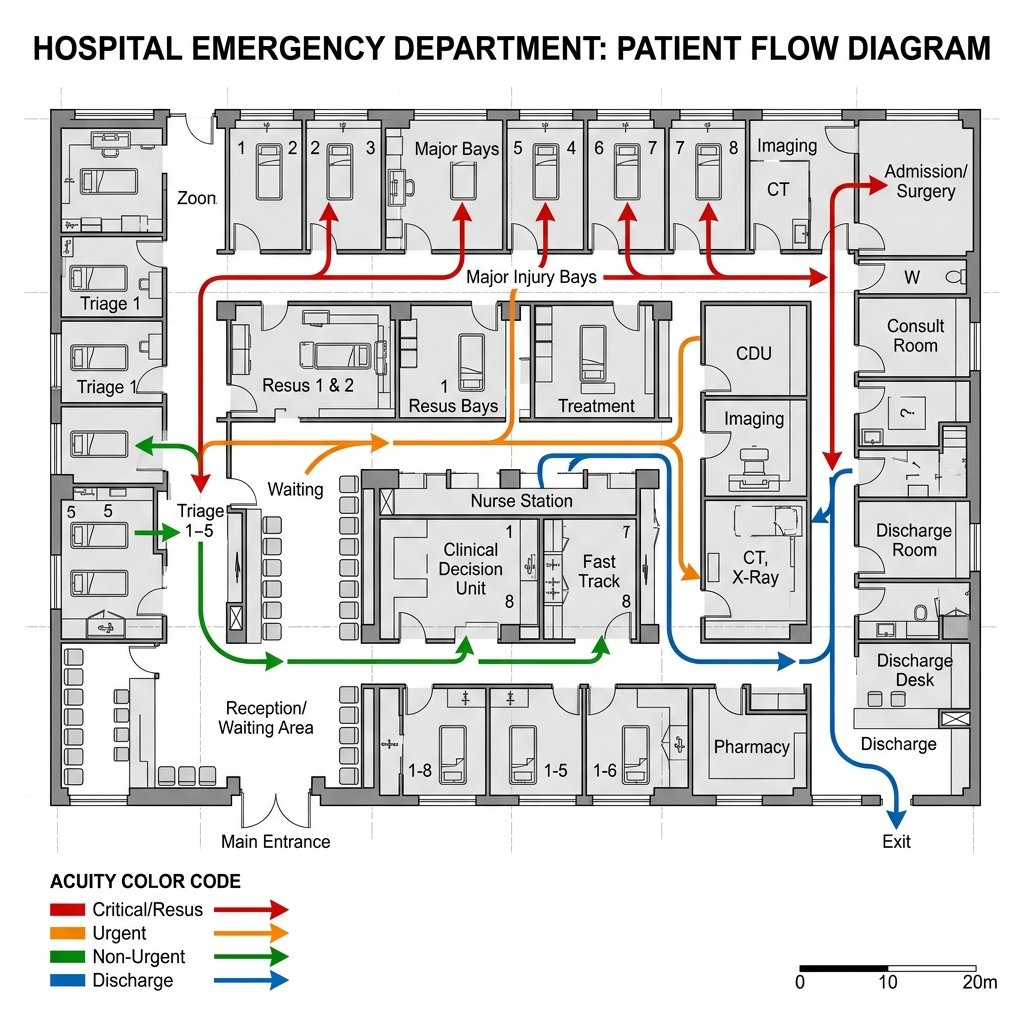
- Emergency Department (ED) Segregation: Providing separate ambulance bay drop-offs with negative-pressure decontamination vestibules, dedicated trauma resuscitation suites, and immediate access to CT and interventional radiology.
- Outpatient Clinics vs. Inpatient Nursing Units: High-footfall ambulatory care clinics should occupy lower ground and podium levels with dedicated parking access, preserving upper tower floors for tranquil, light-filled inpatient suites.
n
n
n
n
Specialized MEP & Cleanroom HVAC Engineering
n
The harsh maritime desert climate of Qatar—characterized by summer temperatures exceeding 48°C and ambient relative humidity above 85%—places immense stress on building envelopes and mechanical systems. Hospital MEP engineering cannot rely on standard commercial HVAC:
n
- n
- Pressure Cascades: Ultra-clean operating theaters must maintain positive pressure (+30 to +35 Pa) with 100% fresh air systems and minimum 20 air changes per hour (ACH) filtered through terminal HEPA H14 filters, conforming to ASHRAE Standard 170.
- Infection Isolation Rooms: Airborne Infection Isolation Rooms (AIIR) require strict negative pressure (-15 Pa) with dedicated exhaust ducts discharging away from air intake louvers.
- Medical Gas Pipeline Systems (MGPS): Engineered strictly under HTM 02-01 or NFPA 99 guidelines, with dual manifold supplies for medical oxygen, nitrous oxide, medical air (4 bar and 7 bar), and surgical vacuum.
n
n
n
n
For complete technical electro-mechanical specifications, consult our specialized MEP and Firefighting engineering division.
n
Hospital Construction Cost & Capital Expenditure in Qatar
n
The construction cost of a multi-specialty private hospital in Qatar typically ranges between QAR 8,500 to QAR 14,500 per square metre (approx. USD $2,300 to $4,000 / m²), contingent upon bed count, architectural finishes, and medical technology integration:
n
| Hospital Development Phase | % of Total Capex | Key Cost Determinants |
|---|---|---|
| Civil & Structural Substructure | 25% – 30% | Deep basement excavation, raft foundations, heavy equipment slabs (MRI/CT) |
| Advanced Hospital MEP & HVAC | 35% – 40% | Cleanroom chillers, redundant generators, medical gas networks, BMS automation |
| Architectural Fit-Out & Finishes | 18% – 22% | Antimicrobial vinyl flooring, lead-lined radiation doors, modular acoustic ceilings |
| Licensing, Testing & Commissioning | 8% – 12% | QCDD smoke tests, HEPA particulate validation, air balancing, MoPH audits |
n
To accurately simulate your project’s structural, civil, and electro-mechanical budget, utilize our proprietary ACCO Project Estimation Calculator.
n
Why Partner with ACCO for Hospital Developments
n
Ahmed Construction Company (ACCO) combines deep regional GCC insight with seasoned international design-build engineering. From bankable feasibility studies and MoPH master planning to turnkey hospital construction and structural execution, we ensure that every square metre of clinical space maximizes operational efficiency and investor ROI.
n
Planning a hospital or specialized medical center in Qatar? Contact our international healthcare consulting team today for a confidential consultation and comprehensive project feasibility review.