Hidden Costs and Cost Overruns in Hospital Construction in Pakistan (2026): What Drives Budgets Up and How to Control Them
Building a modern healthcare facility is one of the most capital-intensive and complex investments an organization can undertake. In Pakistan’s expanding healthcare sector, hospital developers, administrators, and private investors frequently face a daunting challenge: hospital construction cost overruns Pakistan. When projects exceed their budgets, it delays essential medical services and threatens the financial viability of the entire facility.
Ahmed Construction Company (ACCO), a full-service architecture, engineering, and construction firm headquartered at Office 2, 3rd Floor, Bigcity Plaza, Gulberg-III, Lahore, Pakistan (Phone: 0322-8000190, Email: info@acco.com.pk, Website: acco.com.pk), specializes in turnkey hospital design and construction. Having delivered end-to-end medical projects from structural design through final handover, ACCO presents this guide on hidden costs, 2026 cost drivers, and budget control strategies.
🏥 The Budgetary Complexity of Healthcare Infrastructure in Pakistan
Hospitals are highly specialized, technologically integrated ecosystems that must operate continuously under strict sanitary, safety, and mechanical standards. A common pitfall in Pakistan is estimating initial project feasibility using generic commercial construction rates per square foot.
However, meeting regulatory guidelines set by the Pakistan Engineering Council (PEC) and provincial Healthcare Commissions (such as the Punjab Healthcare Commission – PHC) is mandatory. Furthermore, alignment with international standards, such as the World Health Organization (WHO) Health Infrastructure Guidance, is necessary to ensure patient safety. Meeting these requirements demands specialized engineering and architecture from day one, which standard commercial contractors cannot accurately estimate.
💰 The Core Categories of Hidden Costs in Hospital Construction
Baseline budgets usually capture structural costs, basic finishes, and standard labor. However, the items that push projects over budget are specialized clinical systems. Key categories include:
1. Advanced MEP and HVAC Upgrades
Hospital HVAC systems require laminar airflow, HEPA filtration, and strict pressure control to prevent cross-contamination. Upgrading a baseline HVAC system to meet clinical infection control standards can double the expected mechanical budget.
2. Medical Gas Pipeline Systems (MGPS)
Delivering oxygen, nitrous oxide, and medical vacuum requires high-purity copper piping, central manifolds, and alarm monitoring. Import dependencies and copper price volatility make MGPS a major cost escalation risk.
3. Regulatory Compliance and Licensing Surprises
Acquiring NOCs from Environmental Protection Agencies (EPA) and structural approvals from local authorities (LDA, CDA, SBCA) requires detailed submissions. Failing to align designs with provincial Healthcare Commission standards can necessitate expensive structural remodeling.
4. Soil Conditions and Foundation Engineering
Hospitals house heavy machinery (MRI/CT scanners) requiring high-capacity structural load bearings. Neglecting geotechnical soil surveys can lead to unexpected piling requirements, adding millions in unbudgeted foundation costs.
5. Specialized Equipment Integration and Shielding
Radiology departments require lead-shielded walls and doors, while MRI rooms need RF shielding (copper cages). If these specifications are not integrated into architectural plans early, retrofitting post-construction is extremely expensive.
📊 Indicative Budget Impact of Hidden Costs
To help healthcare developers plan their capital allocation, the table below provides an indicative breakdown of common hidden cost categories and their estimated impact on the total hospital construction budget in Pakistan for 2026:
| Hidden Cost Category | Key Components Included | Indicative Budget Impact (%) |
|---|---|---|
| HVAC & Ventilation Upgrades | HEPA filtration, laminar flow, isolation rooms | 8% – 15% |
| Medical Gas Systems (MGPS) | Purity copper pipes, gas manifolds, monitoring systems | 5% – 8% |
| Specialized Structural Foundations | Geotechnical investigation, pile foundations for heavy machinery | 4% – 7% |
| Radiation & RF Shielding | Lead lining, RF shielding, structural slab reinforcement | 3% – 6% |
| Backup Power & Electrical Redundancy | Industrial generators, online UPS systems, dual-bus panels | 6% – 10% |
| Regulatory & Compliance Filings | EPA approvals, PHA/LDA filings, safety certifications | 2% – 4% |
*Note: All figures are indicative 2026 planning estimates and vary by project.*
⚠️ Primary Drivers of Cost Overruns in Pakistan
While hidden costs represent planned items that were left out of the initial budget, cost overruns represent inflation and delays that occur during execution. In Pakistan, several macroeconomic and operational factors drive these overruns:
1. Currency Devaluation and Import Dependencies
Hospital construction has a high dependency on imported materials (medical-grade vinyl flooring, cleanroom panels, and specialized elevators). Due to the volatility of the Pakistani Rupee (PKR), procurement delays result in significant price hikes as exchange rates fluctuate.
2. Design Modifications During Execution
One of the most frequent causes of budget inflation is “change orders” during construction. These occur when administrators request changes to layouts or equipment specifications mid-project, which wastes materials, delays the timeline, and increases labor costs.
3. High Inflation and Material Price Escalation
The volatility of local commodity prices, including steel, cement, and copper cabling, represents a high risk in Pakistan. Without a fixed-price turnkey contract, developers are vulnerable to market price hikes, which contractors pass on through escalation clauses.
📊 Budgeted vs. Actual Cost Analysis: A Case Study
To illustrate how these factors compile, let’s examine a comparison of a typical poorly planned hospital project in Pakistan versus a structured, professionally managed project:
| Cost Driver / Project Element | Typical Poorly Planned Project (Overrun Risk) | ACCO-Managed Turnkey Project (Control Strategy) |
|---|---|---|
| Geotechnical Analysis | Rushed or omitted; leads to foundation changes. | Comprehensive pre-construction soil analysis; fixed design. |
| HVAC Integration | Designed as standard commercial air system; retrofitted later. | Integrated from Day 1 based on infection control standards. |
| Procurement Strategy | Ad-hoc buying; highly vulnerable to inflation. | Phase-wise bulk procurement with locked-in rates. |
| Design Freeze | Ongoing changes allowed during structural and finishing phases. | Strict design freeze before site mobilization. |
| Project Management | Multiple disjointed contractors; results in coordination gaps. | Single point of contact (Turnkey EPC); seamless design-to-build workflow. |
🔧 Strategic Cost Control: How to Protect Your Investment
Controlling hospital construction cost overruns Pakistan requires moving away from traditional fragmented contracting models. Implementing the following strategic controls can help developers secure their investments:
1. Early Engineering and Specialized Architectural Input
Before laying the first brick, developers must invest in specialized healthcare architecture. Medical facility design must balance clinical efficiency, patient flow, and regulatory compliance. Working with a firm like ACCO ensures that structural load calculations, radiation shielding, MEP duct routes, and room layouts are synchronized before construction begins.
2. Feasibility Studies and Geotechnical Audits
Conducting an exhaustive feasibility study is essential. This includes a complete geotechnical soil survey, local regulatory audits, and a thorough assessment of utility availability (high-voltage electricity connections, clean water sources, and municipal sewer disposal).
3. Integrated Turnkey (EPC) Contracts
Fragmenting a hospital project among separate architects, engineers, and civil contractors drives cost overruns. Conversely, an Engineering, Procurement, and Construction (EPC) turnkey model provides a single point of responsibility, absorbing coordination risks and delivering the facility at a locked-in price.
🔗 Related ACCO Services
For more detailed information on planning and budgeting healthcare facilities in Pakistan, explore our comprehensive guides:
- Comprehensive Budgeting: Review our detailed breakdown in the Hospital Construction Cost in Pakistan: A Complete Guide.
- Capacity Planning: Learn how to calculate costs on a capacity basis with the Hospital Construction Cost Per Bed in Pakistan (2026 Guide).
- Smart Tech Integration: Read about integrating modern medical tech and MEP systems in our guide on Smart Hospital Design and Construction in Lahore 2026.
❓ Frequently Asked Questions (FAQ)
Q1: Why is hospital construction so much more expensive than commercial building construction?
Hospitals require specialized clinical environments. The inclusion of complex MEP/HVAC systems for infection control, medical gas networks, radiation shielding, backup power redundancy, and high structural load capacities makes healthcare infrastructure significantly more complex than standard commercial plazas.
Q2: What is the typical percentage of budget overrun on hospital projects in Pakistan?
On poorly planned projects without centralized turnkey management, budget overruns can range from 20% to 50%. These are primarily driven by delayed procurements, currency fluctuations on imported medical equipment, and structural modifications due to late-stage design changes.
Q3: How do regulatory approvals affect the construction budget?
Failing to meet structural, environmental, or healthcare commission guidelines (such as the Punjab Healthcare Commission standards) can delay project licensing. In worst-case scenarios, developers must demolish completed works to comply with corridor widths, safety exits, or ventilation standards, leading to major cost overruns.
Q4: How does a “design freeze” help control cost overruns?
A design freeze is an agreement where no further changes are made to architectural layouts or equipment specifications after a set date. Freezing the design before construction begins prevents mid-project modifications, which are a leading cause of wasted materials, delays, and contractor claims.
Q5: What is the advantage of choosing a turnkey (EPC) contractor for a hospital project?
A turnkey contractor manages everything from architectural design, structural engineering, and procurement to civil construction and final testing. This single point of contact eliminates coordination conflicts between designers and builders, reduces delays, and provides a more predictable budget.
📈 Controlling Healthcare Projects with ACCO
At Ahmed Construction Company (ACCO), we believe that delivering state-of-the-art healthcare infrastructure should not come with unexpected financial surprises. As a leading turnkey engineering and construction firm, we provide developers with end-to-end design-build solutions.
Our in-house team of healthcare architects, structural engineering professionals, MEP specialists, and project managers coordinate every detail of your project. From early soil testing and value engineering to procuring medical-grade finishes and securing regulatory clearances, we manage the entire project pipeline to protect your budget and timeline.
If you are planning to build, expand, or renovate a hospital or medical facility in Pakistan, contact our expert team today to schedule a detailed consultation.
- Headquarters: Office 2, 3rd Floor, Bigcity Plaza, Gulberg-III, Lahore, Pakistan
- Phone: 0322-8000190
- Email: info@acco.com.pk
- Website: acco.com.pk
*Disclaimer: All figures, percentages, and cost projections provided in this article are indicative 2026 planning estimates and vary based on project scope, location, specialized services, and market conditions.*
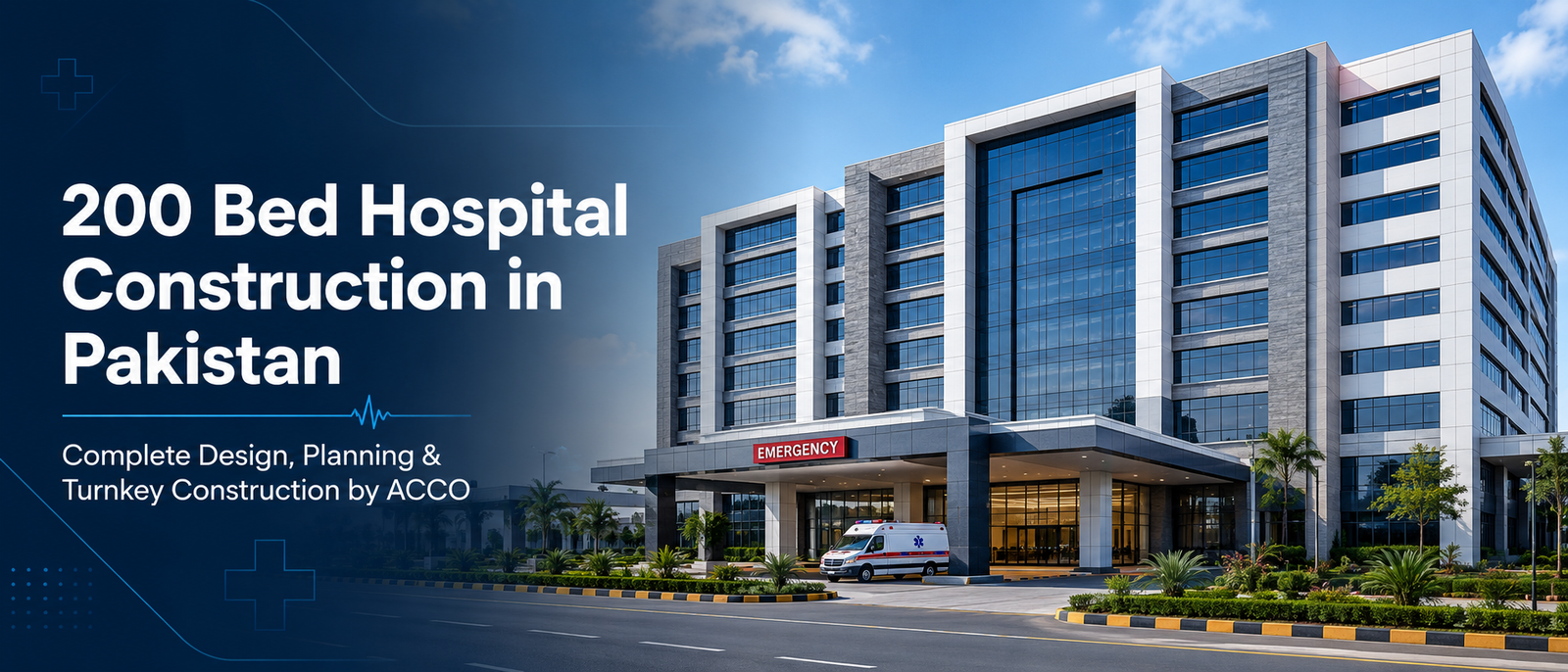
200 Bed Hospital Construction in Pakistan | ACCO Experts
Reliable Hospital Builders in Rahim Yar Khan 2026 | ACCO