
Efficient Industrial Spaces for Modern Textile Production
Textile Mills & Spinning Plants
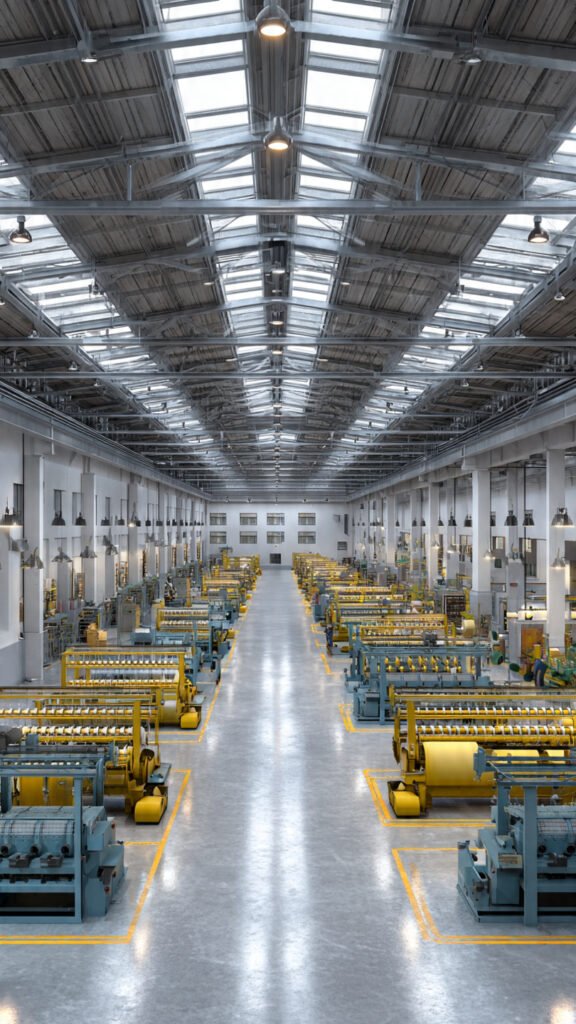
Textile industry Pakistan ki backbone hai, aur is industry ke liye strong, efficient aur scalable infrastructure bohat zaroori hota hai. Textile mills aur spinning plants ke liye buildings sirf structures nahi hoti — yeh production efficiency, machinery performance aur long-term operations ko directly impact karti hain.Ahmed Construction Company (ACCO) textile sector ke liye Pre-Engineered Buildings (PEB) design aur construct karta hai jo specifically industrial requirements ko meet kartay hain. Hum aise structures develop karte hain jo large spans cover kar saken, jahan heavy machinery easily install ho sakay aur production flow smooth rahe.Hamari approach simple hai — practical design, strong structure aur future expansion ka flexibility. Textile mills ke liye proper ventilation, natural lighting aur temperature control bohat important hota hai, jisko hum design phase mein hi consider karte hain. Is se na sirf working environment better hota hai balkay energy efficiency bhi improve hoti hai.Spinning plants ke liye hum vibration-resistant flooring, high roof clearance aur optimized layout provide karte hain taake machinery smoothly operate kare aur maintenance easy ho. Saath hi, hum fast-track construction methods use karte hain jisse project time kam hota hai aur client jaldi operations start kar sakta hai.Ahmed Construction Company (ACCO) ka focus sirf building banana nahi, balkay aisi industrial facility create karna hai jo aapke business ko grow karne mein madad de — reliable, cost-effective aur long-lasting.
Textile Mills & Spinning Plants Services in Pakistan – ACCO
Introduction: Powering Pakistan’s Largest Industry
Textiles are the backbone of Pakistan’s economy. From Faisalabad’s spinning mills to Karachi’s garment factories, the industry employs millions and generates billions in exports. However, textile facilities have unique requirements that standard industrial buildings cannot meet. High humidity damages steel. Vibrating machinery cracks foundations. Dust clogs ventilation. Poor layouts disrupt production flow. Without specialized design, textile mills fail prematurely.
At Ahmed Construction Company (ACCO), we provide the solution. Our Textile Mills & Spinning Plants Services in Pakistan deliver facilities engineered specifically for textile production. With over twenty-five years of experience, we have designed and constructed textile mills for major industry players. For example, we have served Meezan Bank, Bata, BUITMS, and Savour Foods. Additionally, we work extensively in Faisalabad, Lahore, Karachi, and other textile hubs. As a result, our textile facilities are proven to withstand the unique demands of this industry.
Let us explain what specialized textile mill design involves. Moreover, we will show you why ACCO is the trusted choice for textile construction nationwide.
What Are Textile Mill & Spinning Plant Services?
Textile mill design is the specialized discipline of creating facilities for fiber processing, yarn spinning, fabric weaving, and garment manufacturing. Unlike standard industrial sheds, textile facilities require specific environmental conditions. Humidity must be controlled. Dust must be managed. Vibrations from spinning frames and looms must be isolated. Material flow from bale opening to finished fabric must be efficient.
Professional textile mill design includes several key elements. First, building envelope: high-humidity environments require corrosion-resistant materials. Second, structural design: foundations must isolate machinery vibrations. Third, environmental control: HVAC systems must maintain precise temperature and humidity. Fourth, dust management: filtration and collection systems are essential. Fifth, workflow optimization: layouts must move materials efficiently through production stages.
In Pakistan, professional textile mill design is essential. Many contractors build standard industrial sheds for textile use. Consequently, steel corrodes. Floors crack. Production suffers. Therefore, investing in specialized textile facility design is not an expense. It is an investment in productivity and longevity. At ACCO, our architectural engineering team designs textile mills that integrate with your overall building design and production workflow.
Why ACCO? Pakistan’s Leader in Textile Facility Construction
ACCO has been a trusted name in Pakistani construction for over twenty-five years. Our headquarters are located at Office 2, 3rd Floor, Bigcity Plaza, Gulberg-III, Lahore. Furthermore, we maintain a full-service office in Karachi. From these bases, we serve textile clients nationwide. We also work internationally in the UAE, UK, Saudi Arabia, Canada, and the USA.
Our client list includes major organizations like Meezan Bank, Bata, PTC, BUITMS, Savour Foods, Alpine, Lake View, and Gerry DNATA. These names demand quality. Therefore, we deliver it. Every textile mill project, regardless of size, receives the same professional attention and care.
What makes ACCO different? Firstly, we are not just a construction company. Rather, we are a full-service design and engineering firm. Consequently, we understand the unique requirements of textile production. Our team includes structural engineers who specialize in vibration isolation. We produce detailed architectural drafting for every textile facility. For complex projects, we create a 3D architectural walkthrough showing exactly how your mill will function. As a result, you see your facility before construction begins.
Our Complete Textile Mill & Spinning Plant Services
Different textile processes need different facility designs. Accordingly, ACCO offers a full range of specialized services. Below is a detailed breakdown of what we provide.
1. Spinning Mill Design & Construction
Spinning mills convert raw cotton into yarn. They require precise humidity control (50-60% RH) to prevent fiber breakage. ACCO designs spinning mills with corrosion-resistant steel, vibration-isolating foundations for spinning frames, and integrated humidification systems. Your yarn quality will be consistent.
2. Weaving Mill Design & Construction
Weaving mills produce fabric from yarn. They need wide clear spans for weaving machines and high ceilings for fabric rolls. ACCO designs weaving mills with heavy-duty floors for looms and integrated overhead handling systems. Your fabric production will be efficient.
3. Processing & Dyeing Plant Design
Processing plants involve water, chemicals, and heat. These environments are highly corrosive. ACCO designs processing plants with stainless steel structures, chemical-resistant flooring, and integrated wastewater treatment. Your processing operations will be safe and durable.
4. Garment Manufacturing Facilities
Garment factories need flexible layouts for cutting, sewing, and finishing. ACCO designs garment facilities with modular layouts, good lighting, and ergonomic workstations. We also integrate material handling systems. Your garment production will be efficient.
5. Textile Warehousing & Storage
Finished fabric and yarn need proper storage. ACCO designs textile warehouses with high bay racking, fire protection systems, and humidity control. Your inventory will be protected and accessible.
6. Textile Mill Rehabilitation & Expansion
Existing textile mills often need expansion or modernization. ACCO provides rehabilitation services. We assess existing structures, design reinforcements, and manage construction. Your mill will meet modern standards.
7. Utility Integration for Textile Mills
Textile mills need steam, compressed air, water treatment, and electrical systems. ACCO integrates all utilities into your facility design. We coordinate boiler rooms, compressor rooms, substations, and water treatment plants. Your utilities will be reliable.
Comparison Table: ACCO vs. Typical Textile Contractors
Not all textile facility contractors are equal. Accordingly, see how ACCO compares to the typical alternatives.
| Feature | ACCO | Typical Textile Contractor |
|---|---|---|
| Years of Textile Experience | 25+ years | Often less than 5 years |
| In-House Textile Engineering | Yes – PEC registered engineers | No – general industrial only |
| Vibration Isolation Design | Yes – for spinning frames and looms | Rarely – standard foundations only |
| Corrosion Protection | Yes – stainless steel, special coatings | No – standard steel only |
| Humidity Control Integration | Yes – humidification systems designed in | No – afterthought only |
| 3D Visualization | Yes – using 3D architectural walkthrough software | No – only basic 2D drawings |
| Project Timeline | Committed schedule with updates | Often delayed with poor communication |
| Documentation | Full PEC-compliant stamped drawings | Often missing proper stamps |
Our Step-by-Step Textile Mill Design & Construction Process
We follow a proven, step-by-step methodology. Consequently, you get a textile facility that meets production requirements.
- Step 1: Initial Consultation & Site Visit
First, you contact us at +92 322 800 0190. After that, we visit your site. We assess soil conditions, utility availability, and access. We also discuss your production processes, equipment, and capacity needs. - Step 2: Process Flow Analysis
Next, we analyze your material flow. From bale opening to finished product, we map every step. This analysis determines building layout, clear spans, and material handling requirements. - Step 3: Conceptual Design & Layout
Our architects and engineers develop initial facility layouts. We determine bay spacing, eave height, and column locations. You approve the concept before detailed engineering begins. - Step 4: Structural Engineering & Vibration Analysis
Once the layout is approved, we complete full structural engineering. We calculate loads and design vibration-isolating foundations for spinning frames and looms. All calculations follow PEC standards. - Step 5: Environmental Systems Design
We design humidity control, ventilation, dust collection, and temperature control systems. Proper environmental control is essential for textile quality. - Step 6: 3D Modeling & Walkthrough
We create a 3D architectural walkthrough of your textile facility. You see the material flow, equipment placement, and environmental systems. You can “walk through” and identify any issues before construction. - Step 7: Detailed Drawings & Shop Drawings
We produce complete architectural drafting and structural drawings. For fabricated components, we produce shop drawings. Every connection is detailed exactly. - Step 8: Construction & Project Management
We manage all construction activities: foundations, steel erection, roofing, cladding, and utility integration. Our project managers ensure quality, safety, and schedule adherence. You receive a completed, production-ready textile facility.
Why Pakistani Textile Clients Choose ACCO
Pakistan’s textile industry is the country’s largest manufacturing sector. Faisalabad, Lahore, Karachi, and Multan are home to thousands of spinning mills, weaving units, and garment factories. However, many of these facilities were built without proper engineering. Consequently, they suffer from corrosion, foundation cracks, and production inefficiencies.
ACCO solves this problem. Our textile mills are engineered for the specific demands of textile production. We use corrosion-resistant materials. We design vibration-isolating foundations. We integrate proper humidity control. As a result, your facility will last longer and produce higher quality products.
Beyond technical expertise, ACCO understands textile workflow. We have designed facilities for spinning, weaving, processing, and garment manufacturing. We know how material should flow from bale opening to finished product. Your production will be more efficient.
Moreover, ACCO serves textile clients nationwide. From Faisalabad to Lahore to Karachi, we have delivered textile projects. We also work with international textile companies building facilities in Pakistan. Engineering excellence meets textile industry knowledge.
The ACCO Impact by Numbers
Numbers provide proof. Here are some key figures from ACCO’s decades of service in textile mill and spinning plant construction.
- 25+ Years of continuous textile facility experience in Pakistan.
- 100+ Textile Projects completed, including spinning mills, weaving units, and processing plants.
- 20+ Industries Served including textiles, apparel, and home furnishings.
- 5+ Major Textile Hubs where we have delivered projects: Faisalabad, Lahore, Karachi, Multan, and Sheikhupura.
- 5+ Countries where ACCO has delivered engineering services.
- 2 Million+ Sq. Ft. of textile facility space constructed in the last decade.
- 0 Structural Failures on any ACCO-designed textile mill.
- 100% Client Retention for repeat textile industry clients.
Frequently Asked Questions About Textile Mills & Spinning Plants
1. What makes textile mill design different from standard industrial buildings?
Textile mills require corrosion-resistant materials due to high humidity. They need vibration-isolating foundations for spinning frames and looms. They require precise humidity and temperature control. Standard industrial buildings do not address these needs. ACCO specializes in textile-specific design.
2. How much does a textile mill or spinning plant cost in Pakistan?
Costs vary based on size, equipment, and environmental control requirements. Basic spinning mill shells range from PKR 2,000 to PKR 3,500 per square foot. Fully equipped facilities with humidification and utilities cost more. Contact us for a free, fixed-price quote based on your specific requirements.
3. How long does textile mill construction take?
A typical spinning mill of 50,000 sq. ft. takes 8 to 12 months from groundbreaking to completion. Larger or more complex facilities take longer. Contact us for a timeline specific to your project.
4. What materials do you recommend for textile mill construction?
For structural steel, we recommend galvanized or stainless steel in high-humidity areas. For roofing and cladding, we recommend coated steel with high corrosion resistance. For floors, we recommend heavy-duty, chemical-resistant concrete. ACCO advises based on your specific processes.
5. How do you handle vibration from textile machinery?
We design isolated foundations using spring mounts, neoprene pads, or floating slabs depending on machine type. For spinning frames and looms, we calculate vibration frequencies and design foundations that do not transmit motion. Your building structure will be protected.
6. What is architectural engineering, and how does it apply to textile mills?
Architectural engineering integrates building design with structural and MEP systems. For textile mills, this means our designs coordinate humidity control, dust collection, electrical systems, and structural supports. Everything works together efficiently.
7. Do you provide 3D walkthroughs for textile mill designs?
Yes. Our 3D architectural walkthrough service is available for all textile projects. You see your facility from every angle before construction begins. This visualization helps you optimize workflow and equipment placement.
Mid-Content CTA: Ready to Build Your Textile Facility?
Do not trust your textile production to standard industrial buildings. Humidity corrosion, vibration damage, and workflow inefficiencies cost you money every day. ACCO provides specialized textile mill and spinning plant design that delivers durability, quality, and efficiency. Let us assign a textile facility specialist to your project today. Call us now at +92 322 800 0190 or email info@acco.com.pk. You can also visit our Lahore office at Office 2, 3rd Floor, Bigcity Plaza, Gulberg-III. Let’s build your textile facility.
External Resources for Further Reading
All our textile mill designs comply with the building codes set forth by the Pakistan Engineering Council (PEC). For industrial construction standards, consult relevant PEC publications. Additionally, global textile facility practices can be reviewed through resources like the Textile manufacturing overview on Wikipedia.
Explore ACCO’s Full Range of Services
Textile mills and spinning plants are just one part of what we do. Learn about our comprehensive architectural engineering services. See how we create beautiful, functional living spaces with our home floor plan design. Visualize your project before construction using architectural 3D modeling. For the most advanced coordination, ask about our BIM Modeling. Review our credibility by browsing Our Projects. Ready to start? Contact Us directly to schedule your textile mill consultation.
Final CTA: Power Your Textile Production with ACCO
Your textile facility is the heart of your business. Poor construction leads to corrosion, vibration damage, and production losses. ACCO’s specialized textile mill and spinning plant designs are engineered for Pakistani conditions and textile industry requirements. With over twenty-five years of experience, we are Pakistan’s trusted partner for textile construction. From design to engineering to construction, we deliver excellence. Call us now at +92 322 800 0190 or +923 111 749 849. Email us at info@acco.com.pk. Or visit our office in Gulberg-III, Lahore. Let us discuss your textile facility needs today. Together, we will build a mill that produces quality, efficiency, and profitability for decades.