

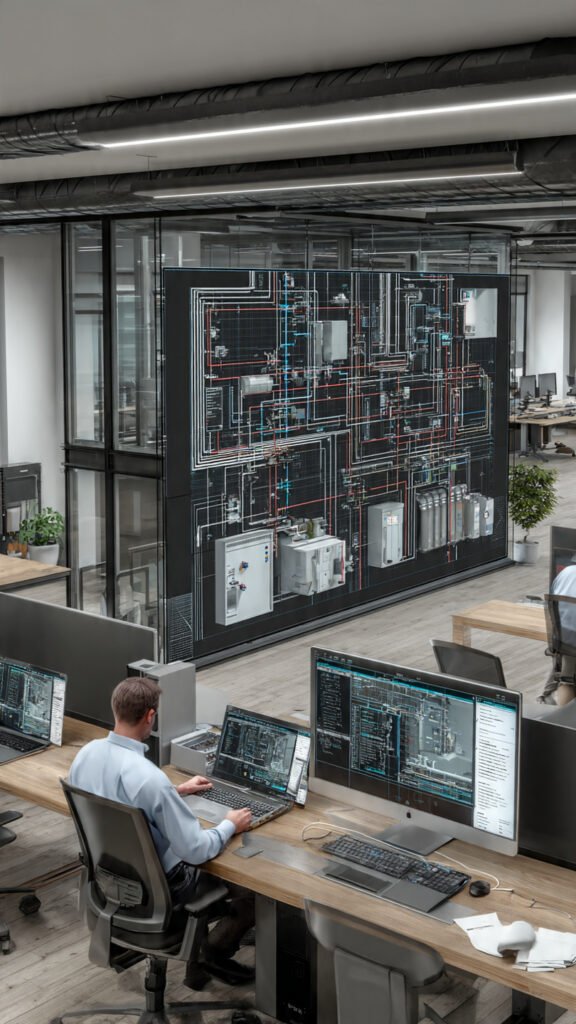
Smart Coordination for Modern Building Systems
MEP BIM Coordination Service
MEP BIM Coordination Service plays an important role in modern construction projects where multiple building systems must work together efficiently. Through Building Information Modeling (BIM), mechanical, electrical, plumbing, and firefighting systems are carefully coordinated in a digital 3D environment before construction begins. This process helps identify clashes between services, optimize routing, and improve overall project accuracy. At Ahmed Construction Company (ACCO), our team focuses on detailed coordination of all MEP and firefighting components to ensure smooth installation on site. By integrating advanced BIM tools with practical construction experience, we help engineers, contractors, and project managers reduce design conflicts, save time, and control project costs. Our coordinated models provide clear guidance for installation, resulting in safer, more efficient, and well-organized building service
#1 MEP BIM Coordination Services in Pakistan | ACCO
You are building a hospital. The architect designed a 2.7m ceiling height in the corridor. The structural engineer placed a 1.2m deep beam. The HVAC engineer routed a 0.6m duct. The plumbing engineer ran a 0.1m pipe. The electrical engineer ran a 0.1m tray. Add it up: 0.1 + 0.1 + 0.6 = 0.8m of MEP, plus 0.05m for hangers and clearance, plus 1.2m beam = 2.05m. The ceiling is 2.7m. You have 0.65m left for ceiling finish and lighting. It fits. Barely. But no one checked. The architect designed in isolation. The structural engineer designed in isolation. The MEP engineers designed in isolation. No one coordinated. On site, the corridor ceiling is a mess of conflicting trades. The hospital opens late. Coordination is not a luxury. It is a necessity.
Ahmed Construction Company (ACCO) delivers that coordination with professional MEP BIM Coordination Services in Pakistan. For over 25 years, we have coordinated MEP systems for residential, commercial, and industrial clients. Our notable clients – Meezan Bank, Bata, BUITMS – require clash-free MEP. We bring that same coordination to every project.
MEP BIM Coordination is the process of integrating Mechanical (HVAC), Electrical, and Plumbing (including Fire Safety) systems into a single, coordinated 3D BIM model, along with architectural and structural elements. Using clash detection software (Navisworks, Revit), we identify conflicts between MEP systems themselves, and between MEP and architecture/structure. We resolve those conflicts virtually, before construction begins. The result: fewer RFIs, less rework, faster construction, lower costs. Whether you need coordination for a residential villa, a commercial tower, or an industrial facility, ACCO delivers MEP BIM coordination that eliminates clashes and streamlines construction.
What Are MEP BIM Coordination Services in Pakistan?
MEP BIM Coordination Services involve the systematic integration of Mechanical (HVAC), Electrical, and Plumbing (including Fire Protection) systems into a coordinated 3D Building Information Model, along with architectural and structural elements, to identify and resolve clashes before construction. MEP BIM coordination is a subset of overall BIM coordination (which may also include other disciplines like fire safety, security, IT, AV, medical gases, etc.). The process uses clash detection software (Navisworks (Autodesk), Solibri, Revit’s Interference Check) to identify three main types of clashes: hard clashes (physical intersection – duct intersecting pipe, pipe passing through electrical tray, sprinkler below light fixture, conduit through beam, duct through column); soft clashes (clearance violations – insufficient space for maintenance (valve, panel, access door), insufficient insulation clearance, insufficient fire stopping, insufficient space for hangers/supports, insufficient space for installation (access, tools)); and workflow or 4D clashes (schedule clashes – trade A scheduled before trade B but needs to be sequenced (e.g., duct before pipe before tray), also space and time (hoist access, material staging)).
A typical MEP BIM coordination process includes: model aggregation (gather BIM models from all disciplines: architecture (walls, doors, windows, ceilings, finishes), structure (columns, beams, slabs, foundations, stairs), HVAC (ducts, diffusers, equipment, controls), plumbing (water supply, drainage, gas, fixtures, equipment, medical gases), electrical (conduit, panels, lighting, devices, cable trays, busway), fire protection (sprinklers, pipe, equipment, fire alarm, controls), fire alarm (detectors, pull stations, notification, panel)). Coordinate with security (CCTV, access control, intrusion), low voltage (data, AV, telecom). Clash detection (run software, generate clash report (list of clashes, categorized by discipline, severity, location), prioritize clashes (critical vs. non-critical, structural vs. aesthetic), assign responsibility (MEP vs. architecture vs. structure). Resolution (virtual meetings (coordination meetings) with all discipline leads (architect, structural engineer, MEP engineers, contractor), review clashes, determine resolution (adjust routing (re-route duct, pipe, conduit), change elevation (raise/lower), change equipment location, coordinate with architect (lower/raise ceiling, add bulkhead, change wall location), coordinate with structural engineer (add sleeve, notch beam, add opening, move column), change sequence (workflow coordination)). Model update: discipline leads update their models to reflect resolutions, re-run clash detection to confirm resolution, iterate until clash-free (typically 95-99% of clashes resolved before construction).
Outputs of MEP BIM coordination include: coordinated BIM model (federated model with all disciplines, clash-free), clash reports (initial (list of unresolved clashes) and final (clash-free confirmation)), combined services drawings (CSD) – 2D plan views derived from coordinated model (all MEP systems shown on one background, with dimensions, annotations, and callouts for field installation), section drawings and details (vertical sections through coordinated model, especially in congested areas (mechanical rooms, plant rooms, ceiling plenum), showing clearances and access), RFI reduction (many RFIs are eliminated because answers are in the model), and savings in time and money (eliminating field rework). For architects, engineers, contractors, and developers across Pakistan, MEP BIM Coordination Services in Pakistan from ACCO deliver clash-free construction, reduced rework, and faster project delivery.
ACCO: 25+ Years of MEP & BIM Coordination Excellence
Ahmed Construction Company (ACCO) has been providing MEP engineering and BIM coordination for over 25 years. From our Lahore headquarters at Office 2, 3rd Floor, Bigcity Plaza, Gulberg-III, and our Karachi office, we have coordinated hundreds of projects. Our notable clients – Meezan Bank, Bata, BUITMS – require clash-free, coordinated MEP. We bring that same coordination to every project.
What makes ACCO different for MEP BIM coordination is our integrated team: PEC-registered MEP engineers (who understand system design, codes, equipment selection, and coordination), Revit specialists (who can model accurately and efficiently), and coordination managers (who facilitate multi-disciplinary meetings). We do not just run clash detection software – we resolve clashes with engineering judgement. We also provide end-to-end coordination (from model aggregation to clash resolution to combined services drawings) and flexible engagement (we can coordinate models provided by others, or we can model MEP and coordinate with your architect/structural engineer).
Our MEP BIM coordination covers all project types: residential (homes, apartments, villas, multi-storey housing), commercial (offices, banks, retail, showrooms, restaurants, hotels), industrial (warehouses, factories, textile mills, food processing, pharmaceutical, paper, ceramic), healthcare (hospitals, clinics, laboratories), and institutional (schools, colleges). We also serve international clients through our outsourcing services. When you choose ACCO for MEP BIM Coordination Services in Pakistan, you get coordinated, clash-free MEP systems that reduce rework, save time, and lower construction costs.
Our MEP BIM Coordination Service Categories
ACCO offers comprehensive MEP BIM coordination services. We can provide individual components or a complete coordination package.
1. Full MEP Coordination (HVAC, Plumbing, Electrical, Fire Safety)
Complete coordination of all MEP systems including: HVAC (ductwork (supply, return, fresh air), diffusers, grilles, registers, VAV boxes, FCUs, AHUs, package units, VRF outdoor units, split systems, exhaust fans, duct heaters, control dampers, fire dampers, smoke dampers, access panels), plumbing (domestic water (cold and hot supply, recirculation), sanitary drainage (waste and vent), storm drainage (roof drains, leaders), gas piping, water heaters, pumps, storage tanks, backflow preventers, expansion tanks, water treatment equipment (softener, RO), grease interceptors, oil separators, floor drains, cleanouts, access panels), electrical (conduit (power (lighting, receptacle, equipment, panels, transformer, generator, UPS, transfer switch), communication (data, voice, AV), security (CCTV, access control, intrusion), fire alarm, conduits exiting panels, lighting fixtures (recessed, pendant, sconce), devices (switches, outlets, sensors), cable trays, busway, panels (distribution, lighting, panelboard, switchboard, MCC), transformers, generators, UPS, transfer switches), fire protection (sprinkler piping (branch lines, cross mains, risers, feed mains, fittings), sprinkler heads (pendant, upright, sidewall, concealed), control valves (butterfly, gate, check), flow switches, tamper switches, fire pumps, standpipes, fire hose cabinets, fire extinguishers, fire alarm (detectors, pull stations, notification appliances (horn, strobe), control panel)). Coordination includes MEP vs. MEP clashes (HVAC vs. plumbing, HVAC vs. electrical, electrical vs. plumbing, fire protection vs. all, etc.), MEP vs. architecture (ceilings, walls, openings, finishes, lights vs. diffusers, outlets vs. furniture), and MEP vs. structure (beams, columns, slabs, foundations, openings). We coordinate all MEP disciplines into a single federated model.
2. MEP vs. Architecture & Structure Coordination
Coordination of MEP with architectural and structural elements including: MEP vs. architecture (ceiling heights (MEP must fit within ceiling void, coordination of ceiling grid (diffusers and lights must align with ceiling grid, or coordinate for aesthetic layout), visually acceptable (diffusers and lights arranged symmetrically in important rooms), bulkheads (coordinate with MEP routing to minimize, where bulkhead is required to conceal MEP), wall penetrations (sleeves, location, size, fire stopping), access panels (for valves, dampers, control panels, junction boxes, pull stations, etc.), equipment coordination (FCUs above ceiling – ensure access panel, room layout (outlets not behind cabinets, switches not behind door, diffusers not blocked by furniture)). MEP vs. structure (beams (MEP routing to avoid beams, or coordinate with structural engineer for openings (sleeve, notch), sloped beams (coordinate with MEP when beams are sloped), columns (MEP routing to avoid columns, or coordinate with architect to add bulkhead, or structural engineer for vertical chase), openings (coordinate with structural engineer for slab openings (penetrations) for risers, sleeves for pipes/conduit passing through columns/beams/walls), loads (support MEP equipment (AHU, FCU, generator, UPS, pump) on structure – coordinate load locations, embed plates, structural reinforcement). We coordinate MEP with architect and structural engineer (or their models) to ensure everything fits.
3. Clash Detection & Resolution Reporting
Systematic clash detection and resolution including: clash detection (run clash detection software (Navisworks, Revit), set parameters (tolerance for hard clash (0mm), soft clash (clearance – e.g., 50mm between duct and pipe, 150mm for access, 300mm for electrical panel clearance, 600mm for valve clearance, 600mm for access door, 100mm for insulation space). Types of clashes: hard clashes (duct vs. pipe, pipe vs. tray, tray vs. duct, duct vs. beam, pipe vs. column, sprinkler vs. light fixture, conduit vs. beam, panel vs. wall, equipment vs. structure). Soft clashes (duct clearance (12 inches) from ceiling, pipe clearance (12 inches) for insulation, electrical panel clearance (36 inches), valve clearance (12 inches for operation), access door clearance, sprinkler clearance (18 inches from obstruction), light fixture clearance (etc.). 4D clashes (sequence mismatches). Reporting (generate clash report (Navisworks or Revit schedule): clash ID, clash type, location (grid, level, xyz coordinates), severity (high/medium/low), discipline (HVAC, plumbing, electrical, fire alarm, fire sprinkler, architecture, structure), description (e.g., “24” supply duct (size) intersecting 36″ wide beam at grid B2, level 1″), assigned to (e.g., HVAC engineer, structural engineer), resolution status. We prioritize high-severity clashes (those that would cause major rework or safety issues). Resolution (coordination meetings (virtual or in-person) with all discipline leads, with clash report, screenshots of clashes (Navisworks viewpoint), propose resolution (adjust routing, change elevation, coordinate with architect (raise ceiling, add bulkhead), coordinate with structural engineer (add sleeve, notch beam, add opening)), agreement, discipline leads update models, re-run clash detection, iterate until resolved (all high and medium severity resolved, low severity resolved or accepted (deferred with client approval, e.g., minor pipe crossing conduit that can be field-coordinated)). We provide clash reports (initial and final) as part of coordination.
4. Combined Services Drawings (CSD) & Section Drawings
2D drawings derived from coordinated BIM model including: combined services drawings (CSD) – plan views (typically 1:50 scale) showing all MEP systems (HVAC, plumbing, electrical, fire protection) on a single drawing, with colour coding (by discipline or system), dimensions (to walls, grids, column lines, and between elements), annotations (valve tags, equipment tags, diffuser numbers, panel numbers, callouts), and notes (e.g., “maintain 12″ clearance between duct and pipe”, “coordinate with ceiling grid”). Section drawings – vertical sections through the building (cut through coordinated model) in congested areas (plant rooms, mechanical rooms, electrical rooms, corridor ceiling plenum). Show all MEP elements (ducts, pipes, conduits, cable trays, busway, light fixtures, diffusers, sprinklers) in relation to structure (beams, slabs, columns) and architecture (walls, ceilings). Provide dimensions (clearances, elevations, offsets). Ensure code-required clearances (valve access, panel clearance, access door, working space, etc.). Detail drawings – enlarged plan views (1:20 or 1:10) of complex areas (mechanical room, electrical room, ceiling plenum in corridor), showing hanger locations, equipment supports, pipe and duct routing in 3D (isometric), etc. CSD and section drawings are essential for contractors to install MEP correctly, with clearances and access, and to resolve field coordination issues before they cause rework.
5. BIM Coordination Meetings & Clash Resolution Support
Facilitation of multi-disciplinary coordination meetings including: meeting setup (schedule regular meetings (weekly or bi-weekly) depending on project phase, with agenda (review unresolved clashes, review resolved clashes, discuss design changes, review schedule, review RFIs). Attendees: architect, structural engineer, MEP engineers (HVAC, plumbing, electrical, fire safety), BIM coordinator (ACCO), contractor’s project manager, subcontractor leads (MEP trades). Virtual or in-person (video conferencing tools, screen sharing (Navisworks model, clash report, viewpoint). Meeting minutes: decisions, assigned actions, responsible parties, due dates, updated clash status. Model updates: discipline leads update models based on meeting decisions, ACCO runs clash detection, updates clash report. Iterate until clash-free. ACCO can facilitate coordination meetings, or we can provide clash detection and reports for your own coordination meetings.
Why Choose ACCO for MEP BIM Coordination?
MEP BIM coordination is critical for complex projects. Here is why ACCO’s MEP BIM Coordination Services in Pakistan deliver clash-free, coordinated, constructible MEP systems.
| Feature | ACCO – Engineered Coordination | Basic Clash Detection Service | Engineering Judgment | Multi-Disciplinary | Clash Types | Reporting | Resolution Support | |
|---|
Our MEP BIM Coordination Process
ACCO follows a structured, collaborative process for every MEP BIM Coordination Services in Pakistan. We bring all disciplines together to resolve clashes before construction.
- Project Setup & Model Aggregation: We gather BIM models from all disciplines (architecture, structure, HVAC, plumbing, electrical, fire protection, fire alarm, others). We verify file formats (Revit, IFC, DWG), coordinate system (shared coordinates, levels, grids), and model quality (LOD, naming, classification, data). We set up a federated model in Navisworks (or Revit).
- Initial Clash Detection & Report: We run clash detection (hard and soft) using Navisworks (or Revit interference check). We generate a clash report (list of all clashes, sorted by discipline, location, severity). We categorize clashes (high/medium/low). We hold a kick-off meeting with all stakeholders to review the report.
- Coordination Meetings (Regular): We schedule regular coordination meetings (weekly). Prior to each meeting, we run updated clash detection (to incorporate model changes). During the meeting, we review unresolved clashes (starting with highest severity). For each clash, we discuss: cause (routing conflict, missing coordination), proposed resolution (adjust routing, change elevation, add opening, change ceiling height), responsible party (MEP engineer, architect, structural engineer), and due date. We update the clash report and assign actions.
- Model Updates by Disciplines: Discipline leads update their models (Revit) to incorporate resolutions. They export updated models (or share Revit links). ACCO aggregates the updated models into the federated model.
- Clash Re-detection & Iteration: We re-run clash detection on the updated federated model. We generate a new clash report (tracking resolved clashes, new clashes (from design changes), and persisting clashes). We iterate steps 3-5 until all high and medium severity clashes are resolved. Low severity clashes may be accepted (deferred) with client approval (e.g., minor overlapping that can be field-coordinated).
- Coordination Deliverables: Once coordination is complete (clash-free or near clash-free), we produce: federated BIM model (Revit or Navisworks), combined services drawings (CSD) – 2D plan views (from coordinated model), section drawings (through congested areas), detail drawings (complex areas), and clash reports (initial and final). We also provide meeting minutes documenting decisions.
- Post-Coordination Support: We provide ongoing support during construction (RFI responses, model updates for design changes, coordination of new clashes that arise due to changes). We can also provide 4D sequencing support (linking coordinated model to schedule).
Why Pakistani Contractors & Developers Choose ACCO for MEP BIM Coordination
Construction rework is expensive. Discovering an MEP clash on site can delay the project for days, require demolition, and cost crores. Pakistani contractors and developers choose ACCO for MEP BIM coordination because we eliminate clashes before construction begins. A coordinated BIM model means: fewer RFIs (requests for information) to the engineer, less rework (no cutting and rewelding, no demolition), faster installation (trades can work in parallel without waiting for clash resolution), prefabrication (accurate quantities, spool drawings for off-site fabrication), and lower total cost (reduced change orders, schedule savings).
Our MEP BIM coordination clients include: general contractors needing clash-free MEP for their projects, MEP subcontractors seeking to avoid field conflicts, developers requiring coordination for design validation, architects wanting to integrate MEP into their architectural model, and international clients outsourcing coordination to Pakistan. They choose ACCO for: engineering depth (MEP engineers coordinate, not just technicians), clash resolution (systematic, documented, with engineering judgement), coordination with architecture and structure, combined services drawings (field-ready), and cost (competitive rates).
Our MEP BIM coordination covers all project types across Pakistan and internationally. View our coordination portfolio to see coordinated models we have delivered. ACCO is registered with PEC – our MEP designs are engineered by licensed professionals.
ACCO by the Numbers: MEP BIM Coordination Track Record
Here is ACCO’s measurable performance in MEP BIM Coordination Services in Pakistan:
- 25+ years of MEP engineering experience, 10+ years of BIM coordination.
- 200+ projects coordinated (residential, commercial, industrial, healthcare).
- 100% coordinated – all models clash-detected and resolved (>95% of clashes resolved).
- Reduced RFIs by an average of 50-70% (based on client feedback).
- Reduced rework – clients report significant savings (estimated 10-15% of MEP cost).
- Coordinated models at LOD 350 – construction-ready.
- 2 major offices in Lahore (Gulberg-III) and Karachi, with nationwide coordination services.
- International clients served in the UAE, UK, Saudi Arabia, Canada, and USA.
- PEC registered – your MEP coordination is led by licensed engineers.
Frequently Asked Questions About MEP BIM Coordination in Pakistan
1. What is architectural engineering and why does MEP BIM coordination need it?
Architectural engineering applies engineering principles to building design. MEP BIM coordination needs architectural engineering because clashes often involve architecture (e.g., duct conflicts with ceiling height, pipe in wall, diffuser in wrong location) and structure (e.g., duct through beam, pipe through column, conduit through foundation) – not just MEP vs. MEP. An architectural engineer understands the implications of moving a ceiling, adding a bulkhead, or sleeving a beam. ACCO’s coordination team includes architectural engineers.
2. How do I get a floor plan for MEP BIM coordination?
We work from your architectural floor plans (2D CAD or BIM model). You provide the architectural drawings (or BIM model) and structural drawings (or model) and MEP drawings (or models). We aggregate them into a federated model for coordination. If you need architectural design, we offer separate home floor plan and architectural design services.
3. What is the difference between architectural design and MEP BIM coordination?
Architectural design creates the layout, appearance, and finishes – architectural BIM focuses on walls, doors, windows, finishes. MEP BIM coordination takes the architectural and structural models, plus MEP models, and ensures that MEP systems fit within the architectural and structural constraints, without clashes, and with adequate clearances. Both are essential for a coordinated building. ACCO provides both services, integrated.
4. Do you provide 3D walkthroughs of coordinated models?
Yes. We can provide a 3D architectural walkthrough of the coordinated federated model, showing all MEP systems in relation to architecture and structure. This allows you to visualize the coordinated space, see resolved clashes, and present to clients. 3D walkthroughs are an optional add-on (video or interactive).
5. Can ACCO coordinate MEP for commercial plazas and hospitals?
Yes. ACCO’s MEP BIM coordination includes residential (homes, apartments, villas), commercial (offices, banks, retail, showrooms, restaurants, hotels), industrial (warehouses, factories, textile mills, food processing, pharmaceutical, paper, ceramic), healthcare (hospitals, clinics, laboratories), and institutional (schools, colleges). Healthcare coordination is particularly critical (medical gases, nurse call, backup power for life support, imaging equipment power and cooling) – we have experience. Learn more about our engineering capabilities for different building types.
6. How long does MEP BIM coordination take?
Timelines vary by project size, complexity, and level of existing model development. A residential villa (simple MEP) may take 2-3 weeks of coordination (weekly meetings, clash resolution). A commercial office (10,000 sq ft) may take 4-8 weeks. A hospital (complex MEP) may take 8-12+ weeks. ACCO provides a schedule during consultation. Coordination typically runs concurrent with design development.
7. Can you coordinate MEP if some disciplines are not using BIM (2D CAD only)?
Yes. We can work with 2D CAD drawings (DWG) for disciplines that are not using BIM. We can convert 2D CAD to 3D BIM (with appropriate LOD) for coordination, or we can overlay 2D drawings on 3D model for clash detection (less accurate but still valuable). For best results, we recommend all disciplines participate in BIM. ACCO can provide MEP BIM modeling services for disciplines that lack BIM capability.
8. How much do MEP BIM coordination services cost?
Costs vary by project size, complexity, number of disciplines, number of meetings, and level of detail (LOD). As of 2025, very approximate ranges: Residential villa (coordination only, assuming models provided by others): PKR 200,000-400,000 (USD 700-1,400). Commercial office (10,000 sq ft, coordination only): PKR 500,000-1,000,000 (USD 1,700-3,500). Hospital (complex, coordination plus modeling for some disciplines): project-based. Contact ACCO for a fixed-price quote based on your specific project requirements and existing model status.
Ready for Clash-Free MEP? Contact ACCO Today
Stop discovering clashes on site. Stop managing RFIs, change orders, and rework. With ACCO’s professional MEP BIM Coordination Services in Pakistan, you get coordinated, clash-free MEP systems that reduce rework, save time, and lower construction costs. From model aggregation to clash resolution, from