
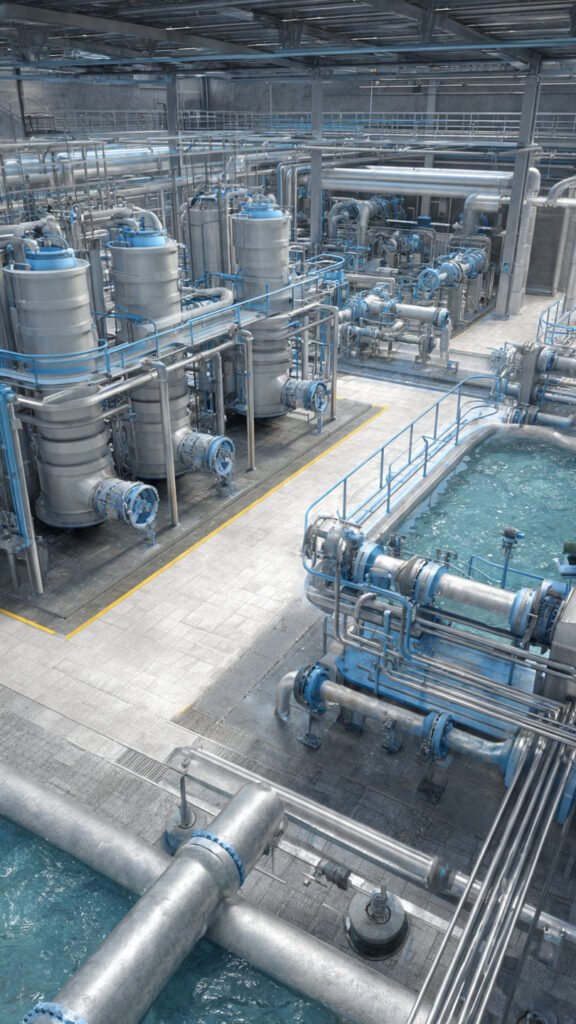
Effluent Treatment Plant Solutions
Effluent Treatment Plant
At Ahmed Construction Company, we understand the importance of sustainable water management in modern construction projects. Our Effluent Treatment Plant (ETP) services are designed to treat wastewater efficiently, ensuring compliance with environmental standards while reducing operational costs.From industrial facilities to residential complexes, our team handles the complete design, installation, and maintenance of ETP systems. We focus on using durable materials, innovative technology, and practical solutions to deliver a plant that not only works effectively but also adds value to your project.With Ahmed Construction Company, you get a reliable partner who ensures your wastewater management system is safe, efficient, and environmentally responsible.
Effluent Treatment Plant Services in Pakistan | ACCO’s Industrial Wastewater Engineering
Your textile mill in Faisalabad produces 500 cubic meters of colored, chemical-laden wastewater daily. The dyeing process uses reactive dyes, caustic soda, and various auxiliaries. The effluent is dark blue, has high COD (Chemical Oxygen Demand), and contains heavy metals. The local sewer authority has rejected your discharge. The Pakistan Environmental Protection Agency (Pak-EPA) has issued a notice. Your mill faces potential shutdown and heavy fines.
Or consider a food processing plant in Lahore. The effluent contains high organic load (BOD – Biochemical Oxygen Demand), fats and oils, and solids. The septic tank is overflowing. The groundwater near the facility shows contamination. The neighboring community is complaining. You need an Effluent Treatment Plant (ETP)—but where do you start? What technology works for your specific effluent? How do you meet NEQS (National Environmental Quality Standards)?
Industrial effluent is different from domestic sewage. It contains higher pollutant concentrations, toxic chemicals, heavy metals, color, and extreme pH. A standard sewage treatment plant (STP) will not work. Industrial ETPs require specialized processes: chemical coagulation, flocculation, sedimentation, biological treatment (for organic effluents), and tertiary treatment like activated carbon or reverse osmosis. Without proper engineering, ETPs fail—and the consequences are severe: regulatory penalties up to PKR 5 million per violation, shutdown orders, legal action from affected communities, and irreversible environmental damage.
Ahmed Construction Company (ACCO) has spent over 25 years providing professional Effluent Treatment Plant services in Pakistan for textile mills, food processors, chemical plants, pharmaceutical manufacturers, and other industries. From our headquarters in Gulberg-III, Lahore, and our office in Karachi, we design complete ETPs including physicochemical treatment, biological treatment, tertiary polishing, sludge handling, and environmental compliance documentation. When you need to meet NEQS and operate responsibly, ACCO delivers industrial wastewater engineering you can trust.
What Is an Effluent Treatment Plant (ETP)?
An Effluent Treatment Plant (ETP) is a facility that removes contaminants from industrial wastewater (effluent) before it is discharged into the environment or into a municipal sewer system. Unlike a Sewage Treatment Plant (STP) which treats domestic wastewater, an ETP is designed to handle the specific pollutants generated by industrial processes: Textile mill effluent (dyes, colors, high COD/BOD, salts, heavy metals, high pH), Food processing effluent (high organic load, fats/oils/grease, solids), Chemical and pharmaceutical effluent (toxic organic compounds, solvents, high COD, variable pH), Tannery effluent (chromium, sulfides, high BOD), and Electroplating and metal finishing effluent (cyanide, heavy metals, acids).
ETPs typically include multiple treatment stages: Preliminary treatment (screening, flow equalization) to remove large solids and balance flow, Primary treatment (chemical coagulation, flocculation, sedimentation, and neutralization) to remove suspended solids and adjust pH, Secondary treatment (biological treatment – activated sludge, MBBR, or anaerobic) to reduce organic pollutants (BOD/COD), Tertiary/advanced treatment (filtration, activated carbon, membrane bioreactor (MBR), reverse osmosis (RO)) for high-quality effluent or water reuse, and Sludge treatment (thickening, dewatering, drying, or disposal).
In Pakistan, the NEQS (National Environmental Quality Standards) set by Pak-EPA specify maximum allowable pollutant concentrations for industrial effluent discharged into water bodies or sewers. Typical NEQS limits: BOD < 80 mg/L, COD < 150 mg/L (into inland waters) or < 400 mg/L (into sewer), TSS < 50 mg/L (inland) or < 400 mg/L (sewer), pH 6-9, Temperature < 40°C, and specific limits for heavy metals, dyes, oils, and other pollutants depending on industry. Our Effluent Treatment Plant services in Pakistan include detailed wastewater characterization, process selection, hydraulic design, equipment specification, civil-structural engineering, piping and electrical design, and full regulatory documentation for Pak-EPA approval. We integrate ETP design with your building design and architectural engineering plans for site layout and building integration. Our architectural drafting team produces detailed ETP layout drawings, tank civil details, piping isometrics, and equipment foundation plans.
ACCO – 25+ Years of Industrial Environmental Engineering Excellence
Ahmed Construction Company (ACCO) has been a trusted partner for Pakistan’s industrial sector for over two decades. Our office at Office 2, 3rd Floor, Bigcity Plaza, Gulberg-III, Lahore, serves as our engineering headquarters, while our Karachi branch handles clients in the southern region. Together, we have delivered over 500 projects including effluent treatment plants for diverse industries.
Our client list includes major names such as Meezan Bank, Bata, PTC, BUITMS, Savour Foods, Alpine, Lake View, and Gerry DNATA. These organizations trust ACCO because we deliver complete, compliant, and cost-effective industrial wastewater solutions. Our multi-disciplinary team includes environmental engineers, chemical engineers, civil engineers, mechanical engineers, electrical engineers, architectural engineering specialists, and 3D architectural walkthrough experts working under one roof. When you request Effluent Treatment Plant services in Pakistan from ACCO, you get designs that meet NEQS and operate reliably.
Our Complete Effluent Treatment Plant Engineering Service Breakdown
We provide comprehensive ETP engineering for all industrial sectors. Below is a detailed breakdown of our capabilities.
Effluent Characterization & Treatability Studies
The first and most critical step—understanding your wastewater. We collect representative effluent samples and analyze them in accredited laboratories for: pH, Temperature, TSS (Total Suspended Solids), BOD (Biochemical Oxygen Demand), COD (Chemical Oxygen Demand), Oil & Grease, Heavy metals (Cr, Pb, Cu, Zn, Fe, etc.), Color (visual and spectrophotometric), and Specific pollutants (dyes, solvents, pesticides, depending on industry). Based on analysis, we design a treatment train that addresses your specific pollutants.
- Textile effluents: High color, high COD, high pH, salts, heavy metals
- Food processing: High BOD, high FOG (fats/oils/grease), solids
- Chemical/Pharma: Variable pH, toxic organics, solvents
- Tannery: High chromium, sulfides, high BOD
Physicochemical Treatment Design
For effluents with suspended solids, color, heavy metals, or variable pH, physicochemical treatment is essential. We design: Flow equalization tank (balances flow and composition), Neutralization tank (acid or alkali dosing to adjust pH to 6-9), Coagulation tank (addition of alum, ferric chloride, or PAC to destabilize colloids), Flocculation tank (gentle mixing with polymer to form flocs), Primary clarifier (sedimentation of flocs), and Chemical dosing systems (storage tanks, dosing pumps, mixing).
Biological Treatment Design (Activated Sludge, MBBR)
For effluents with high organic load (BOD/COD), biological treatment is required after physicochemical treatment. We design: Activated Sludge Process (ASP) – aeration tank with diffused air, secondary clarifier, sludge recycle – good for textile, food, and general industrial effluents, Sequencing Batch Reactor (SBR) – single tank batch process, automated, compact, good for small-medium flows, Moving Bed Biofilm Reactor (MBBR) – plastic biofilm carriers, low sludge production, compact, good for textile and food, and Anaerobic treatment (UASB) – for high-strength effluents, produces biogas, good for food processing and distilleries.
Tertiary/Advanced Treatment Design
For effluent that must meet stringent standards or for water reuse, we design tertiary systems: Multimedia filtration (sand and anthracite to remove residual suspended solids), Activated carbon filtration (removes color, odor, trace organics), Membrane bioreactor (MBR) – combines biological treatment with membrane filtration, produces very high quality effluent (suitable for reuse), Reverse osmosis (RO) – for high-quality reuse (boiler feed, process water), and Disinfection (chlorination or UV for reuse applications).
Sludge Handling & Disposal Design
All ETPs produce sludge—the concentrated pollutants removed from effluent. We design: Sludge thickening (gravity or dissolved air flotation), Sludge dewatering (filter press, centrifuge, or drying beds), and Sludge disposal (landfill, incineration, or safe agricultural use if non-toxic). For hazardous sludge (textile dyes, heavy metals), we design secure disposal systems per environmental regulations.
Civil & Structural Engineering for ETP
We design all ETP civil structures: RCC tanks (for equalization, neutralization, coagulation, flocculation, clarifiers, aeration basins, sludge holding), Chemical storage tank bunds (secondary containment for spill prevention), Pump house and blower room, Control room and laboratory (if required), and Equipment foundations and platforms.
Piping, Pumps & Mechanical Equipment
We specify all mechanical equipment: Effluent transfer pumps (submersible or dry-installed, corrosion-resistant materials), Chemical dosing pumps (magnetic drive or diaphragm), Aeration blowers (positive displacement or centrifugal), Diffusers (fine bubble for efficient oxygen transfer), Mixers (submersible for equalization), Sludge pumps (progressive cavity for high solids), and Filter presses or centrifuges (for sludge dewatering). We design complete piping systems for effluent, chemical dosing, air, and sludge.
Electrical & Control Systems
We design electrical systems: Main power distribution panel (MDP), Motor control centers (MCCs) for pumps and blowers, Variable frequency drives (VFDs) for energy-optimized operation, Backup power (diesel generator, if required). We also design PLC-based automation: pH controllers (dosing acid/alkali automatically based on online pH sensor), Flow meters and level sensors, Online COD/BOD analyzers (if budget allows), and SCADA system for remote monitoring and data logging.
Environmental Compliance Documentation (IEE/EIA)
We prepare all documentation for Pak-EPA or provincial EPA approval: Initial Environmental Examination (IEE) for smaller ETPs or Environmental Impact Assessment (EIA) for large or high-risk facilities, ETP design report (process description, expected treated effluent quality, compliance with NEQS), Wastewater monitoring plan (sampling points, parameters, frequency), and Operation & Maintenance (O&M) manual (standard operating procedures, chemical handling, emergency response).
Comparison: ACCO vs. Typical ETP Supplier
Many ETP suppliers offer “one-size-fits-all” packaged plants without treatability studies. ACCO provides customized, engineered solutions. See the comparison below.
| Feature | ACCO (Professional Engineering) | Typical ETP Supplier |
|---|---|---|
| Effluent Characterization | Lab analysis of actual sample (BOD, COD, heavy metals) \n | Generic assumptions (often wrong) \n |
| Treatability Study | Jar tests, pilot trials for complex effluents \ n | None \ n |
| Process Selection | Based on pollutant type, flow, discharge standards \ n | One technology (what they sell) \ n | Chemical Dosing Design | 七十Calculated based on lab jar tests \ nRule of thumb (overdosing waste, underdosing failure) \ n |
| Civil Design | Detailed RCC tank design, waterproofing, corrosion protection \ n | Prefabricated package (no civil engineering) \ n |
| Coordination with Factory | Integrated with site layout, building setbacks, drainage \ n | Placed wherever space exists \ n |
| Sludge Disposal Design | Dewatering and disposal per environmental regulations \ n | Ignored (sludge piles up) \ n |
| Compliance Documentation | IEE/EIA prepared, NEQS compliance demonstrated \ n | None or generic \ n |
Our 10-Step Effluent Treatment Plant Engineering Process
We follow a rigorous, science-based process to deliver ETPs that meet NEQS reliably.
- Step 1 – Effluent Sampling and Characterization
We collect representative samples from your production process (multiple samples over 24-48 hours to capture variability). We send samples to an accredited laboratory for comprehensive analysis: pH, TSS, BOD, COD, oil/grease, heavy metals, color, and specific pollutants for your industry. - Step 2 – Treatability Study (Jar Tests & Pilot Trials)
For complex effluents (textile dyes, chemical industry), we perform jar tests to determine optimal coagulant type and dosage. For biological treatment, we may conduct pilot-scale trials to confirm treatability and kinetic parameters. - Step 3 – NEQS Target Setting & Process Selection
Based on lab results and required discharge location (inland water body, municipal sewer, or reuse), we determine required removal efficiencies. We select treatment stages: physicochemical only (for metals, color, TSS), physicochemical + biological (for BOD/COD reduction), or physicochemical + biological + tertiary (for reuse). - Step 4 – Flow & Load Calculations
We calculate: Average daily flow (Qavg, m³/day), Peak hourly flow (Qpeak, 2-3× Qavg for hydraulic design), Organic load (kg BOD/day, kg COD/day), Suspended solids load (kg TSS/day), and Heavy metal/color loads. - Step 5 – Process Design & Tank Sizing
We size all unit processes: Equalization tank (volume = peak flow × detention time, typically 8-24 hours), Neutralization/Coagulation tank (detention time 30-60 minutes), Flocculation tank (detention time 15-30 minutes), Primary clarifier (surface overflow rate 20-30 m³/m²/day), Aeration tank (volume = organic load / volumetric loading rate, typically 0.5-2.0 kg BOD/m³/day), Secondary clarifier (surface overflow rate 15-25 m³/m²/day), and Tertiary filters (filtration rate 5-10 m³/m²/hr). - Step 6 – Equipment Specification
We specify all equipment based on process sizing: Pumps (flow and head, material: SS316 or PVC for corrosive effluents), Blowers (airflow with oxygen requirement calculation), Diffusers (type, density, oxygen transfer efficiency), Chemical dosing pumps (flow rate based on jar test dosage), Mixers (kW, torque), Sludge dewatering equipment (filter press area or centrifuge capacity). - Step 7 – Civil & Structural Design
We design RCC tanks (wall thickness, reinforcement, water stops, coatings for corrosion resistance), chemical storage bunds (110% of tank volume), pump house, blower room, and access platforms. We coordinate with geotechnical engineers for foundation design. - Step 8 – Piping, Electrical & Controls
We design piping, electrical, and control systems. - Step 9 – Sludge Management & Disposal
We design sludge thickening, dewatering (filter press or centrifuge), and disposal method (landfill, incineration, or secure disposal for hazardous sludge). - Step 10 – Regulatory Submission & Support
We prepare IEE/EIA documents and submit to Pak-EPA or provincial EPA. We respond to queries and obtain NOC for operation.
Why Pakistani Industrial Clients Nationwide Choose ACCO for ETPs
Pakistan’s industrial sector—textile mills in Faisalabad and Karachi, food processors in Lahore and Multan, chemical plants, tanneries—generates millions of cubic meters of effluent annually. Discharging untreated or undertreated effluent is illegal and environmentally destructive. Pak-EPA and provincial EPAs are increasingly enforcing NEQS, with penalties up to PKR 5 million per violation and potential shutdown.
ACCO has earned the trust of industry leaders including textile mills in Faisalabad (dye house effluent), Savour Foods (food processing effluent), and BUITMS (campus wastewater). These clients choose us because we deliver ETPs that actually meet NEQS—not just on paper, but in real operation. We also serve international clients in the UAE, UK, Saudi Arabia, Canada, and the USA who need Pakistani ETP engineering expertise for their local projects.
ACCO by the Numbers: Effluent Treatment Plant Excellence
The numbers below demonstrate our capability and track record in delivering Effluent Treatment Plant services in Pakistan.
- 25+ years of continuous environmental and industrial engineering experience.
- 500+ projects completed including ETPs and STPs.
- 20+ industries served including textile, food, chemical, pharmaceutical, tannery.
- 2 major offices (Lahore & Karachi) covering all of Pakistan.
- 5+ countries served outside Pakistan (UAE, UK, Saudi, Canada, USA).
- 50+ ETPs designed ranging from 10 m³/day to 5000 m³/day.
- 100% NEQS compliant designs (when properly operated and maintained).
- 0 regulatory penalties for properly designed and operated systems.
Frequently Asked Questions About Effluent Treatment Plants
1. What is architectural engineering?
Architectural engineering combines building design with engineering principles. For ETPs, architectural engineering integrates the treatment plant with factory site layout, access roads, drainage, and building setbacks. Our architectural drafting team produces coordinated site plans.
2. How do I get a floor plan designed for my house?
Getting a home floor plan design from ACCO is simple. Call us at +92 322 800 0190 or visit our contact page. Share your plot size (e.g., 5 marla, 10 marla, or 1 kanal) and budget. Our team will visit your site in DHA, Bahria, Model Town, or anywhere in Pakistan, take measurements, and provide initial concept sketches within 7–10 days.
3. What is the difference between architectural design and structural engineering?
Architectural design deals with aesthetics and space planning. Structural engineering ensures the building stands safely. For ETPs, our structural engineers design RCC tanks and foundations; architectural engineers integrate the plant with the overall site plan.
4. Do you provide 3D walkthroughs?
Yes. We create high-resolution 3D architectural walkthrough videos of proposed ETPs showing tank layouts, equipment, piping, and safety access. This is valuable for regulatory submissions and owner approvals.
5. Is an ETP legally required for my industry?
Yes, for most industries in Pakistan. The Pakistan Environmental Protection Act (PEPA 1997) and NEQS require all industrial facilities to treat effluent to prescribed standards before discharge. Textile, food, chemical, pharmaceutical, tannery, electroplating, and many other industries must install ETPs. Failure to comply can result in fines, shutdown, and legal action.
6. How much does an ETP cost?
Costs vary dramatically based on flow rate, effluent strength, treatment technology, and discharge standards. Small ETP (10-50 m³/day) for simple effluent: PKR 3-10 million. Medium ETP (100-500 m³/day) for textile or food effluent: PKR 15-60 million. Large ETP (1000+ m³/day) for complex chemical effluent: PKR 100-500 million+. Operating costs (chemicals, electricity, sludge disposal) are additional.
7. What is the difference between ETP and STP?
STP (Sewage Treatment Plant) treats domestic wastewater (toilets, sinks, kitchens)—relatively low strength, predictable composition. ETP (Effluent Treatment Plant) treats industrial wastewater—higher pollutant concentrations (BOD, COD), variable composition, toxic chemicals, heavy metals, extreme pH, color. ETPs require more sophisticated treatment (chemical coagulation, advanced biological or chemical oxidation).
8. Can treated effluent be reused?
Yes. Tertiary treatment (filtration, activated carbon, RO) can produce effluent suitable for: factory cooling water, toilet flushing, landscaping irrigation, construction, and even boiler feed or process water (with RO). Reuse reduces freshwater consumption, lowers operating costs, and eliminates discharge. Many textile mills now recycle 50-80% of their water using ETP + RO.
Ready for NEQS-Compliant Effluent Treatment? Contact ACCO Today
Stop pollution, regulatory penalties, and community complaints. ACCO’s Effluent Treatment Plant services in Pakistan deliver engineered, compliant, and cost-effective industrial wastewater solutions. Whether you need an ETP for a textile mill in Faisalabad, a food processing plant in Lahore, or a chemical facility in Karachi, we have the expertise. Our unique ability to deliver everything from architectural drafting to 3D architectural walkthrough visualizations to complete treatability studies to detailed engineering and regulatory documentation makes us a trusted partner.
Call us now: +92 322 800 0190 or +923 111 749 849
Email: info@acco.com.pk
Visit our Lahore office: Office 2, 3rd Floor, Bigcity Plaza, Gulberg-III, Lahore (Mon–Sat, 9:00 AM – 6:30 PM)
Karachi office: Contact us for address and appointment.
Request a free consultation for Effluent Treatment Plant services in Pakistan →
Explore our environmental engineering portfolio on our Our Projects page. Learn how our Architectural Engineering team integrates ETPs with industrial facilities. See how BIM Modeling helps coordinate ETP piping with civil structures. Planning a new industrial facility? Start with our Home Floor Plan Design or visualize your ETP with Architectural 3D Modeling.
For authoritative information on effluent treatment standards, we recommend visiting the Pakistan Engineering Council (PEC), the Pakistan Environmental Protection Agency (Pak-EPA) for NEQS, and the Water Environment Federation (WEF) for international practice.
Stop effluent guesswork. Start engineering compliance. Contact ACCO today to discuss your ETP needs. Let us show you why we are a trusted choice for Effluent Treatment Plant services in Pakistan.