
Reliable Plumbing Infrastructure for Modern Buildings
Water Supply & Sewage Network
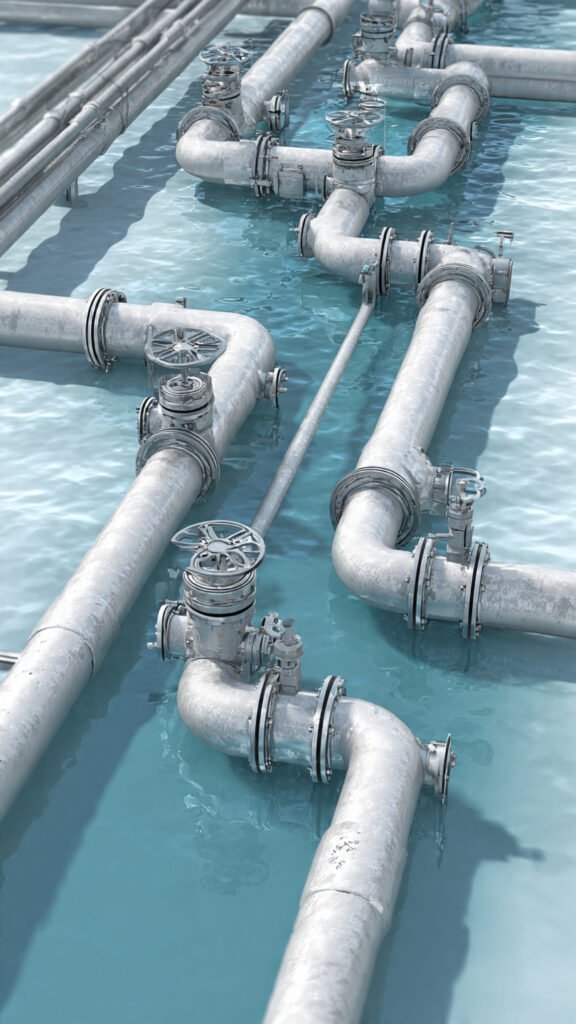
A properly designed water supply and sewage network is an essential part of any construction project. It ensures a continuous supply of clean water while safely removing wastewater from the building. At Ahmed Construction Company (ACCO), we understand that an efficient plumbing infrastructure is critical for the functionality, hygiene, and long-term durability of residential and commercial buildings.Our team carefully plans and installs water supply lines, drainage pipelines, and sewage systems using quality materials and modern construction techniques. Every project is executed with a focus on proper water pressure, leak-free connections, and smooth wastewater flow. From underground pipelines to internal plumbing networks, we make sure the entire system operates efficiently and meets modern construction standards.With proper layout planning and professional installation, our Water Supply & Sewage Network services help prevent common plumbing issues such as water leakage, drainage blockage, and pressure problems. The goal is to create a reliable system that supports the daily needs of occupants while maintaining hygiene and sustainability in the building.
Water Supply & Sewage Network Services in Pakistan | ACCO’s Complete Infrastructure Engineering
Your housing scheme in Bahria Town Phase 8 has 500 plots. Water reaches the first 200 homes. The remaining 300 have trickling taps. Residents complain. You install a larger pump. Still, the far end has no pressure. The problem is not the pump—it is the network design. Undersized pipes, poor looping, no pressure zoning. The entire distribution system needs re-engineering.
Or consider a textile mill in Faisalabad. The factory generates 200 m³ of sewage daily. The existing sewer network was designed for 50 m³. Pipes are undersized, slopes are wrong, manholes overflow during peak hours. The local sewer authority is threatening to disconnect the connection. The maintenance team spends every day unblocking drains instead of maintaining production equipment.
Water supply and sewage network engineering is the backbone of any community or industrial facility. A poorly designed network leads to low pressure, water contamination, sewage backups, and chronic maintenance headaches. Yet many housing schemes and industrial estates in Pakistan rely on ad-hoc layouts without proper hydraulic analysis.
Ahmed Construction Company (ACCO) has spent over 25 years providing professional Water Supply & Sewage Network services in Pakistan for housing schemes, commercial developments, and industrial facilities. From our headquarters in Gulberg-III, Lahore, and our office in Karachi, we design complete water distribution and sewage collection networks including hydraulic modeling, pipe sizing, pump station design, and environmental compliance. When you need reliable water and sewer infrastructure, ACCO delivers engineering excellence.
What Are Water Supply & Sewage Network Services?
Water supply and sewage network engineering encompasses the design of pipes, pumps, storage tanks, and appurtenances that deliver clean water to buildings and safely remove wastewater. Water supply network includes: Transmission mains (large pipes from source, e.g., bore wells, river intake, municipal supply), Distribution network (grid, ring, or branching layout), Storage reservoirs (overhead or ground-level tanks), Pump stations (booster pumps for pressure zones), House connections (service lines to individual plots), and Fire hydrants (for firefighting).
Sewage (sanitary) network includes: House connections (lateral pipes from buildings), Branch sewers (collecting from several houses), Trunk sewers (main collectors), Manholes (access points for maintenance with typical spacing 50-100m), Lift stations (sewage pumps for low-lying areas), and Force mains (pressurized pipes from lift stations to treatment plant).
In Pakistan, water supply and sewage networks are critical for: Housing societies (DHA, Bahria Town, Lake City, private schemes), Industrial zones and textile mills, Hospital and university campuses, and Large commercial developments. Our Water Supply & Sewage Network services in Pakistan include population projection and water demand calculation, hydraulic modeling using industry-standard software (EPANET, WaterGEMS, SewerGEMS), pipe sizing and material selection (DI, GI, PVC, HDPE), pump station and storage tank design, manhole and appurtenance details, and coordination with architectural engineering and architectural drafting for network integration with site planning.
ACCO – 25+ Years of Infrastructure Engineering Excellence
Ahmed Construction Company (ACCO) has been a trusted partner for Pakistan’s development and industrial sectors for over two decades. Our office at Office 2, 3rd Floor, Bigcity Plaza, Gulberg-III, Lahore, serves as our engineering headquarters, while our Karachi branch handles clients in the southern region. Together, we have delivered over 500 projects including water supply and sewerage networks for housing schemes and industrial facilities.
Our client list includes major names such as Meezan Bank, Bata, PTC, BUITMS, Savour Foods, Alpine, Lake View, and Gerry DNATA. These organizations trust ACCO because we deliver complete, sustainable infrastructure solutions. Our multi-disciplinary team includes civil engineers, hydraulic engineers, mechanical engineers, architectural engineering specialists, and 3D architectural walkthrough experts working under one roof. When you request Water Supply & Sewage Network services in Pakistan from ACCO, you get designs that serve communities reliably for decades.
Our Complete Water Supply & Sewage Network Engineering Service Breakdown
We provide comprehensive infrastructure engineering for water and sewer networks. Below is a detailed breakdown of our capabilities.
Water Demand Calculation & Population Projection
We calculate water demand based on: Population served (for housing schemes—number of plots × average family size), Per capita consumption (typical: 150-250 LPCD – liters per capita per day for residential, 50-100 LPCD for commercial, higher for industrial), Peak hour factor (1.5-2.5× average, for sizing distribution network), Fire flow allowance (for fire hydrants, per fire code), and Future growth allowance (20-30% for 20-30 year design life).
- Residential housing scheme: 200-300 m³/day for 500 homes (example)
- Industrial facility: Based on process water + domestic + cooling makeup
- Commercial complex: Bathroom, kitchen, landscaping, HVAC makeup
Sewage Flow Calculation & Design Parameters
We calculate sewage flow as: Average daily sewage flow = 80% of average water supply (most water returns as sewage), Peak factor (2-3× average for sizing sewers, to handle morning/evening peaks), Minimum velocity (0.6 m/s to prevent solids settlement), Maximum velocity (3 m/s to prevent pipe erosion), and Minimum pipe slope (2% for small diameter, 1% for larger).
Water Distribution Network Design (Hydraulic Modeling)
Using EPANET or WaterGEMS software, we model the entire network: Network layout (grid or ring pattern recommended over dead-end branches), Pipe diameters (optimized to ensure minimum residual pressure of 15-20m at farthest node), Node pressures (simulated under peak hour, fire flow, and normal conditions), Pump selection (head and flow based on system curve), Storage tank sizing (balancing volume for peak shaving), and Water quality analysis (chlorine residual, water age).
Sewage Collection Network Design (Hydraulic Modeling)
Using SewerGEMS software, we model the sewer network: Pipe slopes (based on minimum velocity to prevent deposition, maximum depth to limit excavation), Manhole spacing (50-100m, at changes in direction, grade, pipe size), Pipe material and joint selection (uPVC, HDPE, RCC), Lift station design (wet well volume, pump capacity, head), and Force main sizing (for pumped sections).
Water Storage Tanks (Overhead & Ground Level)
We design: Overhead tanks (water towers) – sized for balancing storage (10-15% of peak day demand) + fire storage + emergency storage, Ground-level reservoirs (GLRs) – for bulk storage before pumping or treatment, and Design of RCC tank structures (reinforced concrete, water stops, corrosion protection).
Pumping Station Design
We design: Water booster stations (geared system curve, pump selection, VFDs for variable speed, standby duty), Sewage lift stations (submersible pumps, wet well sizing, odor control), and Electrical & control design (PLC, level sensors, SCADA integration).
Pipe Materials & Specifications
We specify pipe materials based on application: Potable water: DI (ductile iron) for large mains, PVC/HDPE for distribution, GI for house service lines. Sewage: uPVC (for gravity, corrosion-resistant), HDPE (for force mains), RCC (for large diameter trunk sewers). We provide detailed specifications: diameter (mm or inches), pressure rating (PN or Class), joint type (push-on, mechanical, welded), and bedding and backfill requirements.
Network Layout Drawings & Profiles
We produce complete engineering drawings: Water network plan view (pipe routes, valve locations, hydrant positions, node IDs), Water network longitudinal profiles (pipe depth, slope, crossing conflicts), Sewer network plan view (pipe routes, manhole IDs, flow direction arrows), Sewer longitudinal profiles (invert elevations, slopes, manhole depths), and Standard details (manhole construction, pipe bedding, thrust block, valve chamber, service connection).
Bill of Quantities (BOQ) & Cost Estimates
We provide detailed BOQ: Pipe lengths (by diameter and material), Fittings quantity (tees, elbows, reducers, couplings), Valves quantity (gate valves, check valves, air valves, pressure reducing valves), Manholes quantity and depth categories, Pump station equipment (pumps, motors, control panels), and Excavation, bedding, backfill, and reinstatement quantities.
Comparison: ACCO vs. Typical Contractor
Most contractors lay pipes based on intuition without hydraulic analysis. ACCO provides engineered networks. See the comparison below.
| Feature | ACCO (Professional Engineering) | Typical Contractor |
|---|---|---|
| Hydraulic Modeling | EPANET/SewerGEMS, node pressures, velocities calculated \n | None (pipe sized by rule of thumb) \n |
| Peak Factor | Applied to demand (1.5-2.5x for water, 2-3x for sewage) \n | Not considered (undersized) \n |
| Minimum Velocity (Sewer) | 0.6 m/s verified to prevent solid settlement \n | Slope often too flat (sedimentation, blockages) \n |
| Pressure Zones | Booster stations designed where needed \ n | Single pressure zone (high pressure low areas, low pressure high areas) \ n |
| Pipe Looping | Ring/Grid network (redundancy, uniform pressure) \ n | Dead-end branches (stagnation, low flow) \ n |
| Valves & hydrants | Spacing per code, isolation valves for maintenance \ n | Minimum (cannot isolate sections for repair) \ n |
| Coordination with building setbacks | Integrated with site plan, avoid conflicts \ n | Piped wherever open (may be under buildings later) \ n |
| Documentation | Complete plans, profiles, BOQ, specifications \ n | Minimal \ n
Our 9-Step Water Supply & Sewage Network Engineering Process
We follow a systematic, software-based process to deliver reliable, cost-effective networks.
- Step 1 – Site Survey & Data Collection
We collect: Topographic survey (spot levels for sewer slope design), Proposed layout of roads and plots (from home floor plan design or master plan), Water source details (bore well yield, municipal connection pressure, treatment plant capacity), and Population data (number of plots × family size, commercial area employment). - Step 2 – Demand & Flow Calculations
We calculate: Water demand (peak day, peak hour, fire flow), Sewage flow (average, peak factor), and Future growth (20-30 year design horizon). - Step 3 – Preliminary Network Layout
We create proposed pipe routes along roads (following site plan), locate water valves (isolation valves every 200m), locate fire hydrants (typical spacing 150m), locate manholes (at changes in direction, grade, pipe diameter). - Step 4 – Hydraulic Modeling (EPANET for Water)
We input network into EPANET: pipe lengths and initial diameter guess, node elevations and demands, source pressure and flow. We run simulation, analyze pressures (target: 15-40m residual at all nodes, velocity 0.6-2.5 m/s). We adjust pipe diameters and add pressure reducing valves (PRVs) or booster stations as needed. - Step 5 – Hydraulic Modeling (SewerGEMS for Sewer)
We input network into SewerGEMS: pipe slopes and manhole invert elevations, population loads assigned to manholes. We run simulation, analyze velocities (target: 0.6-3.0 m/s, adjust slope as needed). We adjust pipe diameters and slopes to achieve minimum velocity without excessive depth. - Step 6 – Pump Station & Storage Sizing
For water network, we size overhead tank (balancing volume) and booster pumps (head and flow). For sewer network, we size lift stations (wet well volume, submersible pump selection). - Step 7 – Pipe Material & Appurtenance Specification
We specify: Pipe material (DI, PVC, HDPE, uPVC) and pressure class, Fittings, Valves (gate valves on water, check valves, air valves, pressure reducing), Hydrants (dry barrel or wet barrel), Manholes (precast or cast-in-situ, depth-dependent design). - Step 8 – Detailed Drawings & Profiles
We produce: Network plan view (show pipe routes, stations, diameters, appurtenances), Longitudinal profiles (show ground and pipe invert elevations, slopes, crossing details), Standard details (manhole, valve chamber, hydrant, service connection), and Cross-sections for pipe trenches. - Step 9 – Bill of Quantities & Cost Estimate
We extract quantities from drawings: Pipe by diameter, Fittings by type and size, Manholes by depth, Valve chambers, Excavation and backfill quantities, and Pump station equipment. We provide a detailed cost estimate for budgeting and tendering.
Why Pakistani Clients Nationwide Choose ACCO for Water & Sewer Networks
Pakistan’s rapid urbanization has created demand for reliable water supply and sewage collection. Housing schemes in DHA, Bahria Town, Lake City, and Askari Housing need networks that can serve thousands of plots without pressure problems or sewage backups. Industrial zones in Faisalabad, Karachi, and Sialkot need sewer networks that handle large flows without frequent blockages. Developers increasingly require engineered designs for regulatory approval (Local Development Authorities, EPA).
ACCO has earned the trust of developers including Meezan Bank (corporate campuses), textile mills in Faisalabad, and BUITMS (university infrastructure). These clients choose us because we produce networks that work—no low pressure, no sewage backups, and minimal maintenance. We also serve international clients in the UAE, UK, Saudi Arabia, Canada, and the USA who need Pakistani infrastructure engineering expertise for their local projects.
ACCO by the Numbers: Water & Sewer Network Excellence
The numbers below demonstrate our capability and track record in delivering Water Supply & Sewage Network services in Pakistan.
- 25+ years of continuous infrastructure engineering experience.
- 500+ projects completed including water and sewer networks.
- 20+ industries served including residential development, textile, healthcare, education.
- 2 major offices (Lahore & Karachi) covering all of Pakistan.
- 5+ countries served outside Pakistan (UAE, UK, Saudi, Canada, USA).
- 500+ km of water and sewer pipes designed.
- 100% hydraulic software modeled networks (no guesswork).
- 0 pressure complaints for properly installed networks.
Frequently Asked Questions About Water & Sewer Networks
1. What is architectural engineering?
Architectural engineering combines building design with engineering principles. For water and sewer networks, architectural engineering integrates pipe routes with master planning, road alignments, building setbacks, and landscaping. Our architectural drafting team produces coordinated site utility plans.
2. How do I get a floor plan designed for my house?
Getting a home floor plan design from ACCO is simple. Call us at +92 322 800 0190 or visit our contact page. Share your plot size (e.g., 5 marla, 10 marla, or 1 kanal) and budget. Our team will visit your site in DHA, Bahria, Model Town, or anywhere in Pakistan, take measurements, and provide initial concept sketches within 7–10 days.
3. What is the difference between architectural design and structural engineering?
Architectural design deals with aesthetics and space planning. Structural engineering ensures the building stands safely. For utility networks, our structural engineers design thrust blocks at bends (prevent pipe movement) and trench shoring; architectural engineers coordinate pipe locations with site layout.
4. Do you provide 3D walkthroughs?
Yes. We create high-resolution 3D architectural walkthrough videos of proposed utility networks showing buried pipes, manholes, valves, and pump stations. This is valuable for owner approvals and regulatory submissions.
5. How much water does a housing scheme need?
Typical residential per capita consumption in Pakistan: 150-250 LPCD (liters per capita per day). For a 500-plot scheme (assume 4 persons per home = 2000 population), average day demand = 2000 × 200 LPCD = 400 m³/day. Peak hour demand (for network design) = 2.5 × 400 = 1000 m³/day. Fire flow add 50-100 m³/hr. Contact us for a detailed calculation based on your scheme.
6. What is the minimum slope for sewage pipes?
Minimum slopes (to achieve 0.6 m/s velocity): 100mm pipe: 2% (1 in 50), 150mm pipe: 1.5% (1 in 66), 225mm pipe: 1.2% (1 in 83), 300mm pipe: 1.0% (1 in 100). Flatter slopes cause solids deposition and blockages. Steeper slopes are fine but may require velocity checks to prevent pipe erosion.
7. How much does a water and sewer network design cost?
Costs vary based on network length and complexity. For a small housing scheme (1-2 km total pipes), design fee: PKR 100,000-250,000. For a large scheme (10-20 km total pipes), design fee: PKR 500,000-1,500,000. This includes hydraulic modeling, detailed drawings, profiles, BOQ, and cost estimate. The design cost is recovered many times over through optimized pipe sizing and reduced construction waste.
8. What design standards do you follow?
We follow: Water Supply – American Water Works Association (AWWA) manuals, WHO guidelines for drinking water quality, and local WASA/Development Authority standards. Sewerage – Pakistan Plumbing Code, International Plumbing Code (IPC) sanitary drainage section, and local regulations. Hydraulic modeling – EPANET and SewerGEMS industry practice.
Ready for Reliable Water & Sewer Infrastructure? Contact ACCO Today
Stop low pressure and sewage backups. ACCO’s Water Supply & Sewage Network services in Pakistan deliver engineered, modeled, and documented infrastructure that serves your community or facility reliably for decades. Whether you need a water distribution network for a 500-plot housing scheme in DHA Lahore or a sewage collection system for a textile mill in Faisalabad, we have the expertise.
Call us now: +92 322 800 0190 or +923 111 749 849
Email: info@acco.com.pk
Visit our Lahore office: Office 2, 3rd Floor, Bigcity Plaza, Gulberg-III, Lahore (Mon–Sat, 9:00 AM – 6:30 PM)
Karachi office: Contact us for address and appointment.
Request a free consultation for Water Supply & Sewage Network services in Pakistan →
Explore our infrastructure portfolio on our Our Projects page. Learn how our Architectural Engineering team integrates utility networks with site planning. See how BIM Modeling helps coordinate buried pipes with other utilities. Planning a new housing scheme or industrial facility? Start with our Home Floor Plan Design or visualize your utility network with Architectural 3D Modeling.
For authoritative information on water and sewer standards, we recommend visiting the Pakistan Engineering Council (PEC), the American Water Works Association (AWWA), and the WHO for water quality guidelines.
Stop infrastructure guesswork. Start engineering reliability. Contact ACCO today to discuss your water and sewer network needs. Let us show you why we are a trusted choice for Water Supply & Sewage Network services in Pakistan.