

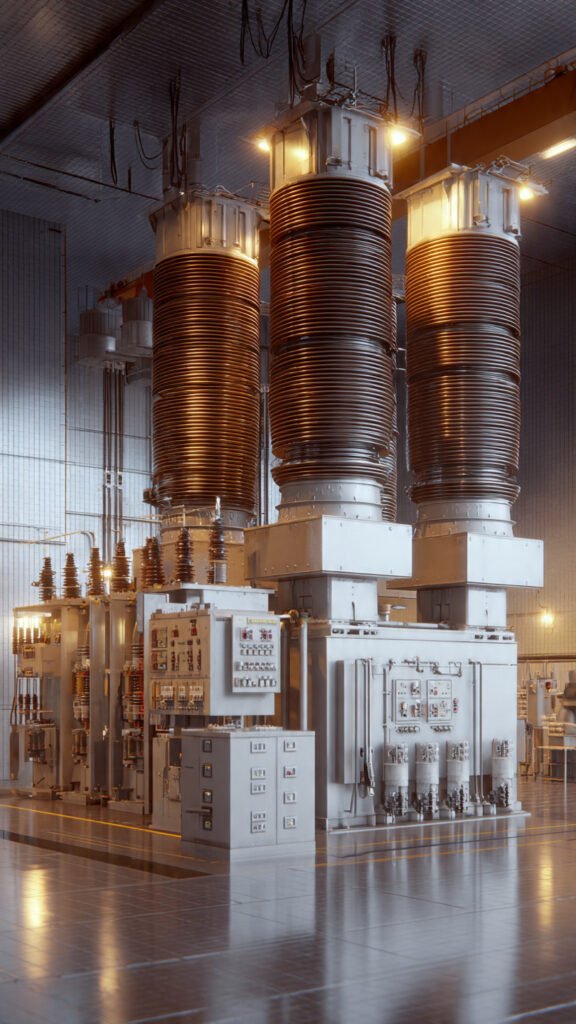
Reliable Transformer Solutions for Every Project
Transformers
At Ahmed Construction Company, we recognize that a strong and reliable electrical system is the foundation of any successful construction project. Transformers play a crucial role in ensuring stable and efficient power distribution, whether it’s for residential complexes, commercial buildings, or large industrial facilities.Our team specializes in designing, installing, and maintaining transformers that meet the highest standards of safety, durability, and performance. We carefully assess your project’s energy requirements and select transformers that not only optimize efficiency but also reduce energy losses, contributing to cost savings over time.From low-voltage residential transformers to high-capacity industrial units, every solution we provide is engineered to handle varying loads and environmental conditions. Our approach is hands-on and project-specific, ensuring that each installation is safe, compliant with local regulations, and aligned with modern electrical engineering practices.Moreover, we offer comprehensive maintenance services, including regular inspections, troubleshooting, and timely repairs, so your transformers continue to operate at peak performance for years to come. By choosing Ahmed Construction Company, you benefit from our decades of experience in construction and electrical engineering, combined with a commitment to quality, reliability, and customer satisfaction.With our transformer solutions, you can be confident that your power systems are not only efficient but also resilient and future-ready, supporting your project’s long-term operational goals without compromise.
Transformers Services in Pakistan | ACCO’s Power Distribution Engineering
Your textile mill in Faisalabad has expanded. New machinery, more production, higher power demand. The existing 1000 kVA transformer is now overloaded. On hot summer days, the transformer oil temperature rises above 95°C. The internal insulation is degrading rapidly. A transformer failure is imminent. When it fails, your entire plant will shut down for days or weeks while you source and install a replacement. The cost will be millions in lost production.
Or consider a housing scheme in DHA Lahore. The developer installed a 500 kVA transformer for 100 homes. Now 200 homes are built. The transformer is severely overloaded. Voltage drops during peak hours. Air conditioners struggle to start. Homeowners complain constantly. The solution is a properly sized transformer—but which size? What type? Oil-filled or dry type? What about efficiency and losses?
Transformer engineering is often overlooked in Pakistan. Many facilities operate with undersized transformers that overheat and fail prematurely, or oversized transformers that waste energy through no-load losses. Ahmed Construction Company (ACCO) has spent over 25 years providing professional Transformers services in Pakistan for industrial, commercial, and residential facilities. From our headquarters in Gulberg-III, Lahore, and our office in Karachi, we deliver transformer sizing, specification, foundation design, and procurement support. When you need transformer engineering you can trust, ACCO delivers power distribution expertise.
What Are Transformer Engineering Services?
Transformer engineering services encompass all technical activities related to selecting, specifying, and installing power and distribution transformers. A transformer is a static device that transfers electrical energy between circuits at different voltage levels. In Pakistan, common applications include: Distribution transformers (11kV/415V) for commercial buildings, factories, and housing schemes, Power transformers (132kV/11kV, 66kV/11kV) for large industrial facilities and substations, Dry type transformers for indoor installations (fire safety), and Pad-mounted transformers for residential areas (aesthetic, tamper-proof).
Proper transformer engineering requires: Sizing (kVA rating based on load calculation, diversity factor, and future expansion), Voltage ratio and tap changer selection (to compensate for voltage variations), Impedance selection (affects fault current level and voltage regulation), Loss evaluation to balance initial cost versus ongoing energy cost (no-load losses and load losses), Cooling type (ONAN, ONAF, etc.), and Foundation and civil works design (oil containment, fire protection, ventilation).
Our Transformers services in Pakistan cover all these aspects. We integrate transformer design with your building design and architectural engineering plans—ensuring proper clearances, fire safety, and oil containment. Our architectural drafting team produces detailed transformer room or plinth drawings, cable trench layouts, and oil spill containment details.
ACCO – 25+ Years of Power Distribution Excellence
Ahmed Construction Company (ACCO) has been a trusted partner for Pakistan’s industrial and commercial sectors for over two decades. Our office at Office 2, 3rd Floor, Bigcity Plaza, Gulberg-III, Lahore, serves as our engineering headquarters, while our Karachi branch handles clients in the southern region. Together, we have delivered over 500 projects across various sectors.
Our client list includes major names such as Meezan Bank, Bata, PTC, BUITMS, Savour Foods, Alpine, Lake View, and Gerry DNATA. These organizations trust ACCO because we deliver complete, professional power distribution solutions. Our multi-disciplinary team includes electrical power engineers, civil and structural engineers, architectural engineering specialists, and 3D architectural walkthrough experts working under one roof. When you request Transformers services in Pakistan from ACCO, you get engineering that ensures reliable, efficient power distribution.
Our Complete Transformer Engineering Service Breakdown
We provide comprehensive transformer engineering services. Below is a detailed breakdown of our capabilities.
Transformer Sizing & kVA Rating Calculation
The most critical step: selecting the correct kVA rating. Undersized = overheating, premature failure, voltage drop. Oversized = higher initial cost, wasted energy (no-load losses), poor efficiency at low loads. We calculate: total connected load (kW) from all equipment, demand factor (not all equipment runs simultaneously), diversity factor (considering peak times), future expansion allowance (typically 20-30%), power factor (to calculate kVA = kW / PF), and load profile analysis (continuous vs. intermittent loads).
- Typical ratings: 100 kVA to 20,000 kVA (20 MVA)
- Applications: Residential buildings (100-500 kVA), commercial (200-2000 kVA), industrial (1000-20000+ kVA)
Transformer Type Selection
We help you select the optimal transformer technology for your application: Oil-filled (most common in Pakistan, efficient, cost-effective, needs oil containment and fire clearance), Dry type (indoor use, no oil, fire-safe, higher cost, noisier), Cast resin (dry type variant, better moisture resistance, good for humid coastal areas), and Pad-mounted (for residential areas, tamper-proof, aesthetic enclosure).
Voltage Ratio & Tap Changer Configuration
We determine the required voltage ratio: HT side (utility supply voltage: 11kV, 33kV, 66kV, 132kV) and LT side (distribution voltage: 415V for three-phase, 230V for single-phase). We specify off-circuit tap changer (OCTC) for fixed voltage adjustment or on-load tap changer (OLTC) for voltage regulation under load (essential for facilities with fluctuating loads).
Transformer Impedance Selection
Impedance (percentage) affects fault current magnitude and voltage regulation. Higher impedance = lower fault current (easier for switchgear) but worse voltage regulation. Lower impedance = better voltage regulation but higher fault current. We select optimal impedance based on: available fault current from utility, switchgear interrupting rating, and voltage regulation requirements (sensitive equipment). Typical values: 4-6% for distribution transformers, 8-12% for power transformers.
Loss Evaluation & Efficiency Optimization
Transformers have two types of losses: No-load losses (core loss, occurs 24/7 even when unloaded) and Load losses (copper loss, proportional to load squared). We perform loss evaluation to compare initial cost versus lifetime energy cost. For continuous operation (24/7 facilities like textile mills), investing in a higher efficiency transformer (lower losses) pays back in 2-4 years. We provide life-cycle cost analysis.
Cooling Type Selection
We specify cooling based on loading and ambient conditions: ONAN (Oil Natural Air Natural) – most common, adequate for normal loading, ONAF (Oil Natural Air Forced) – fans add cooling for overload capability, OFAF (Oil Forced Air Forced) – pumps and fans for high capacity, large power transformers. For Pakistan’s hot summers (45°C+ ambient), we may specify higher cooling capacity or de-rating factors.
Transformer Foundation & Civil Design
Transformers are heavy (a 2000 kVA unit can weigh 5-10 tons) and require proper foundations. We design: concrete plinth with oil containment pit, cable trenches for HT and LT cables (with proper sealing to prevent oil migration), fire protection (fire wall between transformer and building, fire extinguishers or deluge system, depending on local code), and ventilation (for dry type transformers) or radiator clearance (for oil-filled). Our architectural drafting team produces detailed foundation, trench, and containment drawings.
Transformer Specification & Procurement Support
We provide complete transformer specifications including: kVA rating, voltage ratio, impedance (%), cooling type, tap changer type, no-load loss limit (watts), load loss limit (watts at 75°C or 120°C), sound level limit (dB), insulation class (A or F), temperature rise limit (55°C or 65°C), testing requirements (routine, type, special tests), and accessories (thermometer, oil level gauge, pressure relief device, Buchholz relay for >1000 kVA). We recommend reputable manufacturers: Global brands (Siemens, ABB, Schneider), Local manufacturers (Pak Elektron Limited, Heavy Electrical Complex, Al-Karam, Universal Electrical).
Comparison: ACCO vs. Typical Transformer Supplier
Many transformer suppliers simply ask for kVA and deliver a unit without proper engineering. ACCO provides complete engineering. See the comparison below.
| Feature | ACCO (Professional Engineering) | Typical Transformer Supplier |
|---|---|---|
| Load Calculation | Detailed load analysis with diversity and future growth | Rule of thumb or customer specifies only |
| Impedance Selection | Optimized for fault current and voltage regulation | Standard impedance only (no analysis) |
| Loss Evaluation | Life-cycle cost analysis (efficiency vs. initial cost) | Losses not discussed |
| Cooling Selection | Based on ambient conditions and load profile | Standard cooling (may be inadequate for Pakistan) |
| Foundation Design | Complete civil design with oil containment, cable trenches | None (client arranges) |
| Fire Safety | Fire wall, clearance, fire suppression recommendations | Not addressed |
| Coordination with Switchgear | Fault current and protection relay coordination | Not performed |
| Documentation | Complete specification, test requirements, foundation drawings | Minimal or none |
Our 8-Step Transformer Engineering Process
We follow a systematic, engineering-based process to deliver reliable transformer solutions.
- Step 1 – Load Data Collection & Analysis
We gather existing electrical bills (12 months), measure actual load current (if installed), list all equipment (motors, HVAC, lighting, etc.), and understand operating schedules (continuous vs. shift-based). We calculate total connected load and demand load. - Step 2 – Load Profile & Diversity Analysis
We determine peak load timing (summer vs. winter, day vs. night) and calculate diversity factor (typically 0.7-0.9 for mixed loads). We add future expansion allowance (typically 20-30% for industrial clients). The result: required kVA rating. - Step 3 – Voltage Ratio & Tap Changer Selection
We determine utility supply voltage (11kV, 33kV, 66kV, 132kV) and required secondary voltage (415/240V or other). We recommend tap changer type: off-circuit (OCTC) for stable voltage, on-load (OLTC) for facilities with fluctuating loads or weak utility supply. - Step 4 – Impedance & Short Circuit Calculation
We calculate available fault current at transformer secondary (based on utility fault level, cable impedance, and transformer impedance). We ensure fault current does not exceed switchgear interrupting rating. We select transformer impedance to meet safety and performance requirements. - Step 5 – Loss Evaluation & Efficiency Analysis
We calculate annual energy cost of no-load losses (core losses, 24/7) and load losses (based on typical loading). We compare standard efficiency vs. high-efficiency transformer. We calculate payback period for investing in higher efficiency unit. - Step 6 – Cooling & Environmental Factors
We consider ambient temperature (Pakistan summer: 45-50°C), transformer location (indoor or outdoor, confined or open), and altitude (correction factors above 1000m). We specify appropriate cooling type and de-rating if needed. - Step 7 – Foundation, Clearance & Safety Design
We design transformer plinth (size, height, structural reinforcement), oil containment pit (volume = 110% of transformer oil capacity), cable trenches (HT and LT, with fire sealing), fire protection (fire wall, clearance from building, fire extinguisher type and size), and ventilation (for dry type) or radiator clearance (for oil-filled). - Step 8 – Specification & Procurement Support
We produce a complete technical specification document with all parameters, loss limits, testing requirements, and accessories. We provide procurement support: vendor list, tender document preparation, technical evaluation of bids, and witness of factory acceptance testing (FAT) if required.
Why Pakistani Clients Nationwide Choose ACCO for Transformer Engineering
Pakistan’s power infrastructure relies on thousands of distribution and power transformers. Textile mills in Faisalabad, housing schemes in DHA and Bahria Town, commercial buildings in Gulberg, hospitals across the country—all depend on reliable transformers. Yet many facilities operate with incorrectly sized or inefficient transformers. The result is overheating, premature failure, high energy bills, and production downtime.
ACCO has earned the trust of clients including Meezan Bank (branch transformers), Bata (factory transformer upgrades), and BUITMS (campus distribution transformers). These clients choose us because we size transformers correctly, specify appropriate loss levels, and provide complete foundation and safety designs. We also serve international clients in the UAE, UK, Saudi Arabia, Canada, and the USA who need Pakistani transformer engineering expertise for their local projects.
ACCO by the Numbers: Transformer Engineering Excellence
The numbers below demonstrate our capability and track record in delivering Transformers services in Pakistan.
- 25+ years of continuous power engineering experience.
- 500+ projects completed including transformer sizing and specification.
- 20+ industries served including textile, manufacturing, commercial, residential.
- 2 major offices (Lahore & Karachi) covering all of Pakistan.
- 5+ countries served outside Pakistan (UAE, UK, Saudi, Canada, USA).
- 100+ transformers sized annually across our project portfolio.
- 15-25% energy savings achieved for clients through correct sizing and loss evaluation.
- 0 transformer failures due to undersizing for properly designed systems.
Frequently Asked Questions About Transformer Engineering
1. What is architectural engineering?
Architectural engineering combines building design with engineering principles. For transformers, architectural engineering includes transformer room or plinth design, fire wall placement, oil containment pit design, clearance distances, and ventilation pathways. Our team integrates these elements with your building design.
2. How do I get a floor plan designed for my house?
Getting a home floor plan design from ACCO is simple. Call us at +92 322 800 0190 or visit our contact page. Share your plot size (e.g., 5 marla, 10 marla, or 1 kanal) and budget. Our team will visit your site in DHA, Bahria, Model Town, or anywhere in Pakistan, take measurements, and provide initial concept sketches within 7–10 days.
3. What is the difference between architectural design and structural engineering?
Architectural design deals with aesthetics and space planning. Structural engineering ensures the building stands safely. For transformers, our structural engineers design the concrete plinth to support heavy transformer weight (5-20 tons) and withstand seismic forces; our architectural engineers ensure proper clearances and oil containment.
4. Do you provide 3D walkthroughs?
Yes. We create high-resolution 3D architectural walkthrough videos of transformer rooms or outdoor installations showing clearances, cable trench routing, fire walls, and oil containment pits. This helps you visualize the installation before procurement.
5. How do I know if my transformer is undersized?
Signs of undersized transformer: Overheating (oil temperature >95°C, winding temperature >120°C), Frequent over-temperature alarms or trips, Voltage drop under load (lights dim when motors start), High no-load current (magnetizing current >2-5% of rated), Audible humming louder than normal, and Reduced transformer life (requires replacement every 5-7 years instead of 20-25 years). We can perform load logging and thermal imaging to confirm.
6. What is the difference between oil-filled and dry type transformers?
Oil-filled (most common in Pakistan): Lower initial cost, higher efficiency, better cooling, needs oil containment and fire clearance (cannot be installed inside occupied buildings). Dry type: No oil (fire-safe), can be installed indoors, higher cost, lower efficiency, noisier. For indoor commercial installations (e.g., office building basement), dry type is often required by fire codes.
7. How much does a transformer engineering service cost?
For a typical industrial transformer (1000-5000 kVA), our engineering fee ranges from PKR 100,000-250,000. This includes load calculation, kVA sizing, impedance selection, loss evaluation, specification, foundation design, and procurement support. The fee is small compared to the cost of an incorrectly sized transformer (overheating, premature failure, energy waste).
8. Do you witness factory testing of transformers?
Yes. For large or critical transformers, we can witness factory acceptance testing (FAT) at the manufacturer’s facility. Tests include: turns ratio, winding resistance, insulation resistance, power factor (tan delta), induced voltage, impulse test (for higher voltages), no-load loss measurement, load loss measurement, temperature rise test. We provide a test report and acceptance recommendation.
Ready for Reliable, Efficient Transformer Engineering? Contact ACCO Today
Stop transformer overheating, premature failure, and energy waste. ACCO’s Transformers services in Pakistan deliver professional engineering for distribution and power transformers. Whether you need a 500 kVA transformer for a commercial building in DHA Lahore or a 10 MVA transformer for a textile mill in Faisalabad, we have the expertise. Our unique ability to deliver everything from architectural drafting of transformer foundations to 3D architectural walkthrough visualizations to detailed loss evaluation and specifications makes us a trusted partner.
Call us now: +92 322 800 0190 or +923 111 749 849
Email: info@acco.com.pk
Visit our Lahore office: Office 2, 3rd Floor, Bigcity Plaza, Gulberg-III, Lahore (Mon–Sat, 9:00 AM – 6:30 PM)
Karachi office: Contact us for address and appointment.
Request a free consultation for Transformers services in Pakistan →
Explore our power distribution portfolio on our Our Projects page. Learn how our Architectural Engineering team integrates transformers with building design. See how BIM Modeling helps coordinate transformer placement with building structures. Planning a new facility? Start with our Home Floor Plan Design or visualize your electrical room with Architectural 3D Modeling.
For authoritative information on transformer standards, we recommend visiting the Pakistan Engineering Council (PEC), the IEEE for IEEE C57.12 (transformer standards), and the IEC for IEC 60076 (power transformer standard).
Stop transformer problems. Start engineering reliability. Contact ACCO today to discuss your transformer needs. Let us show you why we are a trusted choice for Transformers services in Pakistan.